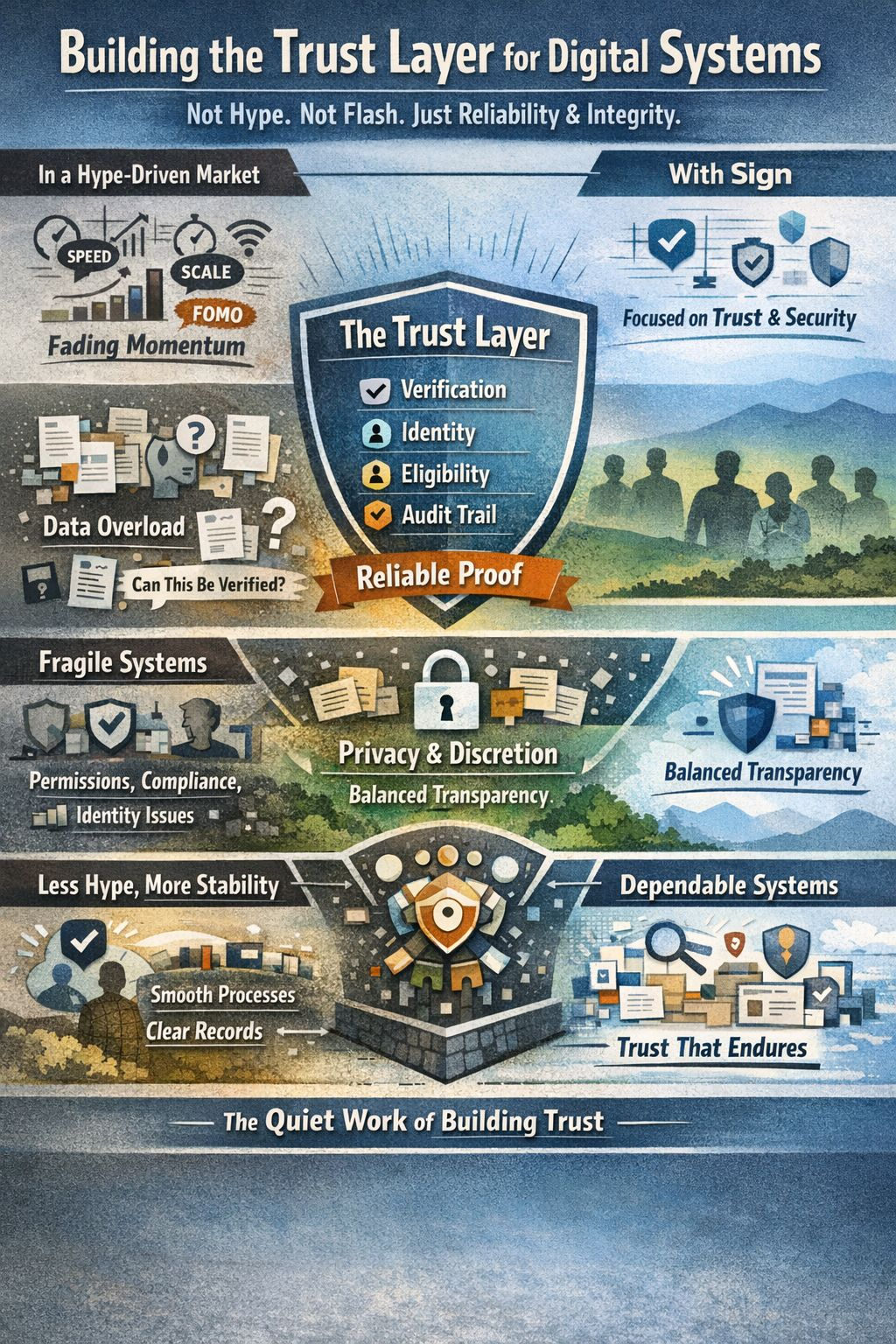
What keeps drawing me back to Sign is straightforward.
It is not trying to dominate attention.
In a market like this, that alone is unusual. Most projects know how to manufacture momentum. They wrap themselves in whatever narrative is trending — speed, scale, culture, adoption, community — and for a while, it works. The story feels compelling, people engage, activity rises, and everything appears to be thriving.
But then reality sets in. Pressure builds. And much of that momentum starts to unravel.
That is where Sign begins to stand apart.
It seems focused on something this space tends to ignore until it becomes a problem: trust.
Not the vague, marketing-friendly version of trust, but the functional kind. The kind that answers real questions. Who approved this? Who is actually eligible? Is this credential legitimate? Can this record still be verified later? Can someone outside the originating platform confirm it without relying on a closed system?
That is typically where things start to break down.
And that is exactly what caught my attention with Sign.
One thing experience teaches you in this space is that the least glamorous problems are often the most important. It is easy to build around excitement. It is much harder to build around friction.
Crypto tends to prioritize movement — moving assets, users, activity, attention. More motion, more metrics, more visible signs that something is happening.
But motion does not equal reliability.
As soon as real-world complexity enters — permissions, approvals, compliance, identity, eligibility, record-keeping, audits, accountability — the true strength of a system is tested. That is when polished ideas can start to look fragile.
Sign appears to be building directly at that point of tension.
It is less concerned with generating activity and more concerned with ensuring that proof holds up under scrutiny.
That distinction matters more than most people realize.
Data is abundant. Records are everywhere. Claims are constant. But the moment you ask whether something is valid — where it came from, who issued it, whether it has been altered, whether it can still be verified — stability disappears. Trust becomes slow, manual, and inefficient, filled with bottlenecks and verification overhead.
That is the underlying problem.
And Sign seems to recognize it clearly.
What strengthens the case further is how it approaches identity.
Many projects have treated identity as a surface feature — a profile, a badge, a social layer. Something decorative rather than essential. That approach rarely leads anywhere meaningful.
Sign appears to take a different path.
It treats identity as infrastructure.
That shift matters. When identity sits beneath a system rather than on top of it, everything connected to it becomes more critical — access, permissions, credentials, eligibility, compliance, distribution, verification. It determines what can be trusted and what can move between systems without losing its integrity.
At that point, identity stops being cosmetic and becomes foundational.
That is the version of this conversation that actually matters.
At the same time, good ideas are only valuable if they survive real conditions. That is where most projects fail.
Strong documentation, clean architecture, and a compelling narrative do not mean much if the system breaks when faced with privacy constraints, institutional resistance, fragmented infrastructure, regulatory pressure, conflicting incentives, or operational friction.
That is the real test.
So the question with Sign is not whether the idea is sound — it is.
The question is whether it continues to function when things become slower, messier, and more complicated than the original vision suggests.
That is what I am paying attention to.
Because it is more worthwhile to watch a team grapple with that reality than to watch another one manufacture superficial momentum.
Another aspect that stands out is that Sign does not seem locked into the simplistic assumption that everything meaningful must be fully public at all times.
That idea may sound appealing, but it rarely holds up.
Real systems require both verification and discretion. They need privacy boundaries, selective disclosure, and the ability to prove specific facts without exposing everything behind them.
That balance is difficult.
Most teams either sidestep it or underestimate its complexity. Sign, at the very least, seems to acknowledge that this tension is unavoidable.
And that matters.
The future of digital systems will not be built on complete transparency or total opacity. It will require something more nuanced — a way to make trust verifiable without turning sensitive processes into public spectacle.
If Sign can contribute meaningfully to that balance, then it is addressing something real.
Because trust problems do not diminish as systems scale. They intensify.
More users introduce more edge cases. More institutions create more friction. More coordination increases the number of points where records, permissions, approvals, and claims can fail.
That is why this category is more important than it appears.
If a project can improve that layer — not perfect it, but make it more reliable — it creates genuine value. The kind that reduces friction, strengthens systems under pressure, and minimizes reliance on manual workarounds every time verification is required.
That value rarely arrives in dramatic ways.
It shows up quietly.
Processes become smoother. Records are easier to verify. Distributions become clearer. Credentials remain intact. Decisions carry more confidence. Systems require less manual correction.
It may not be exciting.
But it is essential.
That said, caution is still necessary. Many capable teams have pursued meaningful ideas and still faded into irrelevance.
This space is full of concepts that never became indispensable.
Sign could follow that same path. Having the right perspective does not guarantee adoption. Building useful infrastructure is one challenge. Becoming something people cannot replace is another.
That is the threshold that matters.
Because if Sign succeeds, it likely will not look dramatic.
It will look subtle.
Less friction. More reliable records. Clearer verification. Better decision-making. Fewer breakdowns. Less dependence on blind trust in closed systems.
Just a bit more certainty in the areas where digital systems usually struggle.
And that might be enough.
What keeps Sign on my radar is not hype or bold promises.
It is the focus on durability.
In a market driven by attention, Sign appears to be focused on resilience.
That does not guarantee success.
But it does make it worth watching.
Because the projects that endure are not always the loudest. Often, they are the ones solving the problems everyone else ignored — until those problems became impossible to avoid.
Trust is one of those problems.
And that is why Sign still stands out.
#SignDigitalSovereignInfra @SignOfficial #sign $SIGN