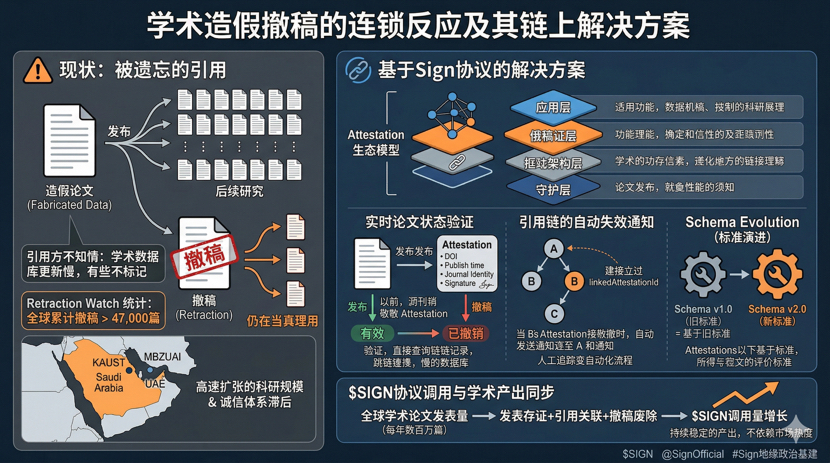
News of academic fraud being retracted comes up frequently, but there is a rarely noticed chain reaction after retraction: this fraudulent paper had already been cited by hundreds of other papers before its retraction. What happens to those articles that cite it as evidence? In most cases, the answer is that no one cares. The citing parties are completely unaware that the evidence they cited has been retracted because the retraction marking in academic databases is updated very slowly, and some may not be marked at all.
This is not a low-probability event. Retraction Watch has reported that the total number of retracted papers worldwide exceeds 47,000, but the citation counts accumulated by these papers before retraction continue to be used as legitimate evidence. A paper with fraudulent data may have already supported the conclusions of twenty to thirty subsequent studies. The authors of those subsequent studies are completely unaware that there are foundational issues.
In the past two years, the Middle East has invested heavily in building universities and research institutions. Saudi Arabia's KAUST and the UAE's MBZUAI are rapidly expanding their research scale and publishing at an incredible speed, but the academic integrity system cannot keep up with the publishing pace. This issue exists globally, but is particularly prominent in the rapidly expanding academic ecosystem.
@SignOfficial The white paper describes a four-layer attestation ecosystem model. The Trust Layer is foundational; the credibility of academic institutions constitutes the bottom layer of trust sources. The Application Layer involves the practical application of trust verified by journals and databases. The Infrastructure Layer handles the indexing and querying services for attestation data, while the Attestation Layer manages the on-chain records of paper publication and retraction.
When a paper is published, the journal issues an attestation that includes the paper's DOI, publication date, journal identity, and signature. During retraction, the journal revokes this attestation. The status changes from valid to retracted, and at any time someone wants to verify the status of this paper, they can directly check the on-chain records without waiting for database updates. No manual marking is needed.
The key lies in the application of the linkedAttestationId mechanism from the white paper in citation scenarios. Each article that cites a particular paper associates its own publication attestation with the attestation of the cited paper via linkedAttestationId upon release, forming a traceable citation chain. When the attestation of the original paper is revoked, all citing parties associated through linkedAttestationId can be notified that the evidence you cited is now invalid, transforming a problem that previously relied entirely on manual tracking into an automated process.
The white paper also includes a Schema Evolution mechanism. Academic standards are not static; certain assessment methods may be deemed inadequate after a few years. After a Schema version upgrade, attestations under the old version remain readable but are marked as based on old standards. When readers look at an old article, they can know which era its assessment standards belong to. It's not simply a matter of right or wrong; it provides context.
For the usage of $SIGN , this scenario has a very good characteristic: it does not rely on a specific industry hotspot; it is a consistently stable daily output. Millions of academic papers are published globally every year, and each publication attestation, every linkedAttestationId established by citations, and every revocation of retraction are protocol calls. The call volume follows the growth rate of global scientific research output and does not depend on market trends.
Those researchers who cited fraudulent papers are not dishonest; they lack a system that can promptly inform them when issues arise at the source.#Sign地缘政治基建