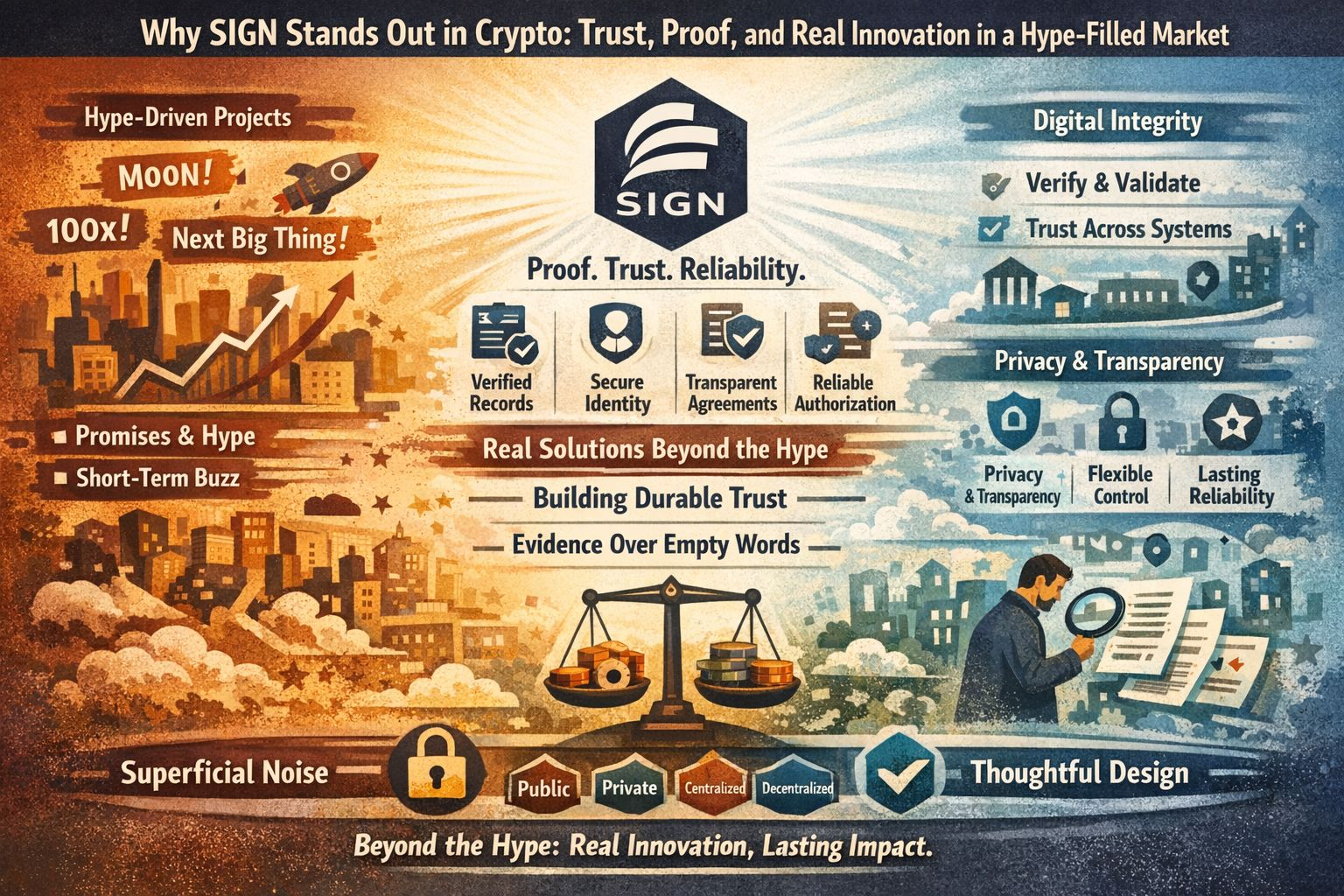
Spending time in the crypto space changes how you see things.
At first, every new project feels exciting. The messaging is sharp, the ideas ambitious, and everything seems wrapped in the same aura of urgency and importance. But after a while, that excitement fades. You start noticing patterns—the same promises resurfacing under new names, a fresh narrative trending for a few weeks, then disappearing into the background along with countless others.
That’s why SIGN keeps lingering in my mind.
It doesn’t come across as another project clamoring for attention before it’s earned. The more I look at it, the more it seems focused on something real. Not something that simply reads well in a blog post or pitch deck, but something that continues to matter after the hype settles.
What makes SIGN truly interesting is how simple its core idea becomes once you strip away the noise. Increasingly, our lives are mediated by digital systems: money, identity, agreements, permissions, records, ownership—all moving online. Yet one persistent problem keeps showing up: how do you prove anything reliably? How do you confirm a claim, validate an approval, trust a record, and ensure that proof holds up over time?
This question extends far beyond crypto, which is exactly why it’s so significant.
Many projects in this space throw around the word “trust,” but it often feels hollow—a marketing tool rather than a real solution. SIGN feels different. It emphasizes evidence over slogans, constantly returning to the core of proof: what happened, who authorized it, under what conditions, and whether that information can be relied on as it moves across systems, institutions, or individuals.
That approach feels grounded—refreshingly so in a market dominated by polished, surface-level language.
And honestly, that’s why it keeps pulling me back. SIGN seems to grasp something most of the market overlooks: trust isn’t built by clever phrases. It’s built when systems are thoughtfully designed, so people don’t have to rely on guesswork.
That insight matters even more today, as the internet feels subtly less trustworthy. Not in a dramatic way, but in a constant, low-level sense that anyone can feel. There’s too much imitation, too much curated perception, too much borrowed credibility, too much content that looks convincing until you pause and ask, “Where did this really come from?” In this environment, proof isn’t optional—it’s essential.
That’s why SIGN feels more relevant than many projects chasing speed, scale, or short-term attention.
It also helps that SIGN doesn’t seem trapped in a naive view of digital systems. Real life is rarely fully public, fully private, fully centralized, or fully decentralized. It’s always a mix. Some records require transparency, others need protection. Some systems thrive on openness, while others demand controlled access, auditability, or discretion. Any project serious about identity, capital, or public digital infrastructure must respect this complexity—and SIGN appears to do just that.
To me, this gives it a sense of maturity that a lot of so-called innovation in crypto lacks. Not because it’s trying to sound smart, but because it’s honest about the environment it’s building for.
There’s something quietly refreshing about a project willing to tackle unglamorous, necessary work. Few people get excited about structure, verification, standards, or layers of digital evidence. These aren’t flashy topics. They don’t make headlines. But when systems scale beyond small communities or experimental use cases, these details stop being optional—they become crucial.
That’s where SIGN shines the longer you study it.
It feels less like a project chasing trends and more like one trying to solve a persistent, growing problem. Much of crypto remains obsessed with creating attention. SIGN, at least from my perspective, focuses on creating durable trust.
That distinction may seem subtle, but it changes everything. Attention is fleeting; trust must endure.
Maybe that’s the simplest way to explain why SIGN keeps drawing me back. In a market full of recycled language, repeating narratives, and glossy emptiness, it feels like one of the few projects attempting to build something substantial—something that doesn’t rely on hype, something that still feels meaningful once you look past the surface.
And in today’s landscape, that alone makes it stand out.
#SignDigitalSovereignInfra @SignOfficial $SIGN