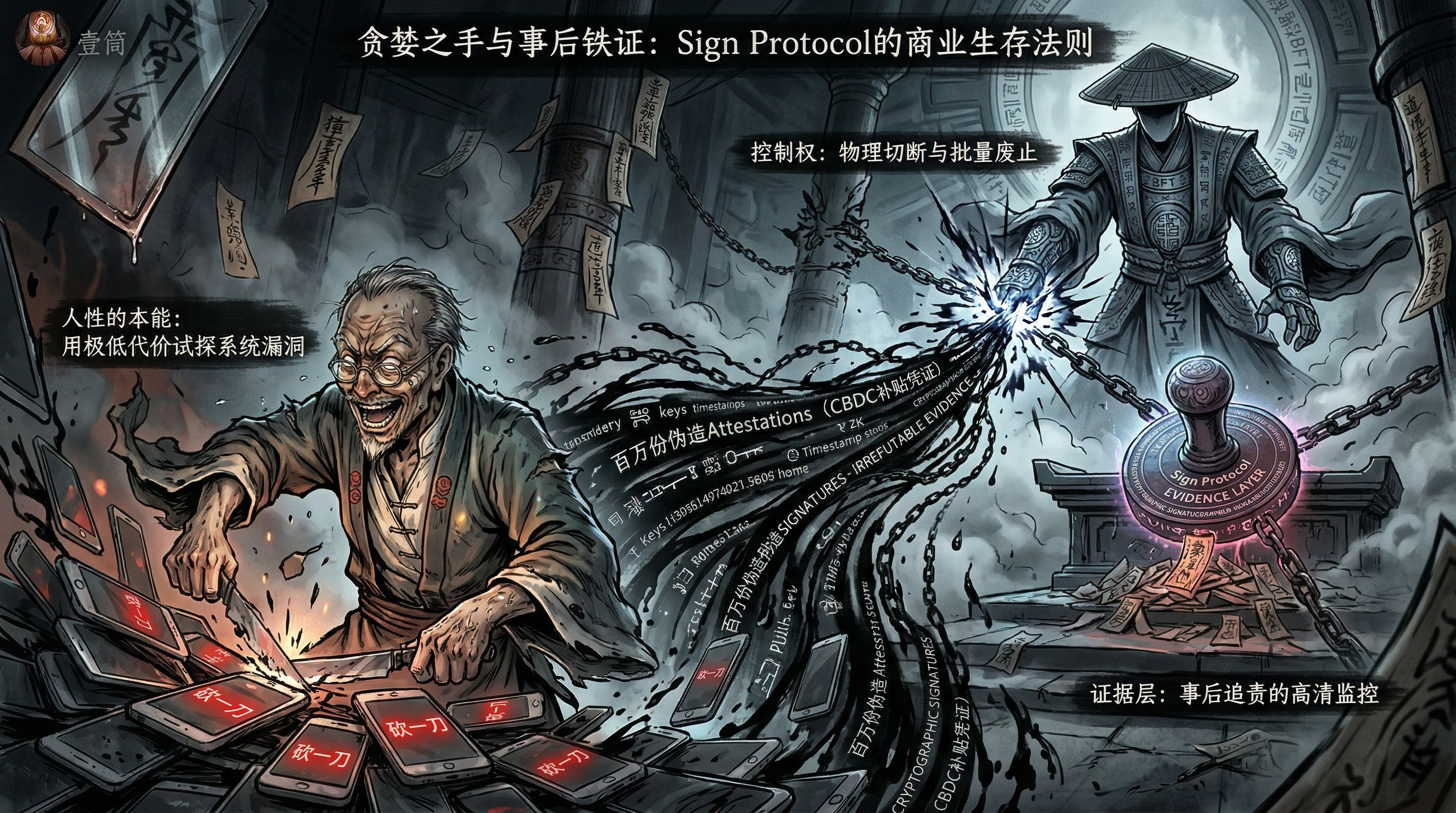
Last night, I went to my uncle's house to borrow a microwave. As soon as I entered the door, I saw him wearing reading glasses, frantically tapping a red web button called 'Cut Once' with his greasy fingers on his smartphone. He was cursing that this software must be a scam and always missing that one cent, while also unable to stop sending the command from the pop-up windows to everyone in the family group. Watching him so anxiously from the entrance, I really felt a bit uncomfortable. People clearly know that the rules are secretly manipulated by the platform, yet they are still driven by small interests to fill that ever-unfillable black hole. To put it bluntly, as long as there is no substantial cost to pay, it has become a human instinct to crazily test the system's vulnerabilities or even cheat.
Watching him click obsessively and futilely on the screen, a corresponding industry scene suddenly flashed through my mind. This attempt to brush away the defensive line with extremely low costs corresponds precisely to the most troublesome attack model in major private networks today. Following this train of thought, I re-analyzed the recently popular Sign Protocol on Binance. Many people are fixated on that 20,000 TPS high concurrency figure written in its Sovereign Stack underlying architecture file daily. However, I have never cared about those glamorous surface parameters. What I truly care about is how high the cost of wrongdoing is set for those who want to exploit or sabotage the system when Sign embeds its core proof mechanism into such a high-concurrency permissioned network.
I carefully reviewed the @SignOfficial underlying logic of sovereign digital infrastructure. The trump card of this play is actually its evidence layer, which defines specific data formats through Schema and then generates Attestations (on-chain proofs) with cryptographic signatures. On the congested public streets of Ethereum, exorbitant tolls naturally block most garbage data. However, once this proof protocol is placed on a high-speed highway with 20,000 concurrent connections and likely no gas fees, the situation completely changes. This directly creates a fatal defensive vacuum, and if someone wants to mass forge proofs, the ultra-high processing speed instead becomes the fastest knife in their hands.
I tried to simulate the trajectory of such extreme attacks in my mind. In this permissioned network, attempting to alter the ledger through computing power is an extremely naive idea, as the network is controlled by admission nodes. The true Achilles' heel lies in exploiting loopholes in the rules for proof abuse. Suppose a legitimate verification node's internal authority is compromised; due to the lack of real monetary transaction costs, the attacker only pays the social engineering expense to bribe that node. Once this breach is opened, they can flood the global proof record table of Sign with seemingly compliant yet actually forged CBDC subsidy claim certificates at a speed of thousands of transactions per second. In just a few seconds, hundreds of thousands of pieces of dirty data with legitimate signatures will pour into the system like a flood.
If it were in a purely decentralized network, this state of pollution would be an almost irreversible disaster. Interestingly, in the face of this massive flood of dirty data, the solution provided by Sign is not a rigid code defense, but rather gives full control to sovereign operators. Its defensive bottom line is actually direct physical disconnection and state isolation. Sovereign entities can directly blacklist the mad node at the consensus layer, and relying on the confirmation characteristics of the BFT architecture, can batch invalidate those hundreds of thousands of forged Attestations based on specific timestamps at the smart contract layer. #Sign地缘政治基建
Many people in the industry have a severe technological superstition, believing that in times of crisis, everything should rely solely on running smart contracts to solve problems. However, I think Sign's acceptance of the existence of centralized intervention in sovereign application scenarios is a shrewd game that sees through human nature. Its evidence layer here no longer serves as an absolute tamper-resistant vault, but as a high-definition surveillance camera for post-event accountability. Although those hundreds of thousands of discarded proofs were rejected, their cryptographic signatures and on-chain timestamps are firmly nailed there. Even with the use of zero-knowledge proof selective disclosure technology, the source of wrongdoing by verification nodes cannot be concealed. That malicious node has left irrefutable evidence, which is the fatal cost it ultimately has to bear. $SIGN
Looking back at my uncle's frantic tapping on the smartphone screen, the greed of humanity is the same everywhere. The Sign Protocol's high TPS permissioned chain proof mechanism does not fundamentally eliminate the idea of wrongdoing. It merely shifts the threshold for wrongdoing from competing on computing power to competing on authority and harsh post-event liquidation methods. This kind of defensive counterattack with a sense of compromise may not sound like the idealistic halo of absolute decentralization, but in the real commercial battlefield, it is often the most effective survival rule.