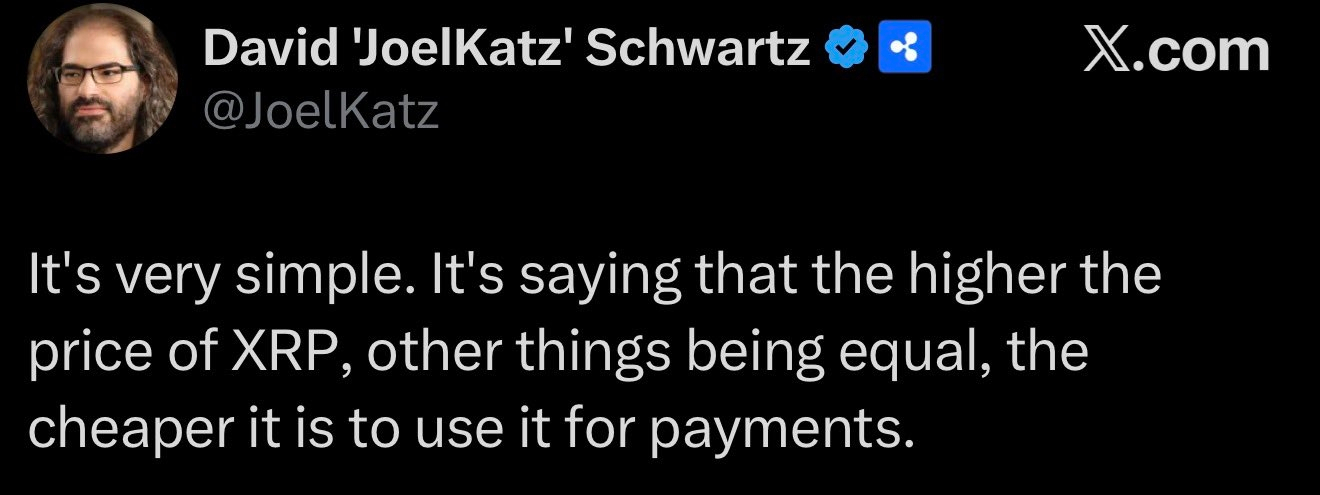
David Schwartz, Ripple's Chief Technology Officer, made a statement that turns common concepts upside down, asserting that the low price of XRP makes its use in payments and exchanges more expensive, not cheaper. This sentence alone is worth reading twice, as it encapsulates a simple yet profound logic: when the price of XRP rises, liquidity increases significantly, and the market can accommodate large transactions without causing sharp price shocks. This means that financial institutions that want to use XRP to move billions of dollars across borders at the lowest possible cost are the same ones that want a high price for XRP; the interest is the same, and the goal is shared. 🏦
📈 Liquidity and Efficiency: The High Price Equation
The equation is clear: the higher the XRP price, the fewer tokens you need to move the same value, thereby reducing transaction costs and minimizing market disruptions during settlement. This concept is fundamental to understanding the role XRP plays as a liquidity bridge in cross-border payments. As Schwartz stated, "A high-priced asset is a better payment tool, at least if you are targeting high-value payments."
🚫 Real reliance does not come from artificial support.
Schwartz did not stop there; he confirmed that Ripple will not pay banks to use XRP with artificial discounts, as demand based on financial support does not reflect true value. He warned of examples like companies such as Uber that lose their users once support is lifted, indicating that real reliance must come from the actual utility of the technology, not from temporary incentives. This underscores Ripple's long-term vision for building a sustainable financial system based on the intrinsic value of XRP. 🔥
📊 Market Gaps and Institutional Arbitrage
In March 2026, Schwartz added a new dimension to this analysis, acknowledging that the market may experience short gaps between the real price and the traded price, but he emphasized that large institutional participants experienced in the cryptocurrency market are always working to correct these gaps through arbitrage between private and public markets. This means that the current price may not reflect the full value, and a correction is inevitable, driven by effective market mechanisms.
🐋 Whale Accumulation: A Signal for the Future
The numbers on the ground support this trend: 42 new wallets holding more than 1 million XRP have appeared since the beginning of 2026, indicating a clear accumulation by whales (large investors) while the public may be unaware of these strategic movements. This accumulation indicates significant confidence from major players in XRP's future and its ability to achieve its goals as a global liquidity asset.
💎 Conclusion: Everyone is heading in the same direction—Ripple, banks, institutions, and whales are all moving toward a high XRP price that supports its efficiency and function in global payments. The smart investor knows to be on the right side of this equation, benefiting from strategic vision and market developments. 💎