
I’ve been staring at screens in this industry long enough to recognize when a project is just dressing up old infrastructure in new jargon. Most of what we call "Web3" isn't really decentralized; it’s just a different set of landlords charging rent for the privilege of existing on their chain. That’s why, when I started digging into what SIGN is building, I didn’t feel the usual wave of exhaustion. Instead, I felt something rare: the quiet recognition of a genuine pivot.
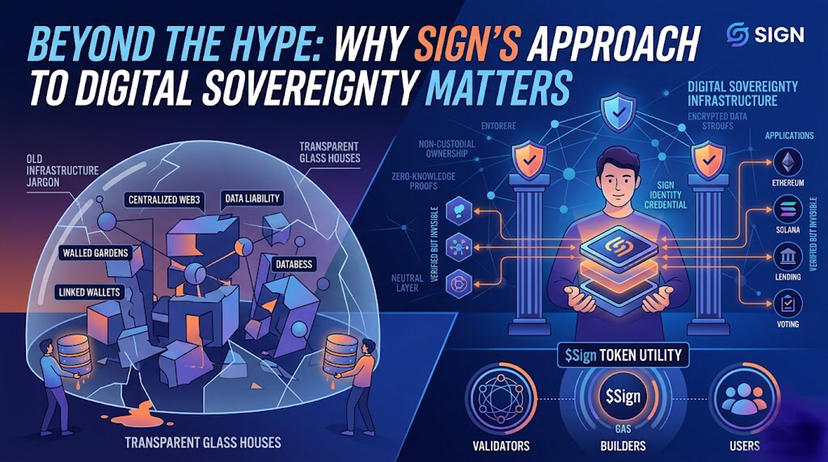 We’ve spent the last few years treating digital identity like an afterthought. You connect your wallet, you sign a transaction, and suddenly a protocol knows your entire financial history, your NFT collection, and your voting record. We pretend that’s sovereignty. It isn’t. It’s just a transparent glass house we’re all living in, hoping no one looks too closely. The concept behind Sign flips that assumption on its head.
What draws me to this isn’t the speculative aspect—I’ve learned to tune out the noise about valuations—but the architecture. Sign is building what they call Digital Sovereignty Infrastructure, and the hashtag SignDigitalSovereignInfra isn’t just a marketing tag; it’s the thesis. We’re moving into an era where your data isn’t supposed to be a liability you carry from one application to the next, hoping it doesn’t leak. It’s supposed to be a credential you hold, verified but invisible.
I remember the early days of crypto, when the ethos was "be your own bank." We nailed the "bank" part, but we forgot about the "identity" part. Today, I juggle thirty different wallets for thirty different chains, each with a fragmented reputation. If I’m a good actor on Ethereum, that doesn’t help me on Solana. If I’ve built trust in a lending protocol, I have to start from zero elsewhere. This fragmentation is the bottleneck that keeps crypto feeling like a series of walled gardens rather than a unified web.
Sign solves this by shifting the locus of control. Instead of applications holding your data, you hold the keys to your own state. The protocol acts as a neutral layer—a substrate where verification happens without disclosure. We’ve talked about zero-knowledge proofs for years as this abstract, futuristic concept. But seeing it applied practically, where I can prove I’m a qualified participant without telling you who I am or how much I hold, feels like the first mature application of the tech.
The token economics here also deserve a closer look without the usual hype. Sign isn’t designed to be a volatile entry point for speculative frenzies. It functions as the gas for this sovereignty layer. Every time a developer builds on this infrastructure, every time a user asserts their identity across a new application, the utility flows through the token. It’s the mechanism that aligns the validators, the users, and the builders into a single economy. If the infrastructure becomes the standard for cross-chain reputation, then the token becomes the underlying resource that powers that reputation.
I’ve been testing a few of the early access features. What strikes me isn’t the flashiness—there are no gamified rewards throwing dopamine hits at you—but the frictionlessness. Usually, setting up a self-sovereign identity feels like you’re walking through molasses. You have to manage seed phrases, understand complex cryptographic curves, and pray you don’t lock yourself out. The Sign interface abstracts that complexity without sacrificing the underlying security. It feels like using a modern app, but with the assurance that the backend is built on principles of non-custodial ownership.
There’s a specific moment during onboarding that crystallized this for me. I was linking my existing on-chain activity to my Sign profile. Usually, when you do this, the platform scrapes your transactions, stores them on a centralized server, and sells the analytics to market makers. Here, the proof was generated locally. The system verified my history without ever storing it. It’s a subtle distinction—most users wouldn’t notice the difference—but it represents a fundamental shift in power dynamics. The platform doesn’t own my history; I simply rented it to them for the purpose of verification.
This is the kind of infrastructure that doesn’t make headlines during a bull run, but it’s exactly the kind of architecture that survives the bear markets. When the hype fades and the leveraged positions get liquidated, what remains are the protocols that solved actual coordination problems. Digital sovereignty is a coordination problem. We need to coordinate trust across thousands of applications without surrendering our privacy.
Looking at the roadmap, the focus on cross-chain interoperability without bridges is ambitious. Bridges have been the Achilles' heel of the industry; they’re complex, prone to exploits, and they fragment liquidity. Sign’s approach leverages the identity layer to facilitate trust across chains without requiring the assets to move through a vulnerable intermediate contract. If successful, this could render the current bridge model obsolete, replacing it with a verification layer where assets remain in their native environment while identity travels.
I’m also watching how the developer community responds to @SignOfficial grants program. Infrastructure is only as valuable as the applications built on top of it. A sovereign identity layer with no apps is just a fancy keychain. But if developers start integrating Sign’s SDK to build dApps that respect user privacy by default, we might finally break the cycle of data harvesting that has plagued the internet since Web2.
I’m not here to tell you this is the next 100x play. That kind of analysis misses the point entirely. We’ve reached a stage in crypto where the winners won’t be determined by who has the loudest community, but by who provides the most essential plumbing. Sign is building the pipes. It’s unglamorous work, but it’s necessary.
Every time I log onto a platform now and see the "Sign in with Google" button, I feel a small twinge of frustration. That button represents a surrender—a trade of privacy for convenience. The vision behind Sign and the #SignDigitalSovereignInfra movement is to replace that button with something that doesn’t ask for permission. It’s a future where your identity is a portable, encrypted asset that you command, not a database entry that commands you.
We’ve been promised sovereignty before, only to receive it wrapped in the same old centralized packaging. This feels different. It feels like the first time the infrastructure actually matches the ideology. I’m holding my position, not because I expect it to explode overnight, but because I believe that in five years, we’ll look back at this moment as the point where we stopped asking for permission to exist online and started proving our worth without exposing our lives. That’s the kind of shift worth building for. $SIGN
