
I’ve seen plenty of government and crypto announcements over the years and honestly most of them fade after the headlines. This one didn’t feel the same.
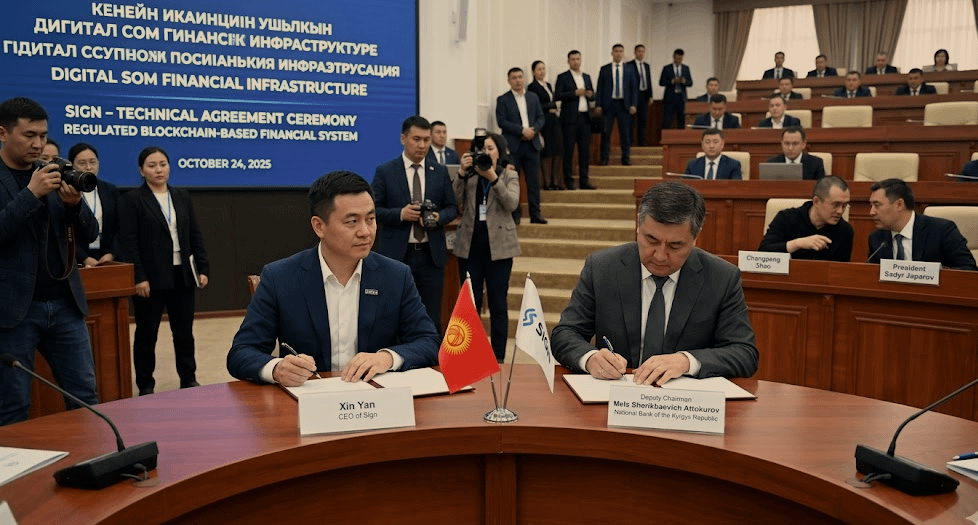
At first glance Sign partnering with the National Bank of the Kyrgyz Republic seemed like another soft collaboration. But the details tell a different story. On October 24, 2025 during the Second National Council for the Development of Virtual Assets and Blockchain Technologies in Bishkek, Sign CEO Xin Yan signed a formal technical agreement with Deputy Chairman Mels Sherikbaevich Attokurov.
That meeting wasn’t symbolic. President Sadyr Japarov was present, along with Changpeng Zhao, who isn’t just an attendee - he’s acting as a public advisor on Kyrgyzstan’s digital asset strategy. That level of alignment between politics and industry is rare.
What’s being built goes beyond a typical CBDC rollout. Digital SOM is positioned as a fully regulated blockchain-based financial system, directly overseen by the National Bank. According to Chairman Melis Turgunbaev, it has already moved into the practical implementation phase, not just theory. That matters, because most CBDC projects never get that far.
What caught my attention isn’t just digitizing currency. It’s the ecosystem being created around it. There’s a national stablecoin (KGST) already launched on BNB Chain, plans for a National Cryptocurrency Reserve, full localization of Binance services for Kyrgyz users, and an education platform to onboard the population. This isn’t a single product - it’s an entire system forming in real time.
And the infrastructure layer behind it is what stands out. Digital SOM isn’t being framed as “digital cash.” It’s more like programmable money with embedded logic. Payments, settlement, and compliance can all be automated at the system level. If it works as intended, it removes the friction traditional finance struggles with - delays reconciliation gaps operational overhead. Not hype. Just efficiency.
The KGST stablecoin integration is a key signal. Most countries building CBDCs tend to isolate their systems, but Kyrgyzstan is connecting its local currency infrastructure with external blockchain liquidity from day one. That is significant especially for a smaller economy trying to establish a global presence. It also aligns with President Japarov push to make Kyrgyzstan a regional hub for digital finance. When you consider regulatory clarity a growing number of licensed participants, digital public services and a young tech-oriented population the direction starts to make sense.
From what I can see, Sign isn’t just a paper partner. They’re building the core components - payment infrastructure, identity and verification layers, distribution logic. That’s backend ownership. And from experience, long-term value usually sits here. Frontend narratives change fast; infrastructure sticks, especially once governments depend on it. If this system scales, replacing those rails becomes difficult.
From a market perspective, this is the kind of setup that usually gets ignored early. There’s no immediate hype trigger, no fast revenue story - just slow, structured progress. I’ve seen this pattern before. Sometimes it quietly compounds; sometimes it stalls if execution slips. And yes, risks remain real. Government timelines can stretch, policy direction can shift, and adoption isn’t guaranteed.
But compared to most CBDC announcements, this feels grounded. Legislation is in place, implementation is active, and the ecosystem is being developed - not just a single product.
So what is this, really? It’s not a finished success story. It’s not guaranteed. But it’s definitely not noise anymore. It feels like a country rebuilding parts of its financial system from the ground up - with real partners, real timelines, and a clear direction. And that’s rare enough to pay attention to.