
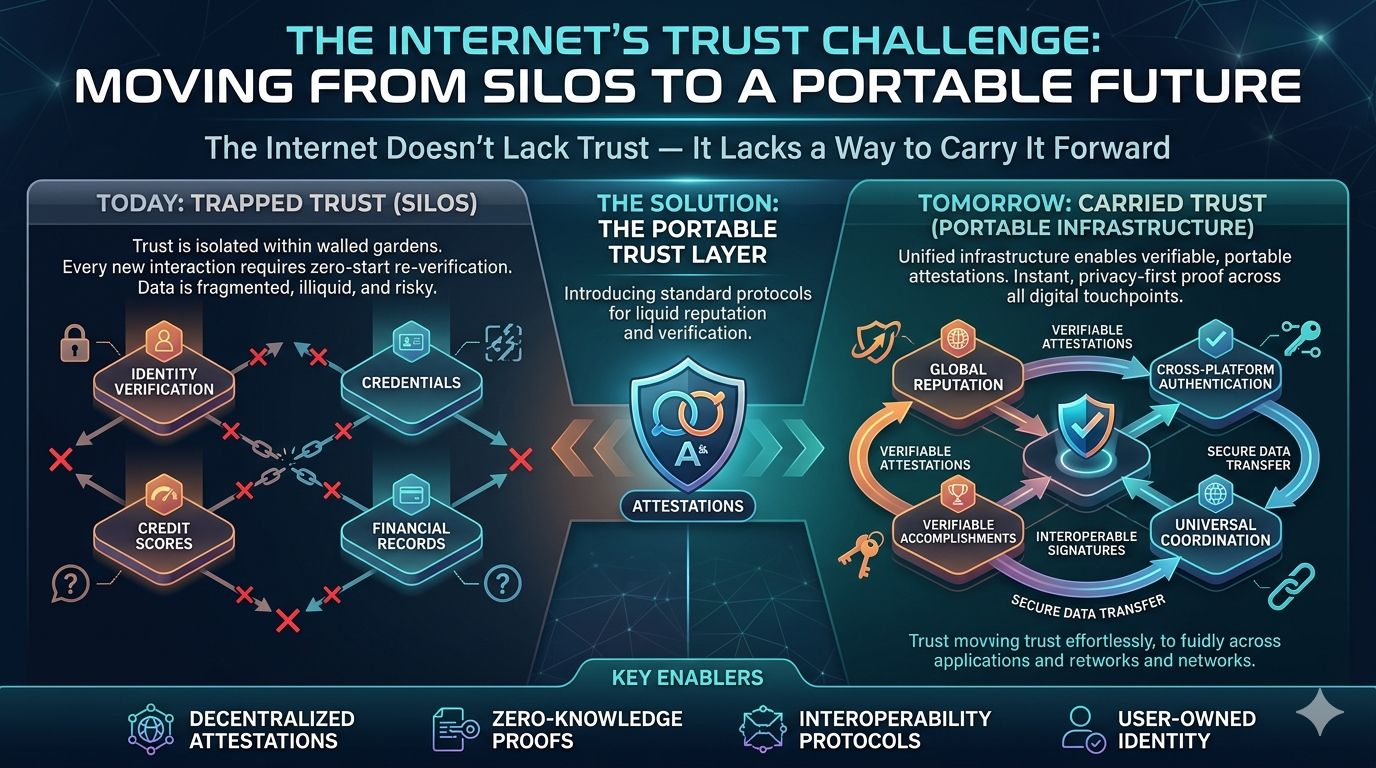
Lately I’ve been thinking about something strange…
The internet still runs on introductions.
Not the social kind.
Not “hey, meet this person.
I mean the quiet kind.
One system basically telling another:
“this person is legit… you can trust them… let them through.
And then things happen.
You get access.
You receive something.
You’re recognized.
You’re included.
At first, you don’t notice it.
But once you do… you start seeing it everywhere.
The weird part?
We don’t actually have a shortage of information.
The internet already knows a lot about us.
It can track what we’ve done, what we hold, where we’ve participated, what we’ve earned, what we qualify for.
That’s not the problem.
The problem is… none of that travels very well.
You can be “someone” inside one system…
…and basically a stranger everywhere else.
Inside a platform, everything makes sense.
It knows your history.
Your actions.
Your value.
But the moment that needs to be understood somewhere else?
Everything resets.
Suddenly it’s like:
* prove it again
* connect this again
* wait again
* explain again
It’s tiring.
And honestly… a bit frustrating.
That’s when you realize something important:
Trust on the internet is still very local.
Each system trusts itself
But it doesn’t really know how to trust others.
So every time information moves, it has to be re-checked, re-understood, re-built.
---
And that creates this invisible friction we all deal with.
Not in a big dramatic way.
In small annoying ways.
Over and over.
If you zoom out, a lot of what we call “verification” is really just…
introductions at scale.
A system saying:
“this came from a real source”
“this person actually did this”
“this still holds true”
And another system being able to say:
okay… I believe that
Simple idea.
Surprisingly hard to do.
Even things like token distribution follow this pattern.
People think it’s just about sending rewards.
But it’s not.
Before anything gets sent, there’s always a reason.
Why this person?
Why not someone else?
And that “why” usually comes from somewhere else.
A contribution.
A holding.
A role.
A moment in time.
The token is just the outcome.
The real story is the claim behind it.
And honestly… connecting those two cleanly is where everything starts to fall apart.
Not because it’s impossible.
But because the infrastructure isn’t quite there yet.
Most systems still feel like islands.
They work perfectly fine on their own.
But the moment they need to cooperate…
things get awkward.
Messy.
Manual.
And people feel that.
Not as “bad infrastructure.”
But as repetition.
Having to prove yourself again and again.
Having to reintroduce yourself to every new system.
Like your past never quite follows you properly.
Good infrastructure fixes that quietly.
It doesn’t make noise.
It just removes friction.
It lets something you proved once… actually carry forward.
That’s the shift that feels important here.
Not just:
can we verify something?
can we send something?
But:
can trust move… without breaking along the way?
Because right now, that’s where most of the internet struggles.
Not in knowing things.
But in sharing them in a way others can actually rely on.
And that’s why SIGN is interesting to me.
Not because it adds more stuff.
But because it tries to make that movement smoother.
Cleaner.
More reliable.
So that when something is true in one place…
…it doesn’t have to start from zero somewhere else.
It’s a small shift in how things work.
But it touches a much bigger problem.
And those kinds of changes usually don’
t look loud in the beginning…
they just slowly make everything else feel easie