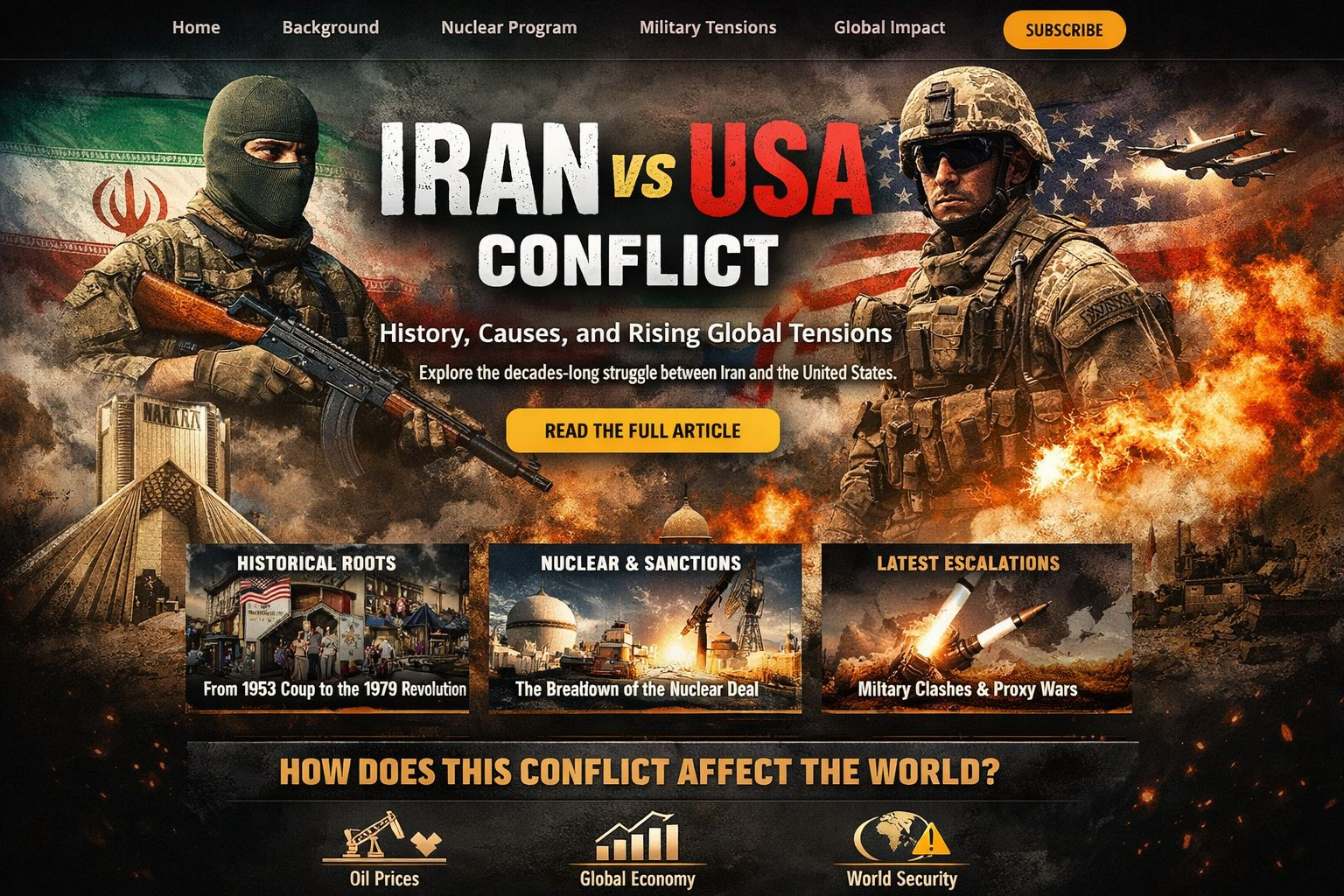
The long-standing conflict between Iran and the United States remains one of the most complex geopolitical struggles in modern history. What began as diplomatic and ideological disagreements has evolved into decades of mistrust, economic sanctions, proxy wars, cyber operations, and periodic military escalations that continue to shape global security.
1953 CIA Intervention
The roots of the Iran USA conflict can be traced back to 1953, when the United States and the United Kingdom supported a covert operation that removed Iran’s democratically elected Prime Minister, Mohammad Mossadegh. This event deeply damaged Iran’s perception of the U.S. and planted early seeds of distrust.
1979 Islamic Revolution
Tensions escalated dramatically in 1979 when Iran’s monarchy was overthrown during the Islamic Revolution. The new Islamic Republic adopted an anti-Western stance, and relations with the United States collapsed after Iranian students seized the U.S. Embassy in Tehran and held American diplomats hostage for 444 days.
Core Causes of the Conflict
One of the central issues in the conflict is Iran’s nuclear program. While Iran insists its nuclear activities are for peaceful energy purposes, the United States and its allies have long expressed concern that Iran may be seeking nuclear weapons capability.
Iran and the United States support opposing sides in several Middle Eastern conflicts. Iran backs various armed groups and political movements across Lebanon, Syria, Iraq, and Yemen, while the U.S. maintains strong alliances with Israel and several Gulf countries.
The United States has imposed extensive economic sanctions on Iran over the years, targeting its oil exports, banking system, and international trade. These sanctions have significantly impacted Iran’s economy and intensified political hostility.
In 2015, Iran and world powers signed the Joint Comprehensive Plan of Action (JCPOA), commonly known as the Iran nuclear deal. The agreement placed restrictions on Iran’s nuclear program in exchange for sanctions relief.
However, in 2018, the United States withdrew from the agreement under President Donald Trump and reimposed sanctions. This move led to Iran gradually reducing its compliance with the deal and increasing uranium enrichment activities, further escalating tensions.
In recent years, the conflict has shifted into a more dangerous phase involving direct and indirect military actions.
The United States and its allies have conducted targeted strikes on Iranian-linked military sites and infrastructure.
Iran has responded with missile attacks and drone operations targeting regional U.S. interests and allied positions.
Proxy conflicts involving Iran-backed groups and U.S.-aligned forces have intensified across the Middle East.
These developments have raised global concerns about the possibility of a wider regional war.
The Iran–USA conflict is no longer limited to traditional warfare. It now includes:
Cyber warfare: digital attacks and intelligence operations
Proxy warfare: indirect battles through allied groups in the Middle East
Economic warfare: sanctions and trade restrictions
Limited military strikes: targeted air and missile operations
The ongoing tensions between Iran and the United States have far-reaching consequences:
Oil prices: instability in the Middle East affects global energy markets
Global economy: financial markets often react sharply to escalation news
International security: increased risk of wider conflict involving regional and global powers
The Iran–USA conflict is a deeply rooted geopolitical struggle shaped by decades of political distrust, ideological differences, and competing regional interests. While it has not escalated into full-scale war, the combination of sanctions, proxy battles, cyber operations, and periodic military confrontations continues to make it one of the most volatile international conflicts in the world today.
#TrumpSeeksQuickEndToIranWar #USNoKingsProtests #CLARITYActHitAnotherRoadblock