
I kept picturing one wallet sitting in a payout run, fully lined up for release, but still frozen. The payout table is here. The claim window is here. The operator reviewing the row is here. But the fact that decides whether this wallet should be paid was attested somewhere else on another chain. That is the support problem I keep coming back to. Not because the rule is confusing, but because the proof that unlocks this one payout is stranded somewhere the local flow cannot act on by itself.
That is usually where the process stops being a system and turns back into people carrying truth around by hand. Someone posts a screenshot. Someone pastes a transaction hash. Someone explains what the remote attestation supposedly says. But the row is still sitting there waiting for one real answer. Release this wallet or keep it frozen. Finance does not want a cross-chain story. It wants a yes or no it can act on.
That is the part of SIGN that feels practical to me. It does not ask a human to transport the remote proof into the local payout flow. The request becomes its own attestation on an official schema. It points to the target chain, the target attestation, and the exact data that needs to be checked through extraData. SIGN says that extraData is emitted through the schema hook as an event instead of being stored, which cuts the cost by about 95 percent. What matters here is not just cheaper messaging. It is that the blocked payout now carries a precise verification request forward instead of a vague instruction for someone to go inspect another chain.
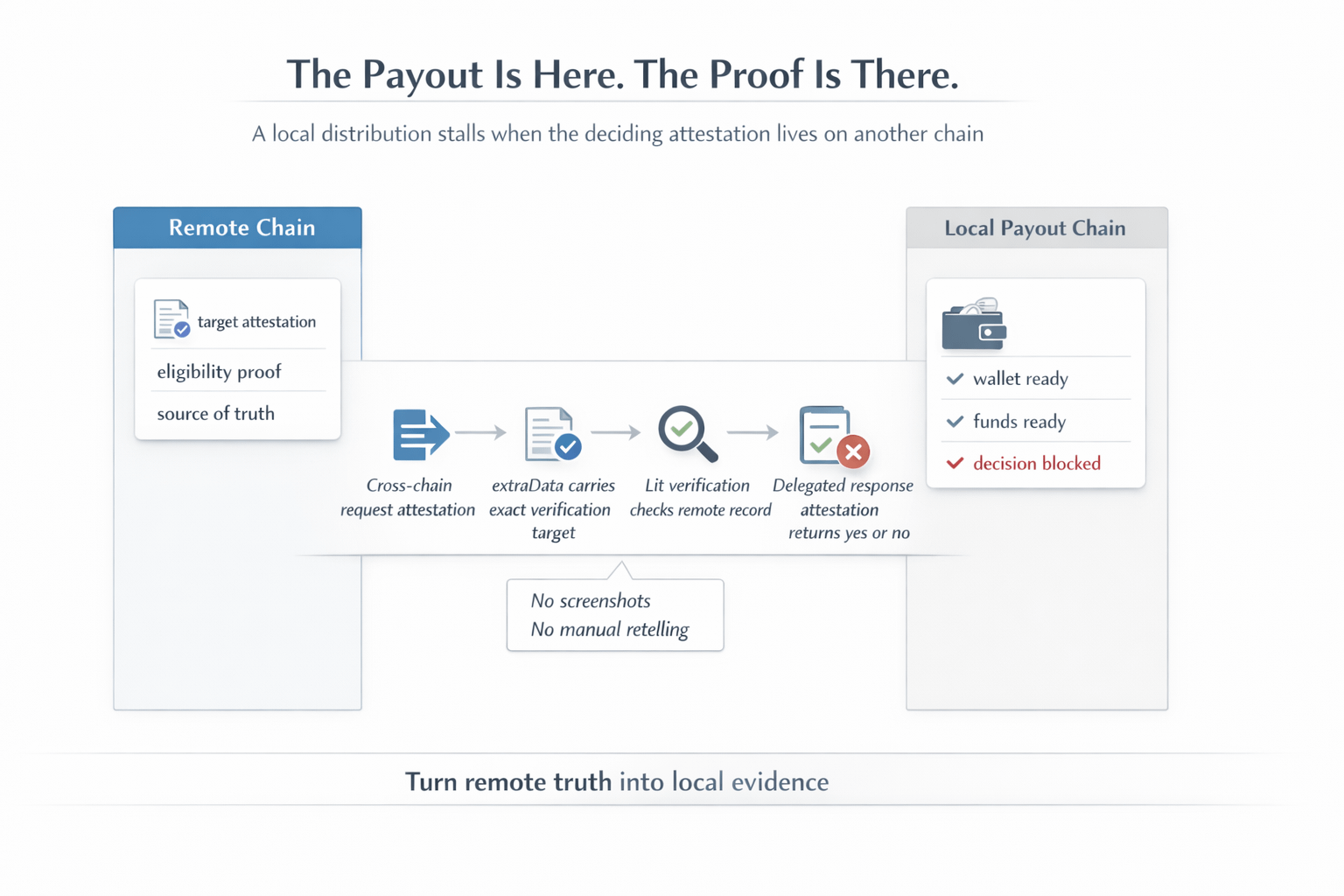
Then the only question that matters gets resolved inside the flow. The event is emitted. Lit picks it up, fetches the target attestation from the remote chain, compares the data, and returns a signed delegated attestation on the official cross-chain response schema with a boolean result. SIGN says that result is signed by at least two thirds of the Lit network through threshold cryptography. So when the operator comes back to this wallet, they are not reading a screenshot or a support note. They are reading a returned record that tells the local payout logic whether this row clears now or stays frozen.
That is the workflow pressure I care about. The payout was never blocked because nobody had a rule. It was blocked because the rule depended on a fact that lived too far away for the local system to use cleanly. Once that happens, teams start improvising. Notes get added. Confidence gets performed. Support replies sound certain for a day and become impossible to replay later. SIGN changes that sequence. Request attestation. Remote fetch. Delegated response. Local yes or no. The operator stays inside the system, and finance can finally do the one thing it came here to do: release the payout on the returned true, or keep the wallet frozen on the returned false.
That is also where SignScan matters for this exact case. When the operator reopens the blocked row, the request and response need to be visible without turning the review into chain-by-chain scavenging. SIGN's indexing layer gives a unified read path across supported chains through REST and GraphQL, so the evidence behind this one release decision stays inspectable instead of disappearing into infrastructure clutter before the final call is made.
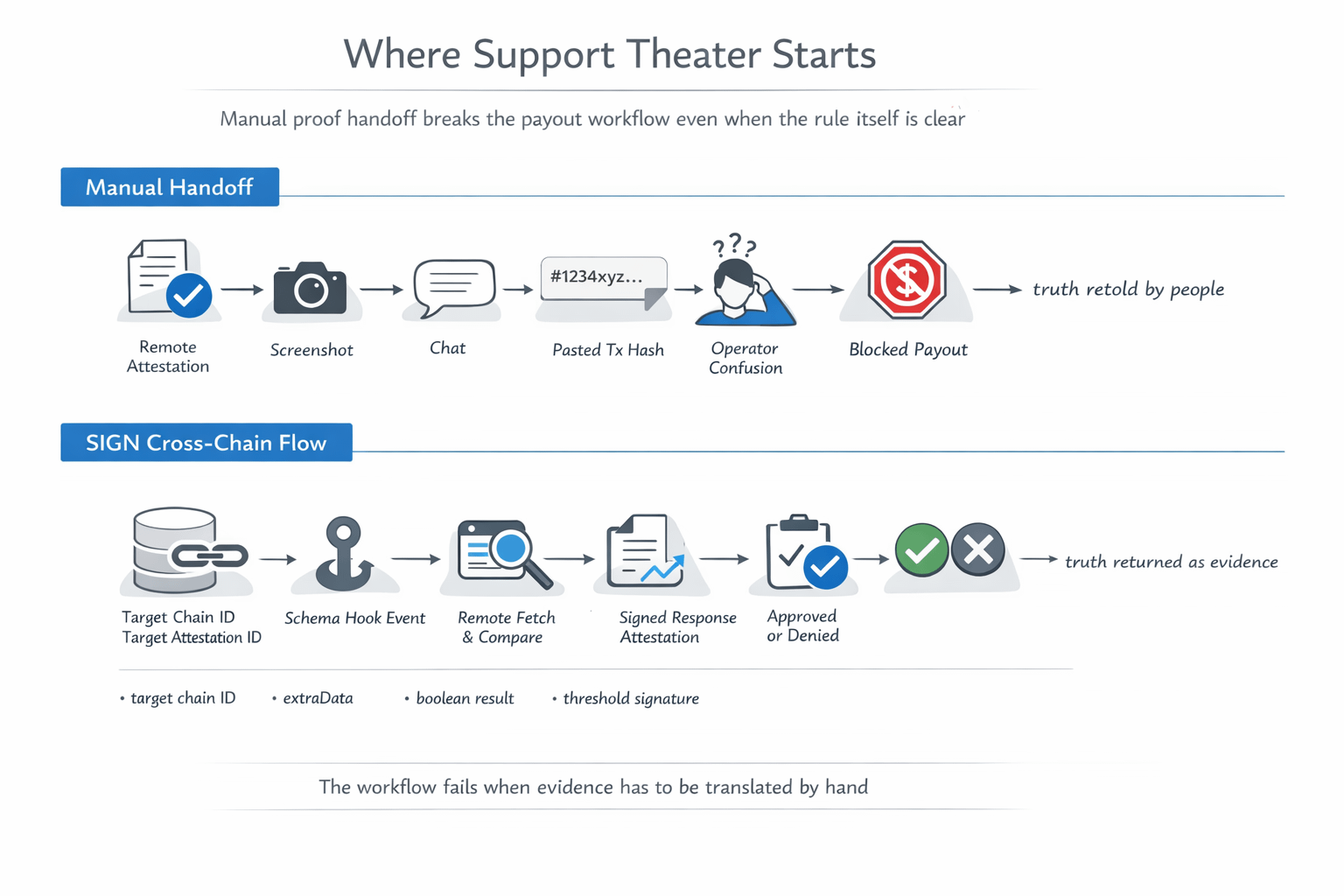
That is the first place where $SIGN feels earned to me. Not because a token mention has to be forced into the article, but because this is the difference between one payout staying inside verifiable system logic and one payout falling back into screenshots, retellings, and staff interpretation. The money is ready to move here. The deciding fact lives there. The real test is whether the returned delegated response is enough for this wallet to move cleanly without support theater filling the gap.
I think that is the real test for SIGN. When one wallet is waiting to be paid on this chain, and the proof that unlocks it lives on another one, can the system hold the row in place until the delegated boolean comes back, then either release it or keep it frozen without asking a human to bridge trust by hand.
#SignDigitalSovereignInfra $SIGN @SignOfficial
