
The New Capital System is a core pillar of the S.I.G.N. architecture, designed to modernize how capital is issued, allocated, and distributed at national and institutional scale. It introduces a programmable approach to capital—where rules, compliance, and execution are embedded directly into digital systems—powered by TokenTable and Sign Protocol.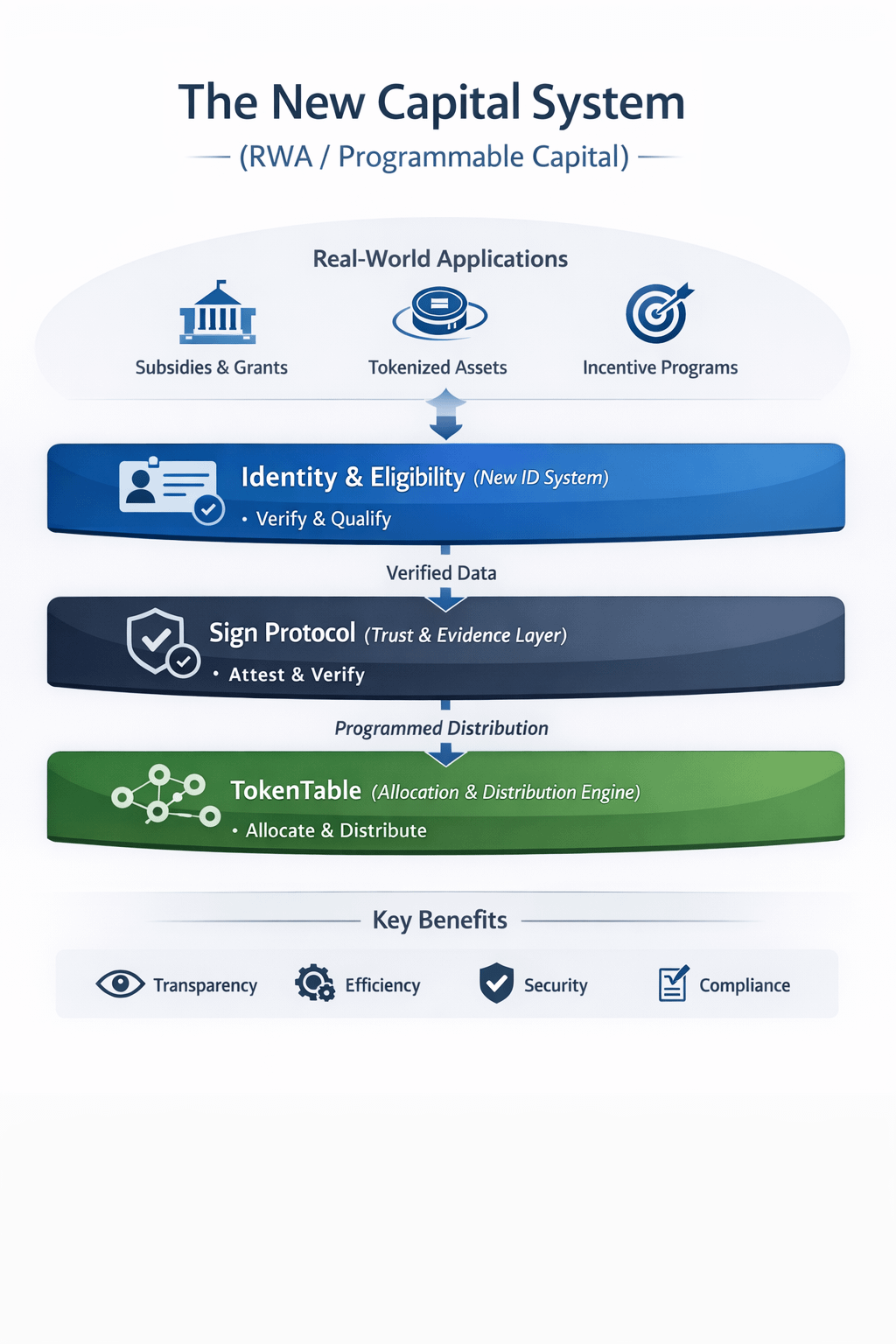
1. What is the New Capital System?
The New Capital System enables tokenized real-world assets (RWA) and programmable capital distribution, allowing governments, institutions, and ecosystems to manage funds with precision, transparency, and automation.
It supports:
Large-scale distribution of subsidies, grants, and incentives
Tokenized assets such as bonds, funds, or commodities
Compliance-aware transfers with embedded rules
Real-time auditability and reporting
Unlike traditional financial infrastructure, this system treats capital as programmable infrastructure, not just passive value.
2. The Role of Programmable Capital
Programmable capital refers to financial assets that behave like software—executing actions automatically based on predefined conditions.
In the RWA context, this means:
Funds are released only when eligibility conditions are met
Vesting schedules are enforced automatically
Compliance checks occur before and during transfers
Reporting and audits are generated in real time
This transforms capital distribution from manual processes into deterministic, rule-driven execution systems, reducing fraud and operational inefficiencies.
3. TokenTable: Allocation & Distribution Engine
TokenTable serves as the execution layer of the New Capital System.
Core Functions:
Defines who gets what, when, and under which rules
Manages allocation tables, vesting schedules, and claim conditions
Executes distributions across blockchain tokens, stablecoins, or CBDC rails
Supports revocation, clawbacks, and governance controls
Key Capabilities:
Deterministic allocation logic (no ambiguity in distribution)
Automated vesting (cliff, linear, custom schedules)
Flexible claim models (push, pull, delegated execution)
Audit-ready outputs and reproducible distribution logic
TokenTable replaces fragmented systems like spreadsheets and manual reconciliation with programmable, auditable infrastructure.
4. Sign Protocol: Trust & Evidence Layer
Sign Protocol underpins the entire system as the verification and evidence layer.
What it does:
Records structured, verifiable claims as attestations
Links identity, eligibility, and execution events
Provides cryptographic proof for every action
Enables cross-system verification and interoperability
Why it matters:
Without a unified evidence layer:
Data becomes fragmented across systems
Audits become manual and unreliable
Trust must be re-established repeatedly
Sign Protocol standardizes how data is created, verified, and queried, enabling reusable trust across applications.
5. System Architecture: How It Works Together
The New Capital System integrates three critical layers:
1. Identity & Eligibility (New ID System)
Determines who qualifies
Generates verifiable credentials
2. Evidence Layer (Sign Protocol)
Anchors eligibility and actions as attestations
Creates an immutable audit trail
3. Execution Layer (TokenTable)
Applies rules to distribute capital
Enforces vesting and compliance
Produces final settlement records
This layered approach ensures separation of concerns while maintaining end-to-end verifiability.
6. Advantages Over Traditional Systems
Transparency
Every allocation and transaction is traceable and auditable.
Efficiency
Eliminates manual reconciliation and reduces operational overhead.
Security
Cryptographic attestations prevent fraud and duplicate claims.
Compliance
Built-in policy enforcement ensures regulatory alignment.
Scalability
Designed for large-scale deployments with millions of users.
7. Toward Sovereign Capital Infrastructure
The New Capital System represents a shift from:
Manual → Automated
Opaque → Transparent
Static → Programmable
By combining TokenTable and Sign Protocol, S.I.G.N. enables a future where capital distribution is:
Rule-based
Verifiable
Interoperable
Audit-ready by design
This creates a foundation for sovereign, programmable financial systems, where capital flows are governed by logic—not discretion.
#SignDigitalSovereignInfra #blockchain #Web3 #BinanceSquareFamily #Binance