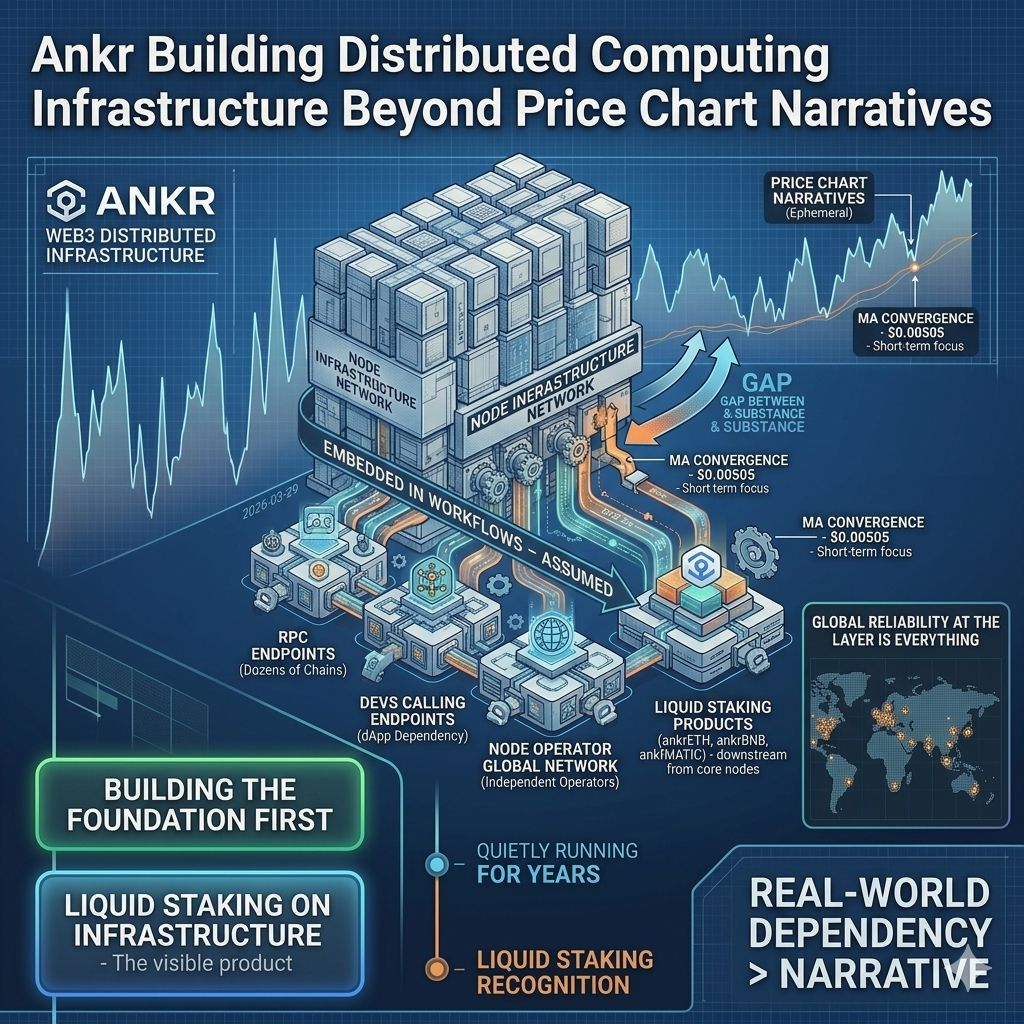
Ankr Building Distributed Computing Infrastructure Beyond Price Chart Narratives
I've been watching Ankr for a while now, and most people still don't understand what they're actually looking at.
That's not entirely their fault. When you pull up ANKR/USDT on Binance and see a price sitting at $0.00500, up 2.04% on the day, trading 1.19 billion tokens in 24 hours — the instinct is to read the candles. Look at the MAs. Decide if it's a buy or a sell.
And you'll miss the entire point.
Because what's priced at half a cent isn't a meme. It's a node infrastructure network that's been quietly running underneath Web3 for years while the market treated it like a lottery ticket.
That gap between price and substance is where the real story lives.
The Chart Tells You One Thing. The Network Tells You Another.
Look at that 15-minute candle chart. MA(7), MA(25), MA(99) all clustered around $0.00505. Price sitting right at support. Volume spike earlier in the session — that big green candle pushing to $0.00519 — and then a slow bleed back down.
Traders see indecision. A ranging asset. Low conviction.
What they're not seeing is that somewhere behind that chart, Ankr is running RPC nodes for dozens of blockchains simultaneously. Developers are calling those endpoints right now. dApps are depending on that infrastructure to stay alive. That activity doesn't show up in the candlestick. It never does.
Infrastructure doesn't pump. It just runs.
What Ankr Actually Builds
Most people in crypto need to access blockchain data without running their own node. That's expensive, technically complex, and overkill for most use cases.
Ankr solved that by distributing node infrastructure across independent operators globally. You get the API endpoint. They handle the node. You build your application.
That sounds simple. It isn't.
Because reliability at that layer is everything. One degraded RPC endpoint breaks every dApp sitting on top of it. Every wallet call fails. Every transaction query times out. Users blame the application. The application blames the provider. The provider has to fix it silently before anyone notices.
That's the job. Invisible when it works. Catastrophic when it doesn't.
Ankr has been doing that job long enough that it's embedded in workflows most people never think about. That kind of quiet dependency is exactly what infrastructure looks like before the market prices it correctly.
Liquid Staking Is the Layer People Are Starting to Notice
The Binance UI tags ANKR under "Liquid Staking" — and that's where retail attention has drifted lately, because liquid staking has a narrative right now.
ankrETH, ankrBNB, ankrMATIC. Stake an asset, receive a liquid receipt token, deploy that token elsewhere while your original position keeps earning. It's a capital efficiency play, and it works.
But liquid staking is the visible product sitting on top of the infrastructure, not the infrastructure itself. The reason Ankr can offer staking across that many chains is because they already operate the nodes. The staking product is downstream of the node network.
Most competitors building liquid staking products don't have that. They're building the roof without the foundation.
Ankr built the foundation first. The roof came later. That ordering matters enormously and almost nobody talks about it.
Why $0.00500 Is an Uncomfortable Price for a Real Network
I'll be honest about what that chart actually shows.
The trend is weak. All three moving averages — MA(7) at 0.00501, MA(25) at 0.00505, MA(99) at 0.00506 — are compressing and sloping down. Volume dried up after that earlier spike. The 24-hour low of $0.00478 wasn't that long ago.
This is not a chart that screams confidence.
And that's exactly the tension worth sitting with. Because the network activity doesn't care about the candlestick. Developers using Ankr's RPC endpoints aren't checking the 15-minute chart before making an API call. The infrastructure keeps running regardless of where price is.
That disconnect — between a functioning network and a struggling token — is either a problem waiting to resolve itself, or a market that's just slow at pricing boring things.
I've seen both outcomes. There's no guarantee here.
What Would Change the Story
Infrastructure narratives move slowly, then all at once.
The signal isn't a price pump. The signal is depth of integration. How many protocols depend on Ankr endpoints without thinking about it. How many liquid staking products get redeemed and re-staked without friction. How many developers treat the RPC layer as a given rather than a choice.
When a system becomes assumed, that's when it becomes infrastructure.
Ankr is closer to that threshold than the chart suggests. But closer isn't there. And the market won't care until the dependency becomes undeniable.
Until then, the candles will keep doing what candles do.
And the nodes will keep running whether anyone's watching or not.
That's what infrastructure looks like from the outside.
Quiet. Consistent. Underpriced — until it isn't.
#Ankr #ANKR #Web3Infrastructure #LiquidStaking #RPC $ANKR