

I’ve lost count of how many times I’ve opened a “revolutionary” crypto project… and closed it five minutes later.
Same rhythm every time.
Clean branding. Big words. “Trust layer.” “Identity solution.” “Next-gen infrastructure.”
Then you dig one inch deeper… and it falls apart.
Or worse it doesn’t fall apart. It just doesn’t matter.
That’s the part that bothers me most.
Because the real problem isn’t that we lack ideas.
It’s that most of them never connect to anything real.
And that’s where Sign Protocol caught me off guard.
Not because it impressed me.
Because it didn’t try to.
Let me explain.
I’ve had moments real ones where something as simple as proving who I am online turned into a full-blown mess.
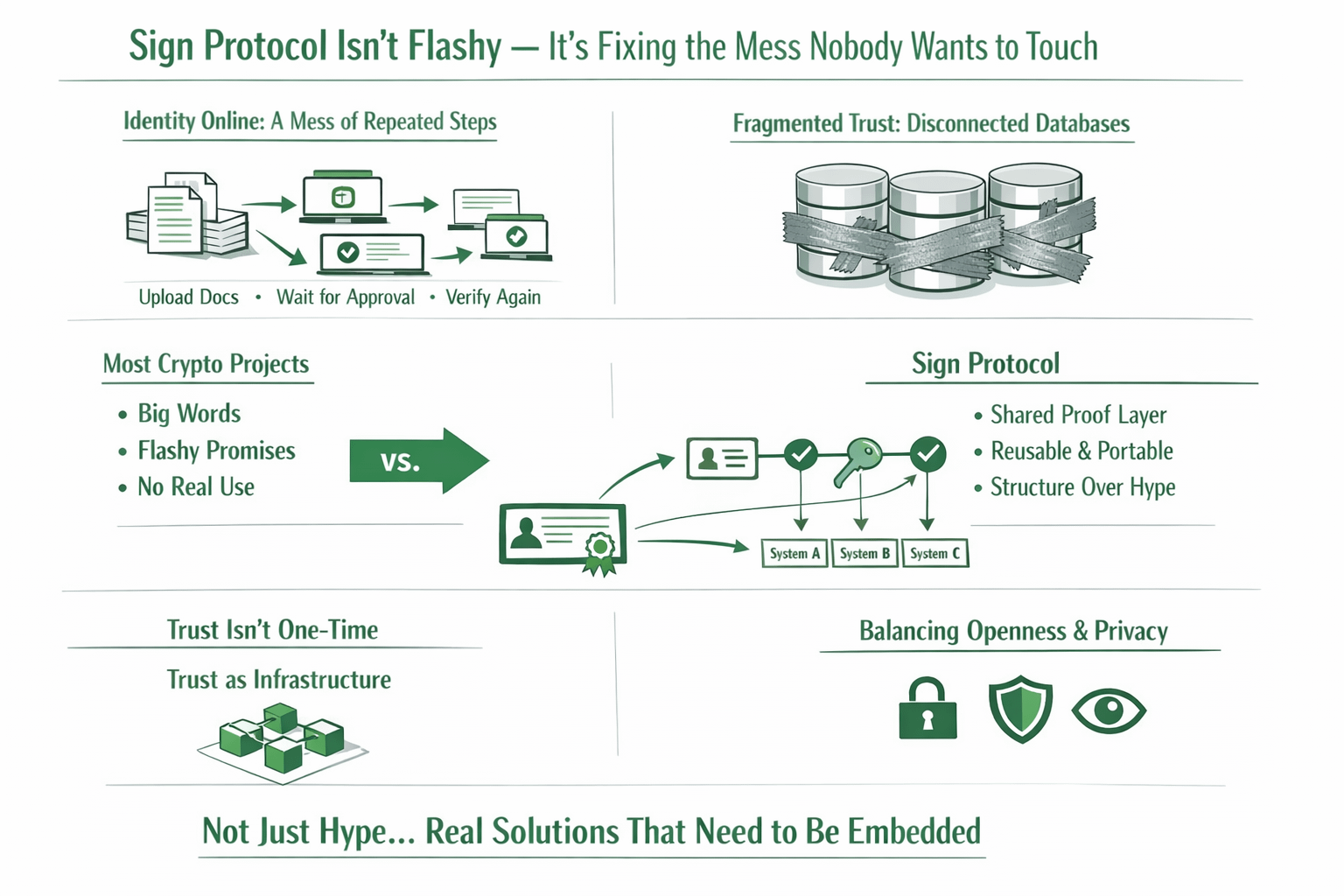
Upload documents. Wait for approval. Do it again on another platform. Then again somewhere else. Same data. Same process. Slightly different UI pretending it’s a new experience.
It’s exhausting.
And it’s everywhere.
That’s the system we’re still living in.
Fragmented records.
Disconnected databases.
Trust that has to be rebuilt every single time.
It’s not just inefficient it’s stomach-turning when you realize how much of it is held together by duct tape and blind faith.
Now here’s the uncomfortable truth.
Most crypto projects don’t fix that.
They just wrap it in better language.
Sign Protocol feels like it’s actually trying to deal with the mess.
Not with noise.
With structure.
The idea is simple… almost annoyingly simple.
Instead of every system building its own way to prove things identity, credentials, ownership, permissions Sign Protocol creates a shared layer where these claims can exist, be verified, and actually move across systems.
That’s it.
No theatrics.
No grand ego trip about “changing everything overnight.”
Just… proof that works.
And honestly, that’s refreshing.
Because proof is the part everyone quietly struggles with.
We talk about decentralization like it’s solved.
We talk about ownership like it’s obvious.
We talk about identity like it’s portable.
It’s not.
Not really.
What I like about Sign Protocol is that it doesn’t pretend otherwise.
It leans into the friction.
Identity is messy.
Verification is messy.
Trust is messy.
And most systems deal with that by adding more layers.
More checks.
More forms.
More delays.
Sign is trying to reduce that not by removing trust, but by making it… reusable.
That’s the key shift.
Not trust as a one-time event.
Trust as infrastructure.
Think about it.
If you prove something once your identity, your eligibility, your credentials why should you have to do it again and again and again?
You shouldn’t.
But you do.
Every day.
That’s the gap Sign Protocol is stepping into.
And it’s a big one.
Now, let me slow down for a second… because this is where most projects start to lose me.
The idea sounds clean. Too clean.
And I’ve seen this story before.
A project identifies a real problem… builds a beautiful framework… and then quietly disappears because nobody actually uses it.
That’s the risk here.
A big one.
Infrastructure doesn’t win by sounding good.
It wins by being unavoidable.
And that’s a brutal test.
Because for Sign Protocol to matter, it can’t just exist.
It has to be embedded.
Inside apps.
Inside workflows.
Inside systems that people rely on without even thinking about it.
That’s where things usually break.
Not at the idea level.
At the adoption level.
I’ve watched too many projects with solid logic just… drift.
Good design.
Smart team.
Clear thesis.
No pull.
So yeah, I’m skeptical.
I always am now.
But there’s something about Sign Protocol that keeps me from dismissing it outright.
It feels… grounded.
The pieces connect.
Schemas define what data should look like.
Attestations record the actual claims.
Verification becomes something you can check without rebuilding the entire process from scratch.
It’s not trying to do everything.
It’s trying to do one thing properly.
And that’s rare.
Most projects start wide.
They want to be everything at once identity layer, payment layer, governance layer, coordination layer…
It’s too much.
It always is.
Sign Protocol feels narrower.
More focused.
Maybe even a little stubborn.
And I like that.
Because stubborn projects tend to survive longer than flashy ones.
There’s also something else here… something quieter.
Sign isn’t just about making systems more frictionless.
It’s about making them more honest.
If something is true, it should be provable.
If something is verified, it should be easy to check.
If something exists, it shouldn’t be trapped in a silo nobody else can access.
That sounds obvious.
But it’s not how most systems work.
Most systems are closed.
Guarded.
Isolated.
Protective of their own version of truth.
And that creates friction.
Endless friction.
Sign Protocol is trying to open that up… without losing integrity.
That balance is hard.
Really hard.
Because the moment you start making data more portable, you run into the other side of the equation.
Privacy.
Control.
Exposure.
Everyone wants verification.
Nobody wants to give up everything to get it.
That’s the tension.
And Sign seems to understand that it doesn’t go away.
It has to be managed.
I respect that.
Still… respect isn’t enough.
Not in this market.
Execution is everything.
I want to see where this actually lands.
I want to see developers building with it.
I want to see real use cases, not just diagrams.
I want to see systems that depend on it not just experiments that try it.
Because that’s the difference.
Between something interesting… and something essential.
Right now, Sign Protocol sits somewhere in between.
It’s not noise.
It’s not hype.
It’s not another polished promise designed to farm attention for a few weeks and disappear.
But it’s not proven either.
And maybe that’s why I keep coming back to it.
Not with excitement.
Not with blind conviction.
Just… curiosity.
Because in a space full of projects trying to look important…
this one seems to understand what actually is.
And that raises a bigger question.
Not about Sign Protocol itself but about the market around it.
Are we actually ready for infrastructure that solves real problems…
or are we still too busy chasing the next story that sounds good for five minutes?