
That’s probably the clearest signal in how $SIGN currently talks about itself.
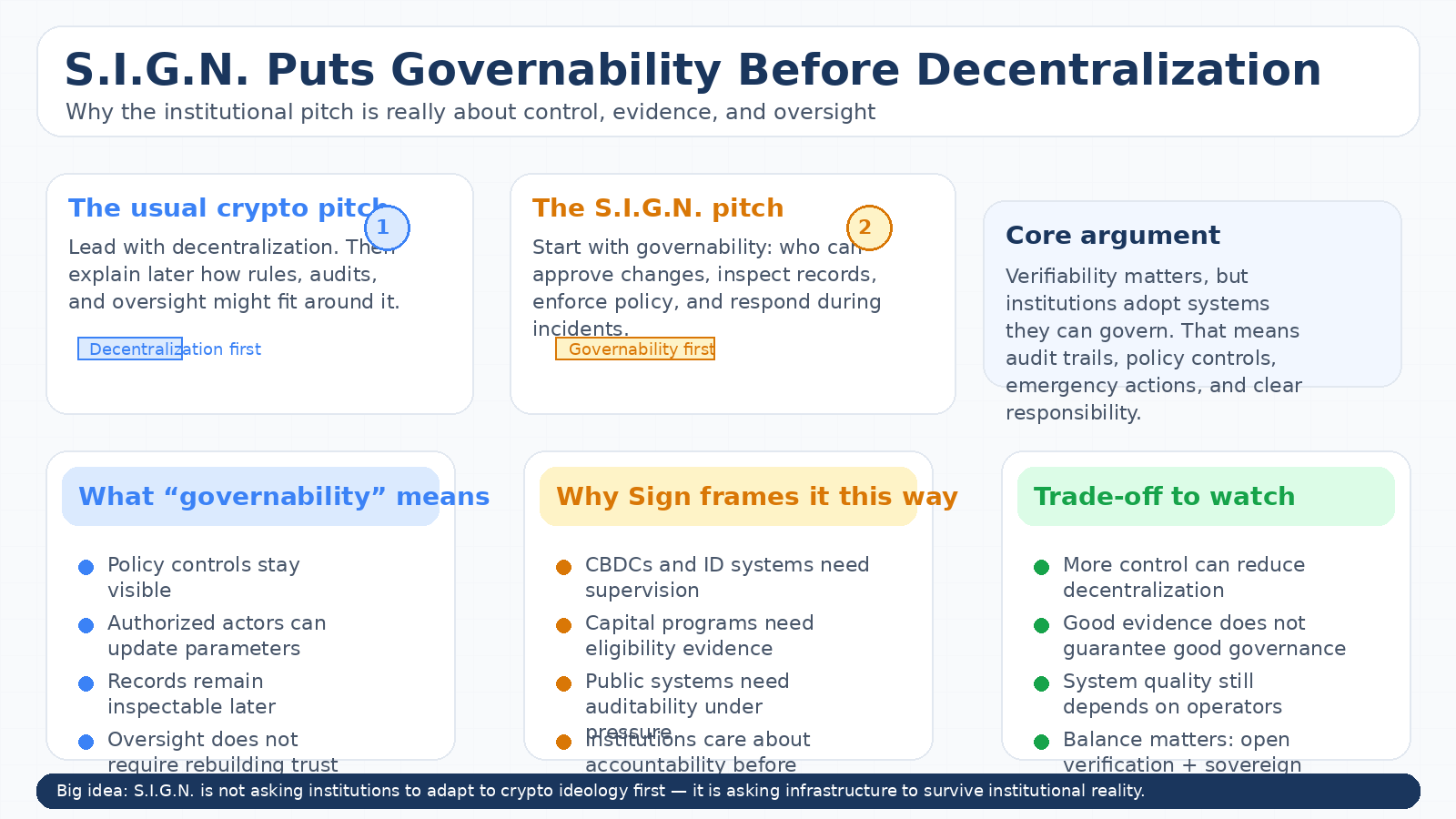
A lot of crypto projects still lead with decentralization as the main headline and then build everything else around that idea. Sign’s framing feels almost the reverse. The docs position S.I.G.N. as “sovereign-grade digital infrastructure” for money, identity, and capital, and then consistently emphasize a different set of priorities: governability, auditability, inspection-ready evidence, operational control, and interoperability at national scale. It’s not anti-crypto language, but it’s definitely not the usual crypto pitch either.
What makes this interesting is that the shift doesn’t seem accidental. The documentation is explicit that S.I.G.N. is “not a product container” but a system-level blueprint designed for deployments that must remain governable, auditable, and operable under national conditions. That choice of wording matters. It suggests they are not trying to persuade institutions to adopt decentralization as a principle. Instead, they are proposing a stack where cryptographic verification remains intact, while policy control, oversight, and emergency intervention also remain possible.
That feels like the real institutional pivot.
Because when you look at use cases like CBDCs, national identity systems, benefits distribution, subsidies, or regulated capital programs, the primary questions are rarely about decentralization in the abstract. The more immediate concerns are: who has authority to approve changes, who can review activity, what rules were applied, and how exceptions are handled when something goes wrong. Sign’s whitepaper leans directly into those questions. It describes mechanisms like government-controlled transaction fee policies, validator whitelists in certain deployment modes, multi-signature governance for protocol changes, parameter adjustments by authorized parties, and emergency controls for incidents. In practical terms, the design allows sovereign operators to retain meaningful control over the system.
This is also where misunderstandings can happen.
If someone approaches Sign expecting a purely decentralization-first narrative, the emphasis on governance can look like compromise. But the intent doesn’t seem to be ideological purity. It’s more pragmatic: an open and verifiable infrastructure where evidence is portable and cryptographic, while still aligning with regulated or sovereign environments. The docs even state that S.I.G.N. is “designed for deployment realities, not ideology,” with support for public, private, and hybrid modes depending on whether transparency or confidentiality is required.
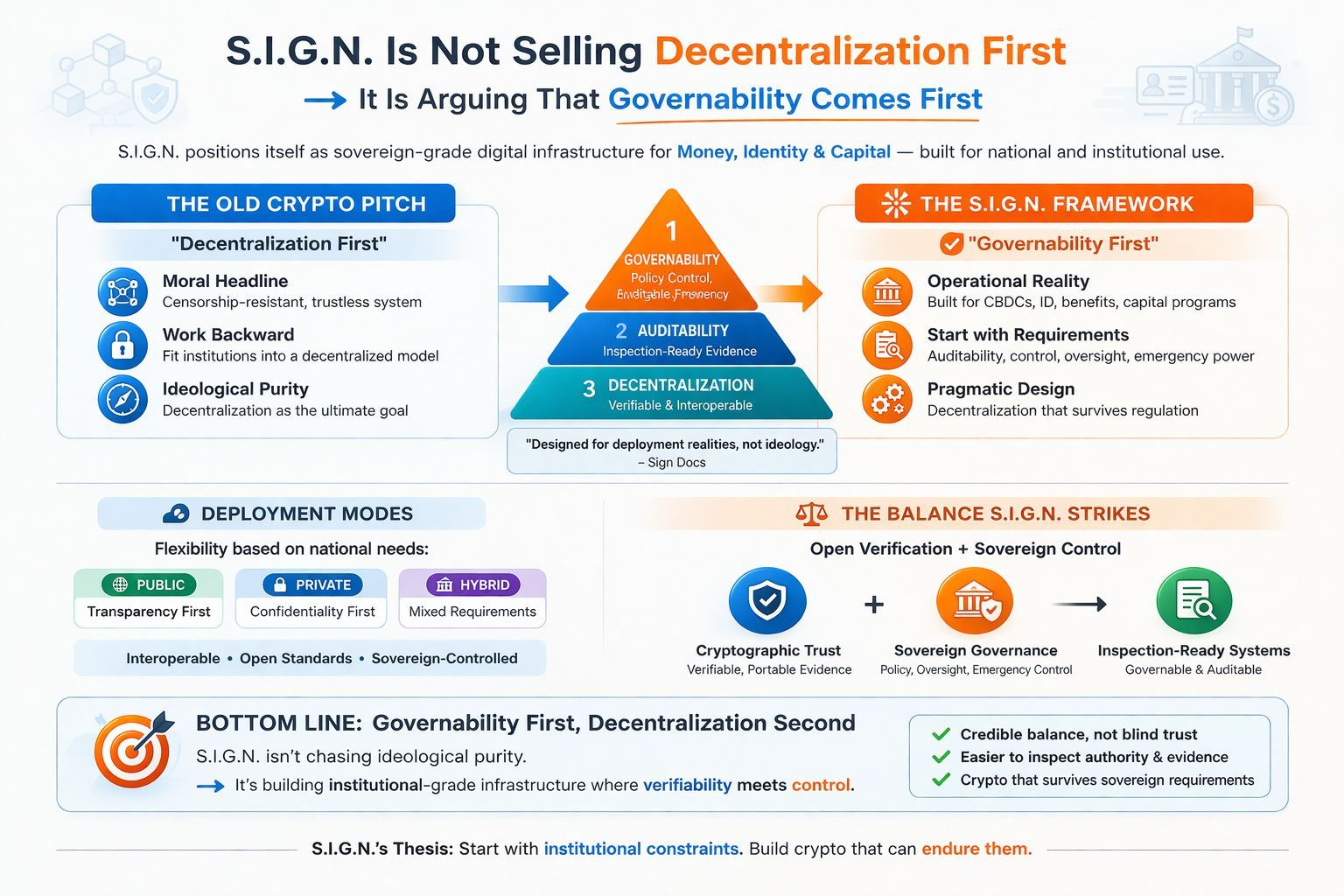
That phrase “not ideology” carries a lot of meaning. It suggests the core challenge isn’t whether a system can be decentralized in theory, but whether it can actually be operated in environments that require supervision, auditing, upgrades, pausing mechanisms, and integration with existing institutions without losing verifiability. In that framing, decentralization is still relevant, but it is no longer the primary selling point. Governability takes the lead.
Their evidence-layer approach reinforces this perspective. Sign Protocol is described as a shared evidence layer built around schemas and attestations, enabling systems to answer questions like who approved a given action, under what authority, at what time, which ruleset applied, and what evidence supported a decision. These are fundamentally institutional questions. The focus shifts from censorship resistance as a slogan to the ability to reconstruct and verify official actions over time.
This is why debates around decentralization can sometimes feel too narrow in this context. If the goal is to provide inspection-ready evidence across identity, financial systems, and capital flows, the more relevant evaluation isn’t whether decentralization is maximized at every layer. It’s whether the system can maintain a workable balance between cryptographic verification and sovereign oversight without turning into a closed or overly centralized platform. On paper, Sign is trying to achieve exactly that: open standards, interoperable components, portable attestations, and governance mechanisms that remain under institutional control.
The challenge, however, is that this balance is easier to describe than to maintain.
As systems rely more on governance controls—such as parameter adjustments, validator permissions, and emergency mechanisms—their effectiveness becomes closely tied to the quality of the institutions operating them. Verifiability can make actions transparent and auditable, but it doesn’t guarantee that governance decisions themselves are optimal or fair. So rather than viewing Sign as “trustless government infrastructure,” it may be more accurate to see it as infrastructure that reduces blind trust by making authority, actions, and evidence easier to inspect and verify.
In that sense, the title still holds.
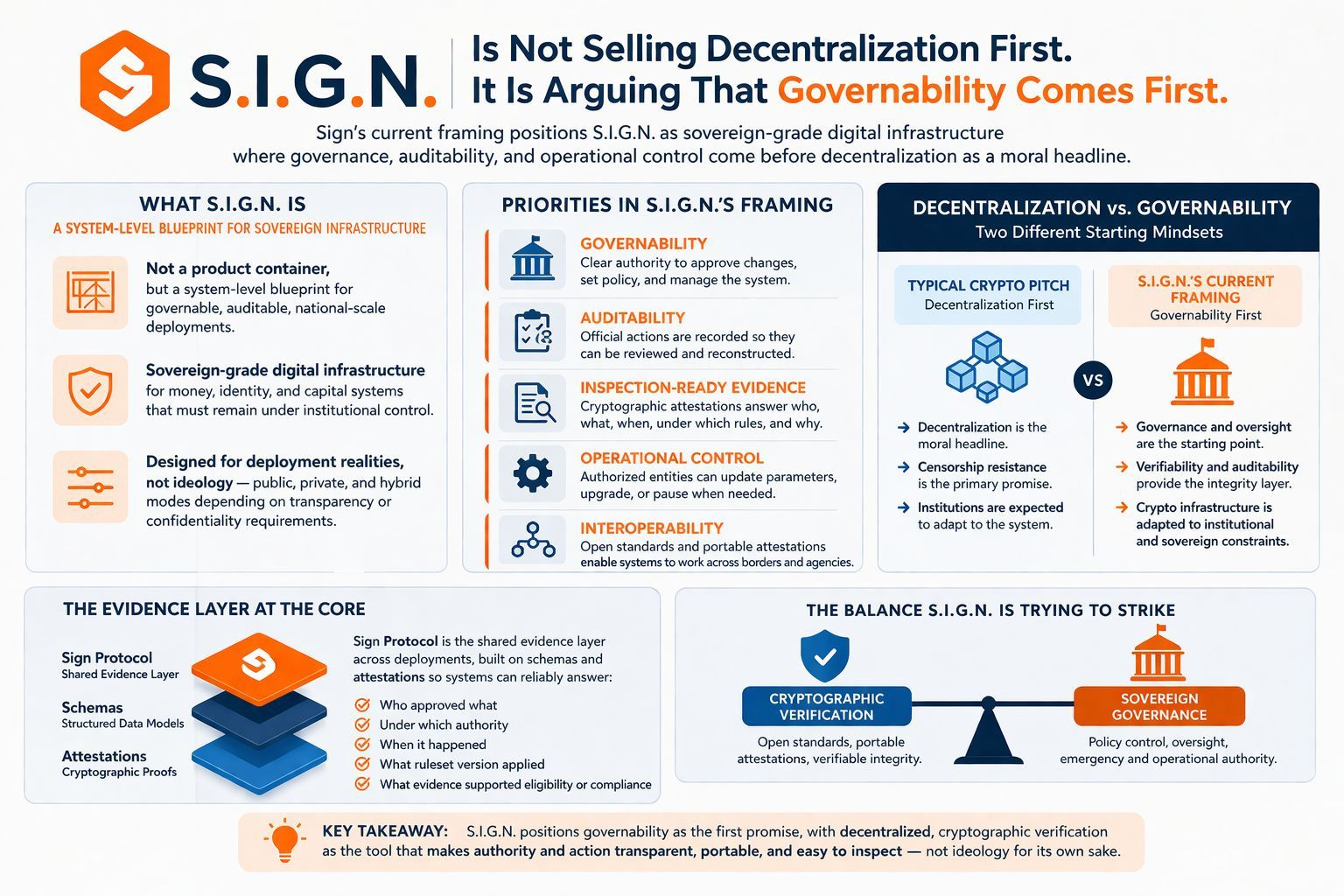
S.I.G.N. does not place decentralization at the center as the primary objective. Instead, it prioritizes control, oversight, and auditability, with decentralization playing a supporting role where it fits. Whether that framing is appealing depends on how someone defines the purpose of blockchain infrastructure in the first place. But the direction of the documentation is fairly clear: it is not starting from crypto ideology and asking institutions to adapt. It is starting from institutional constraints and asking whether crypto infrastructure can operate effectively within them.
When you compare that mindset with systems like Bitcoin($BTC ), which is built around minimizing trust and maximizing decentralization, or Tether Gold ($XAUT ), which relies on asset backing and issuer accountability, S.I.G.N. appears to sit somewhere in between combining cryptographic verification with structured governance. That hybrid positioning is likely what defines its approach moving forward.