
every day starts the same way — unlocking your phone, logging into apps, verifying who you are over and over again. A password here, an OTP there, maybe a document upload if something needs “extra verification.” It feels routine, almost invisible. But if you look closely, it’s a loop of repeating the same proof in slightly different forms.
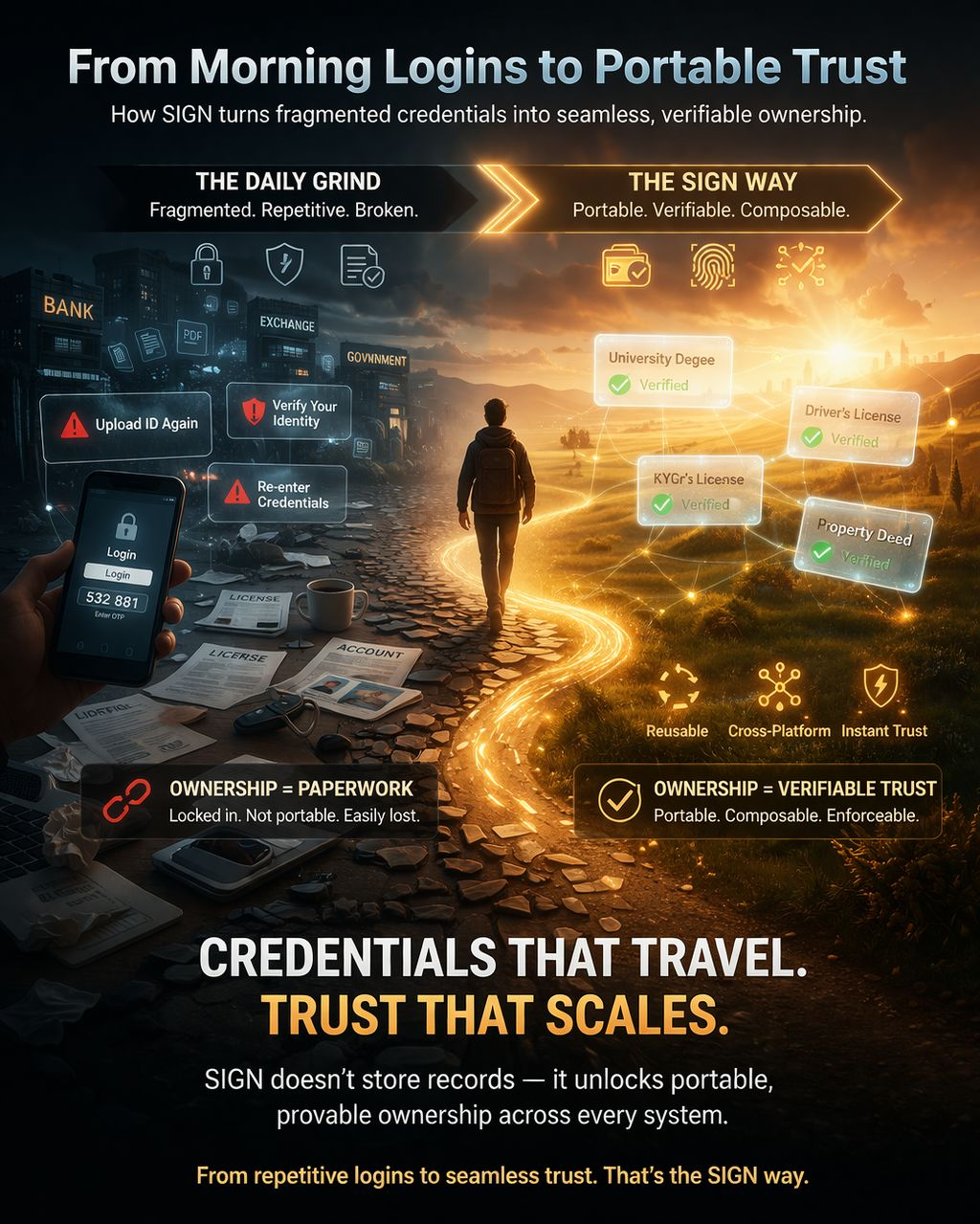
that’s where the deeper question begins.
what is a credential, really
most systems treat it like a static record — something issued, stored, and checked when needed. A certificate, an ID, a license. But in reality, a credential is rarely just a record. It’s a relationship between whoever issued it, whoever holds it, and whoever needs to trust it. And that relationship keeps getting broken every time you’re asked to verify the same thing again.
this is the problem most people notice only in fragments.
you feel it when onboarding takes too long. When platforms don’t “talk” to each other. When ownership ends up meaning nothing more than having access to a file sitting somewhere. Each moment feels small, but together they reveal a system that was never designed for continuity of trust.
ownership, on its own, is just paperwork.
document can say you own something, but only within the system that recognizes it. Step outside that environment, and suddenly it needs to be revalidated, rechecked, or even reissued. Trust doesn’t travel — it resets.
SIGN flips that model.
instead of treating credentials as isolated records, it turns them into verifiable attestations that can move across systems. Not just stored, but reusable. Not just presented, but understood. The shift isn’t just digital — it’s structural. Credentials become something that can interact, connect, and carry meaning beyond where they were created.
and that changes everything.
trust no longer has to restart at every step. A verified credential in one place can be recognized in another, without friction. Over time, this creates a compounding effect — where trust builds instead of breaking.
that’s the real shift SIGN introduces.
It’s not about redefining identity as a fixed label, but as a collection of verifiable proofs that persist across environments. Who you are becomes less important than what can be consistently proven about you.
so those small, repetitive actions in your daily routine?
they point to a much bigger gap.
and SIGN is quietly building toward a world where that gap disappears where credentials stop being static records and start becoming portable, composable trust.