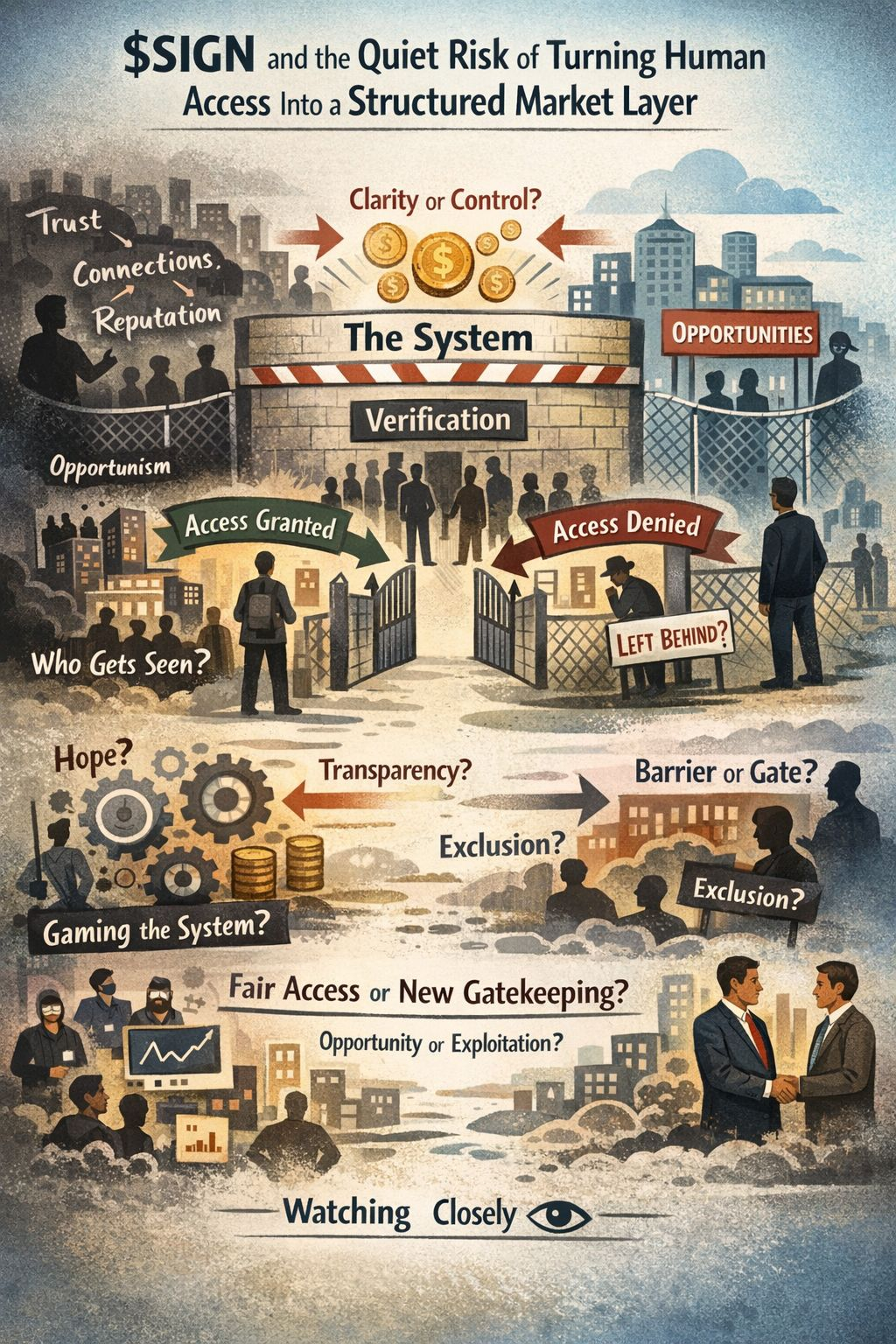
I keep coming back to $SIGN, and maybe that is because the idea lingers longer than it should.
At first, it sounds simple. Verification. Credentials. Distribution. Participation. A system that helps define who qualifies, who can prove it, and who gets access. In a space where most things arrive wrapped in noise, that kind of concept feels unusually clean. Almost rare.
But the more I sit with it, the less simple it becomes.
Because what is really touching is not just infrastructure. It is access. And access has never been as straightforward as systems like to pretend.
In real life, participation is messy. It is shaped by timing, trust, relationships, reputation, and sometimes things people cannot even fully explain. It is not always about whether you technically qualify. Sometimes it is about whether the system sees you. Sometimes it is about whether someone trusts you. Sometimes it is about whether you are known, vouched for, or standing close enough to the right network at the right moment.
That is why I always slow down when I hear ideas like this.
The moment something human gets translated into structure, it changes. Maybe not completely, but enough to matter. A system has to reduce complexity into rules it can understand. It has to sort, define, and draw lines. Who fits. Who does not. Who qualifies. Who stays outside.
That can create clarity.
But it can also flatten reality.
And that is where my hesitation begins.
Because once access becomes structured, it also becomes something people can study, optimize, and eventually game. The moment eligibility starts carrying value, it stops feeling neutral. People begin to treat it like an opportunity. They learn what the system rewards. They shape themselves around it. Some will do that honestly. Others will only learn how to perform the appearance of legitimacy.
That is not cynicism. That is just what happens when incentives enter the room.
Markets do not leave useful systems untouched. They test them. Push them. Stretch them. And over time, they bend them toward extraction if the design is not strong enough to resist it.
So when I look at $SIGN, I am not only asking whether the idea is smart. I am asking whether it stays honest once real behavior starts pressing against it.
Because that is always the real test.
A lot of systems sound fair when they are still ideas. They sound open. Efficient. Rational. But once people start using them at scale, their real shape begins to appear. You start seeing who benefits first. You start seeing who gets left behind. You start seeing whether the structure truly creates clarity or whether it simply builds a cleaner version of the same old barriers.
That is the part that matters to me most.
And I think it matters even more when I think about places like the Middle East.
Access there, like in many parts of the world, has never been purely formal. It often moves through trust, local credibility, relationships, reputation, and an unspoken understanding of how to move inside the social and institutional reality around you. People do not always succeed because they meet written criteria. Sometimes they succeed because they are recognized. Because they are trusted. Because they are connected to the right circles, or because someone inside the system knows exactly where to place them.
So when a system comes in and tries to formalize participation, that can go in two very different directions.
Maybe it creates clarity. Maybe it reduces some of the ambiguity that keeps opportunity uneven, hidden, or difficult to reach. Maybe it gives people a more visible path into systems that were previously hard to navigate. Maybe it makes verification reusable and lowers the quiet friction that so many people deal with when trying to access opportunity, funding, or recognition.
But there is another possibility too.
Maybe it simply replaces one form of gatekeeping with another. Maybe it takes something that was once informal and turns it into something officially inaccessible. Maybe it gives exclusion a cleaner interface. Maybe it makes barriers feel more legitimate just because they are now structured, measurable, and easier to defend.
That is why I cannot look at this as purely good or bad.
There is something real here. I believe that. The idea of making participation clearer, making trust more portable, making access less arbitrary — all of that matters. Too many systems today are still confusing, repetitive, and unfair in ways people have quietly learned to accept. If something can reduce that friction and make the process more transparent, then it deserves attention.
But usefulness is not the same thing as integrity.
A system does not remain fair just because it began with good intentions. It remains fair only if the incentives inside it are strong enough to protect that fairness once pressure starts building. And pressure always comes. Markets bring pressure. Institutions bring pressure. Users bring pressure. The moment people realize there is value in qualifying, proving, or belonging, the whole system begins to bend around that realization.
That is why I am still watching $SIGN instead of rushing to define it.
I do not think the real test is the concept itself. The real test is what happens after people start using it seriously. What happens when edge cases appear. What happens when behavior stops matching the assumptions behind the design. What happens when the system meets ambition, opportunism, inequality, and all the messy instincts that come with real human behavior.
That is when a project like this either matures into something genuinely useful or quietly starts becoming something else.
And I think that is what keeps my attention here.
Not hype. Not branding. Not the polished language around infrastructure.
Just the feeling that this idea touches something deeper than it first appears to.
Because once you start trying to structure participation, you are not just building a tool. You are making decisions about how people move through systems. Who gets seen. Who gets recognized. Who gets access. Who stays outside.
That is not a small shift.
That is the kind of shift that can make systems more fair — or simply make them more efficient at hiding where the unfairness really lives.
So I am not looking at like a simple token story.
I am looking at it like a live question.
Can participation be made clearer without becoming colder?
Can access be structured without becoming more restrictive?
Can a system make things more transparent without turning human complexity into something rigid, gameable, and easier to exploit?
I do not know yet.
But I think that uncertainty is exactly why it is worth watching.
Because some ideas do not reveal what they are when they are first introduced. They reveal themselves when people start relying on them. When incentives begin pulling on them. When reality starts pressing against the edges. That is usually when the polished language falls away, and the true shape of the system finally becomes visible.
Until then, I think the most honest way to look at $SIGN is with interest, but also with caution. Not dismissing it. Not glorifying it either. Just watching closely to see whether it truly expands access, or simply redraws the boundaries around who gets it.
#SignDigitalSovereignInfra @SignOfficial $SIGN