
It is now 0:38, and Lucky🌸 still can't sleep, repeatedly flipping through the already creased paper in hand.@SignOfficial White paper, staring at the Sign Stack series of cold, hard code architecture, only one phrase fills my mind: 'dimensionality reduction strike.'
If you only look at that $SIGN Rev 2.2.0 white paper, Lucky would even have a momentary illusion that Web3 has finally welcomed its 'moment of the gods.' With a steady annual income of 15 million dollars, the cost of a single distribution can be forced down to below 0.1 dollars; this extreme industrial efficiency is simply rubbing traditional finance into the ground. Last year, TokenTable's cumulative unlocking scale surged to the billion-dollar level, covering over 40 million addresses, with top projects like DOGS and ZetaChain all settling on it. This kind of support from ERC-20 to BTC RGB across the entire protocol spectrum, who in the whole circle dares to say it isn't hardcore? Plus, it has an almost terrifying national-level endorsement: official partner of the UAE, CBDC agreement with the Central Bank of Kyrgyzstan, and even the national-level identity infrastructure Singpass, covering over 4 million citizens in Singapore, has completed technological integration.
But this is precisely where Lucky feels a chill down the spine— the more perfect the narrative, the more rigid the rules behind it become.
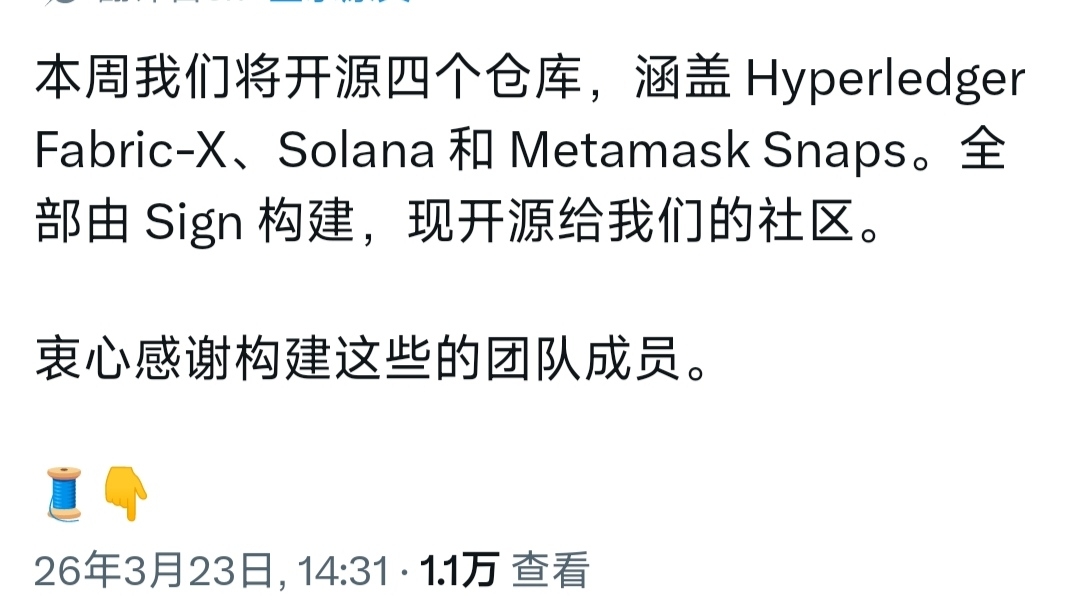
On March 23, 2026, Sign's CTO Jack Xu publicly tweeted, stating: “This week we will open source four codebases, covering Hyperledger Fabric-X, Solana, and Metamask Snaps. All code is built by Sign and is now open source for our community to use.” This tweet looks like charity, but in reality, it is a standard 'technical conspiracy': using the name of open source to lower the defensive mindset of global developers, and through the privacy-focused permissioned chain architecture of Fabric-X, it buries the logic for revocation backdoors in the codebase. This so-called 'strong type constraint' essentially hands sovereign institutions a digital guillotine that can be disconnected at any time. Lucky took a closer look; how can this be simply about providing benefits? This is clearly constructing a fully controllable digital rule, directly welding the verification logic into everyone's interaction terminal through Metamask Snaps.
Ironically, under such grand sovereign endorsement, there are still several issues regarding unlocking calculation errors on GitHub that remain unresolved for a long time. On one hand, it carries national-level credibility, while on the other hand, it can even miscalculate the most basic token unlocking (Vesting) logic; this extreme disconnect leaves Lucky feeling a sense of coldness. Reflected on the market, the price oscillates around $0.03, with single-day retracements approaching 30%, and in 30 days, it gives you an illusion of a 35%+ rebound with $SIGN. This market value management tactic is so sophisticated it takes your breath away, and such rebounds are often a prelude to liquidity withdrawal; the blade of the game is already pressed against the throat.
And then there's the community reward distribution, where everyone is currently focused on the 1,968,000 token reward pool from CreatorPad, calculating the small accounts for the rewards to be distributed on April 22, yet few see the risk black hole behind the 40% community token dilution. Many still cannot see the digital economic ledger hidden within! Simply put, the essence of Sign Stack is an extremely seasoned financial operation logic cloaked in sovereign clothing. Lucky did the math: supporting 5 chains costs only about $1.5-3 million a year, yet it aims to harvest a global entry fee in the tens of millions; this information asymmetry is extremely cold.
I'm not being contrary, just been through too many pitfalls, and I must stay vigilant! For this situation, Lucky only has four words of advice for himself: 'reverse game strategy'.
First of all, absolutely do not blindly bet at such key points like $0.03. The main players can wash out a 30% amplitude, which is just to fish for your stop-loss points. In terms of operation, you can participate in tasks with relatively strong certainty like CreatorPad to earn rewards, but before the massive unlocking of 400 million tokens on April 15, you must secure your profits. The suggestion is: treat $SIGN as a purely 'arbitrage tool' rather than a 'long-term belief'. Since they want to use 2 million rewards to buy activity, then sell them activity, but do not stake your capital on their flawed code logic.
But I plan to invest in the bottom position at Sign0.02, as I have also seen that aside from these cold calculations, the ambition of Sign Stack has indeed opened up a new path. It turns the ethereal consensus of Web3 into tangible tools for sovereign nations. Jack Xu has thrown four core codebases to the community, perhaps also betting: when technology is no longer a secret, when global developers participate in this 'sovereign game', can this enormous device spark a truly inclusive new digital order that we have yet to perceive amidst the tension between power and freedom?
Note: The above analysis and strategy are solely personal opinions and do not constitute any trading advice!#Sign地缘政治基建
Lucky still says: rational observation, the risk is greater than the sky. Don't wait until you become the unfortunate one eliminated by the revocation logic before remembering to scrutinize the sharp edges in these codes. In this digital sovereign logic encirclement, if you cannot see through its operational essence, you will be the cost in its next unlocking cycle. But from another perspective, this coin wrapped in layers of sovereign endorsement has never shown its other side before rolling to the ground. Will it become a shackle of power or the cornerstone of a new order? The key is now in the community's hands, let's see how this grand play unfolds.