

First off, these guys aren't idiots. They aren't trying to murder Web2 identity. That’s where most of these "purist" projects fall on their face—they come in with this "burn the KYC databases, free the digital soul" energy. Nah. SIGN looks at the dumpster fire and realizes the verification already exists. Your university already checked your degrees. Coinbase already KYC’d you. Your job already vetted you. The problem isn’t creating "new" truth—it’s moving the proof you already have onto a chain without some middleman taking a cut or snooping through your business.
I respect that. It’s honest.
The Strategy: Cryptographic Sticky Notes
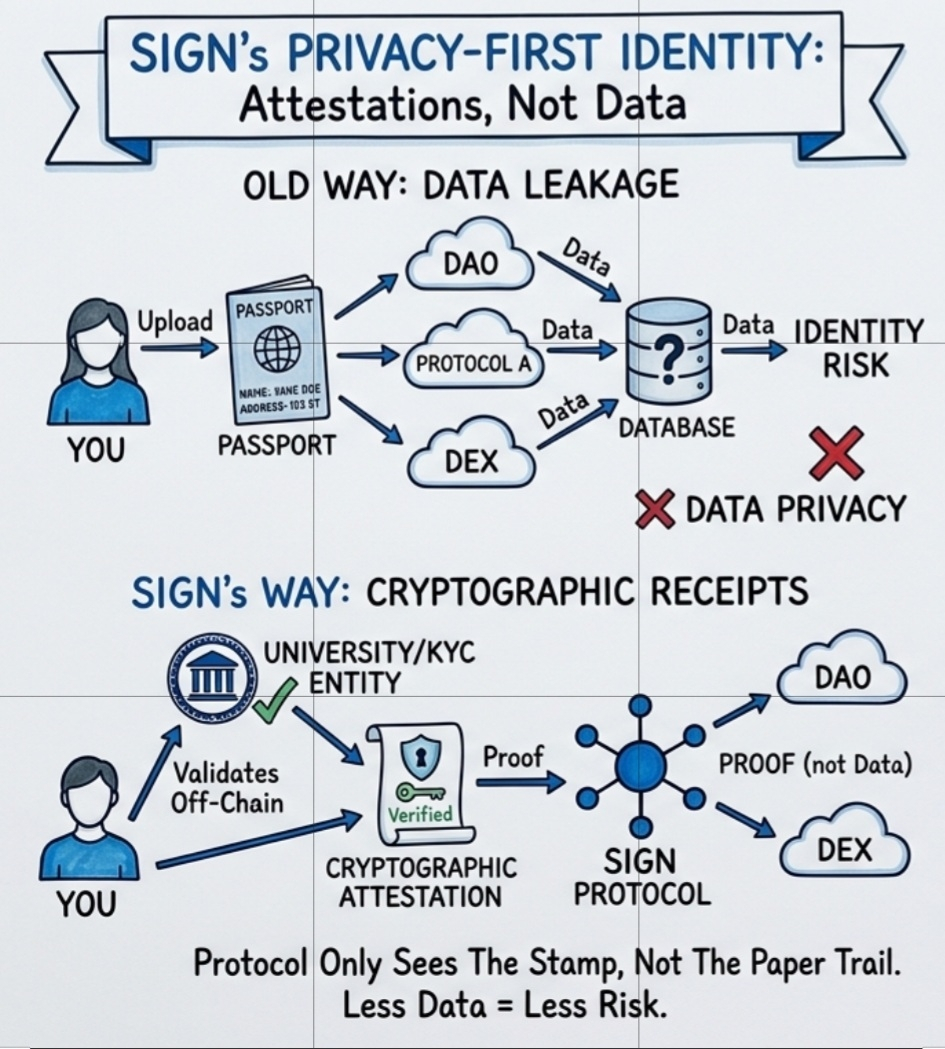
Here’s the move: They don’t store "you." They store attestations. Think of them as small, sharp claims: "This person passed KYC." "This person graduated." It’s not your home address or your mother’s maiden name. It’s just a little cryptographic sticky note saying someone credible vouched for this specific fact. Suddenly, you aren't leaking data every time you log in; you’re just carrying receipts.
And the KYC part? This is where it gets interesting. Most platforms make you upload your passport until your hands bleed. SIGN flips the script: verification happens off-chain, and only the result hits the ledger. Instead of handing your docs to ten different protocols, one trusted entity says "yep, they’re legit," and that’s it. The world sees the stamp, not the paper trail.
The Reality Check: Who Do We Actually Trust?
But now we hit the wall. The real one.
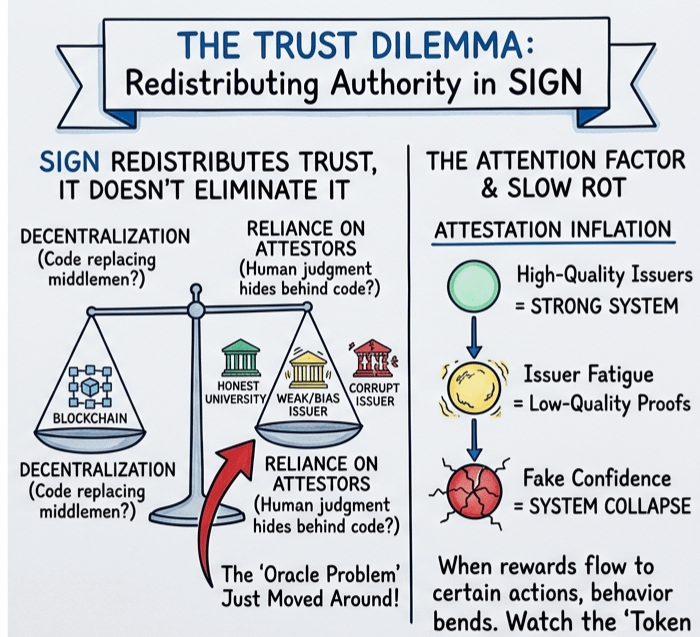
SIGN doesn’t kill trust; it just moves it around. If an attestor is weak, biased, or just plain corrupt? The whole system tips over. You haven't solved the "oracle problem"—you’ve just dressed it up in better clothes. I’ve seen too many projects pretend that math replaces human judgment. It doesn't. It just hides the human mess behind a wall of code.
Where it Actually Works
Don't get me wrong, the use cases are legit:
On-Chain Education: Universities issuing graduation proofs that can't be faked.
Real Reputation: Instead of a vague "DAO contributor" badge, you have proof you shipped this feature or voted on that proposal. That’s precise.
The Airdrop Killer: This is how you fight the bots. You don't count wallets; you check for actual human receipts. That’s sharp.
The "Slow Rot" and the Invisible Filter
But let’s look at the cracks. I’m talking about attestation inflation. If issuers start handing out proofs like candy because they’re lazy or incentivized, the system fills with fake confidence. When everyone is "verified," verification means absolutely nothing. It’s a slow rot I’ve seen kill a dozen reputation systems before this one.
And here’s what keeps me up at night: SIGN doesn't just reflect truth—it shapes it.
Before you can verify anything, it has to fit a "schema." A mold. If your life experience doesn't fit into a tidy data structure, it basically doesn't exist to the protocol. That’s not neutral; it’s a filter. The real world starts twisting itself to fit the code, not the other way around. People stop asking "What’s true?" and start asking "What can I prove to the machine?"
The Human Cost
The Frozen Ghost: The blockchain doesn't forget. But humans grow and change. Your on-chain identity might end up being a frozen ghost of who you were three years ago—permanent, immutable, and totally wrong.
Invisible Centralization: Power hasn't vanished. It’s just hidden inside the people who design the schemas. Whoever decides what "counts" as a valid proof is the one holding the leash.
The Unprovable: What happens to intuition? To the "gut feeling" of a veteran dev? If it can't be turned into a boolean yes/no attestation, it becomes invisible.
The Bottom Line
I’m not saying SIGN is bad. I’m saying it’s powerful. And any power that decides what "counts" as truth needs eyes on it 24/7.
SIGN isn't a revolution; it’s a bridge. But a bridge is only as good as the land it's built on. I’m going to keep watching, because this isn't just about code—it’s a mirror. And I want to see whose face is looking back at us from the other side.
$SIGN @SignOfficial #SignDigitalSovereignInfra
