
I still remember the first time I signed something on-chain without really thinking about it.
It was just another approval. A quick click, a wallet popup, a signature that felt routine. Nothing broke, nothing looked suspicious. The app worked exactly as expected.
But later, when I went back and tried to understand what I had actually authorized, I noticed something uncomfortable.
I was not interacting with something fixed. I was interacting with something that could change.
That realization now sits at the center of how I think about protocols like Sign Protocol, and more broadly, anything built on upgradeable proxies.
Most users never notice proxies. From the wallet side, everything looks static. Same contract address, same UI, same flow. You come back a week later and it behaves slightly differently, maybe a new feature, maybe a new permission request, maybe nothing obvious at all.
But underneath, the logic you are interacting with might not be the same code you originally trusted.
That is the quiet tradeoff.
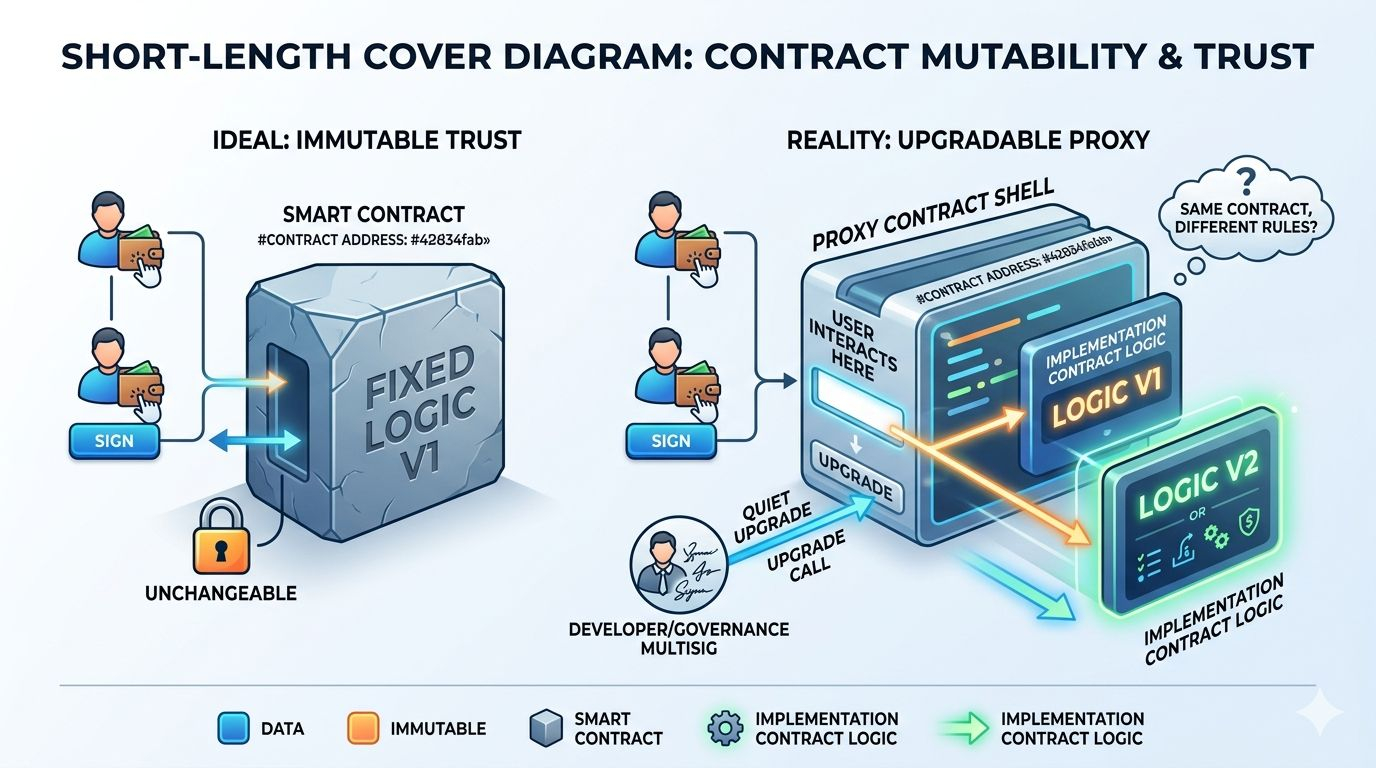
Smart contracts were originally framed as immutable, almost like digital stone. Once deployed, no one could change them. That idea shaped early trust. You could inspect the code, verify it, and feel confident it would not shift later.
But immutability turned out to be impractical. Bugs exist. UX needs improvement. Systems evolve.
So developers moved toward proxy patterns. The contract you interact with becomes a shell, and the actual logic can be swapped behind it.
From a user perspective, nothing changes. From a control perspective, everything does.
In a typical proxy setup, the contract you send transactions to stores your data and forwards your actions. The real logic lives elsewhere, and that logic can be replaced by whoever controls the upgrade key.
So when you trust a contract, you are often not trusting code. You are trusting whoever can upgrade that code.
This is where something like Sign Protocol becomes interesting.
On the surface, it feels like a simple primitive. Attestations, identities, structured data, signatures. You sign something, it gets recorded, and that is it.
But if the system underneath uses upgradeable proxies, then the rules of what that signature means can evolve over time.
Not by changing the stored data, but by changing how it is interpreted and used.
Most users do not think about this. They think in terms of actions, not architecture. They think, I signed this, so it exists.
They do not think, the contract processing this signature could behave differently tomorrow.
This gap between user perception and infrastructure reality shows up everywhere in DeFi.
When I use a $DEXE , I think about slippage and execution speed. When I approve a token, I just want the transaction to go through smoothly.
That is why centralized exchanges still feel easier. Not because they are more advanced, but because the mental model is simple. You trust the platform. That is all.
In DeFi, we replaced one type of trust with another, but we did not make it easier to understand.
Upgradeable proxies introduce soft mutability. The contract address stays the same, so everything looks stable. But behavior can change, and the trust surface shifts over time.
The uncomfortable part is that these changes are mostly invisible unless you actively monitor them.
There is no natural UX layer that tells you the logic behind this contract was upgraded yesterday, and your previous approvals now interact with new code.
Technically, everything is transparent on-chain. Practically, almost no one checks.
Even experienced users rely on habits. You interact with something a few times, it works, and that familiarity becomes your trust layer.
Not the code itself.
This is how proxies quietly reshape behavior.
They let developers iterate. Bugs get patched, features get added, flows improve. Without proxies, many protocols would feel outdated quickly.
But for users, it creates a moving target.
When you sign something in a system like Sign Protocol, you are not just interacting with a static system. You are participating in something that can evolve.
That does not make it unsafe. It just means the trust model is different from what most people assume.
The real issue is visibility.
Wallets do not explain upgradeability. They show contract addresses and signatures, not governance structures or upgrade permissions. They do not tell you who can change the logic or how quickly it can happen.
So users fall back on simple signals.
If the UI looks clean, if the brand feels familiar, if the transaction succeeds, they assume it is fine.
This mirrors behavior in centralized systems, but without the same safety nets.
In a way, upgradeable proxies bring DeFi closer to Web2 patterns than many would like to admit.
There is still an operator, even if it is a multisig or DAO, that can change the system.
The difference is that this power is encoded on-chain instead of hidden on servers.
But from a user perspective, what matters is control.
Who can change the rules, how fast, and how visible that process is.
In many proxy systems, a single function can update the entire logic of a protocol. That is efficient, but it concentrates power in a way most users never consider when they click sign.
And this loops back to behavior again.
Users do not optimize for decentralization in practice. They optimize for smoothness. Fewer clicks, faster confirmations, less thinking.
That is why abstractions keep growing. Session keys, account abstraction, relayers.
Upgradeable proxies sit in the same space. They improve usability, but they also move control further away from what the user can see.
I have started to think of this less as a security issue and more as a visibility issue.
If users could clearly see, at the moment of interaction, who controls upgrades, what has changed recently, and what permissions are active, the mental model would shift.
But today, most of that context is hidden in explorers, audits, or governance threads that very few people read.
So people default to trust.
And trust, in crypto, was supposed to be minimized.
There is an irony here. As infrastructure becomes more advanced, the experience starts to resemble the systems crypto was meant to replace.
Not because of bad intent, but because complexity has to be managed somehow.
Proxies, including those behind systems like Sign Protocol, are part of that management layer.
They solve real problems. They also introduce new ones, mostly around perception and control.
Avoiding them is not realistic. Without upgradeability, most protocols would either break or stagnate.
But it does change what it means to trust code.
It is no longer about verifying something once. It is about understanding who can change it over time, and how often that happens.
And most of us do not track that.
We just sign, interact, and move on.
Maybe that is fine. Maybe that is what adoption looks like.
But it does make me pause sometimes, especially when something feels routine.
Because underneath that routine, the system is not as fixed as it appears.
It is more like a surface that stays still while the structure below keeps shifting.
And most of the time, we do not notice.
CRT kal ke beech mein, $BTC aaye coin.
@SignOfficial #SignDigitalSovereignInfra
