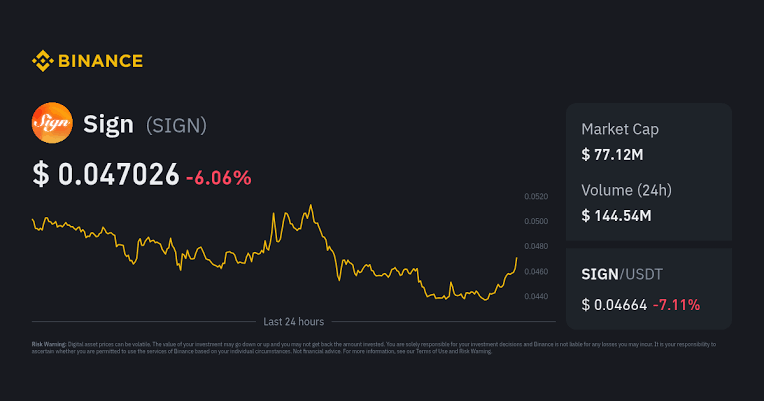
$SIGN At the heart of this transformation is @SignOfficial (SIGN), an omni-chain attestation infrastructure that is quietly becoming the "World’s Notary." As we look at its current market status and long-term potential, it’s clear that SIGN is moving far beyond being just another crypto token—it is building a global public infrastructure.
1. Current Market Status (March 2026 Update)
As of late March 2026, the @SignOfficial token is navigating a period of healthy consolidation.
Current Price: Approximately $0.032 – $0.041 (depending on the exchange and liquidity pair).
Recent Volatility: The token recently faced a "supply shock" due to a 100 million token unlock event. While such events often cause temporary price dips as early investors liquidate, the market has shown strong "buy-the-dip" behavior.
Support & Resistance: $SIGN is currently holding a firm base at the $0.030 level. A successful hold here, combined with the launch of the Orange Basic Income (OBI) staking program, suggests that the bottom is likely in, with analysts eye-ing a move toward the $0.08 resistance zone by Q3 2026.
2. What Exactly is SIGN Protocol?
Unlike many projects that focus solely on finance,
@SignOfficial about Data Integrity. It allows anyone—individuals, companies, or governments—to create "Attestations." These are cryptographically signed proofs that a piece of information is true.
Key Components include:
EthSign: The world’s first on-chain electronic signature dApp, making digital contracts legally binding and tamper-proof.
TokenTable: A sophisticated platform for managing token distributions, vesting, and airdrops, ensuring that "promises" made by crypto projects are hard-coded and verifiable.
SignPass: A decentralized identity (DID) system that allows you to prove your credentials (like a degree or a work permit) on-chain without revealing sensitive personal data.
3. Future Scope: The Road to 2030
The future value of SIGN is not tied to hype, but to Utility. In a world where AI-generated "deepfakes" are becoming common, the need to verify what is real is reaching an all-time high.
Short-Term (2026-2027): Institutional Adoption
By the end of 2026, the project aims to finalize several Sovereign Nation partnerships. Currently, projects in Kyrgyzstan and Sierra Leone are testing SIGN for national identity and CBDC (Central Bank Digital Currency) infrastructure. If these go live, the demand for $SIGN as a "Gas" fee for every national-level attestation could drive the price toward $0.15.
Long-Term (2028-2030): The Global Standard
By 2030, the goal is for SIGN to be the universal standard for digital verification.
Price Potential: Bullish estimates suggest a range of $0.35 to $0.50 if SIGN becomes the backend for global supply chain certificates and healthcare records.
The Deflationary Angle: As the protocol processes millions of attestations daily, a portion of the fees is designed to be "burned" or redistributed to stakers, reducing the effective supply over time.
4. Strategic Summary for Traders
For someone focused on achieving a one lakh monthly income, SIGN represents a "Mid-to-Long Term" play.
Staking is Key: Participating in the Orange Basic Income program allows you to earn passive rewards, helping you reach your income targets even during sideways market movement.
Watch the Unlocks: Always track the vesting schedule. Buying after a major unlock (like the one we just saw) is historically the most profitable entry point.
Conclusion: SIGN Protocol is more than a coin; it is the Trust Layer of the Internet. While memecoins like PEPE offer quick thrills, SIGN offers the structural stability of a project that is solving a trillion-dollar problem: Digital Honesty.
#SIGN
@SignOfficial @sign #SİGN #BitcoinPrices #BTCETFFeeRace