✔️ A person contacted me personally.
✔️ I shared my real trading pattern.
✔️ I discussed this with him as a mini-session.
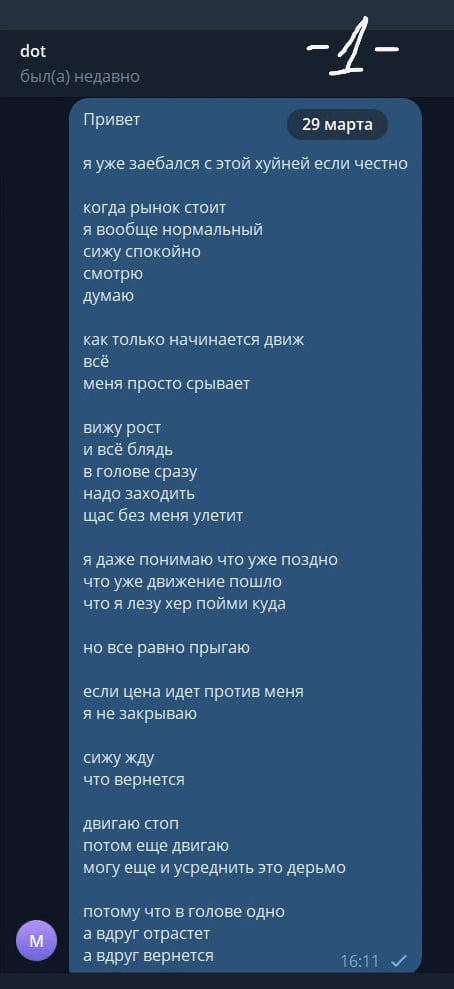
✔️ Look at what he writes.
✔️ While the market is standing → he is calm.
✔️ Sits. Watches. Thinks.
❗ As soon as the movement starts → he gets disrupted.
❗ Sees growth → in his head immediately:
**"you need to enter. now it will take off without me"**
❗ And this is already the first problem.
❗ Because at that moment his analysis ends
and the reaction to the impulse begins.
✔️ He understands himself that it is already late.
✔️ Understands that the movement has already started.
✔️ Understands that he is not entering the point but chasing.
❗ But still jumps into the deal.
❗ Here is where his failure lies.
❗ The problem is not that he doesn't know the market.
❗ The problem is that he doesn't keep himself in the moment.
❗ Further is even more important.
❗ If the price goes against him → he does not close.
✔️ He is waiting.
❗ Then he moves the stop.
❗ Then he moves the stop again.
❗ Sometimes he also averages the position.
✔️ Why.
❗ Because he does not accept the loss.
❗ For him, a loss → is not a working part of trading.
❗ For him, a loss → is something that needs to be urgently canceled, corrected, waited out, pulled back.
❗ That is, he is no longer trading the situation.
❗ He starts to struggle with the fact that he was wrong.
❗ And this is no longer about the market.
❗ This is about the psyche within the deal.
✔️ Next is the next block.
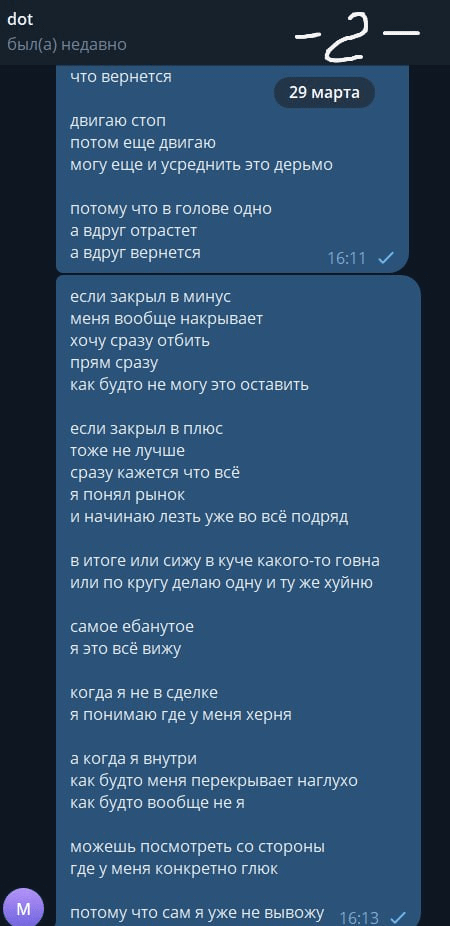
❗ If he closed in a loss → he is overwhelmed with the desire to recoup immediately.
❗ Immediately.
❗ Without a pause.
❗ Without cooling.
❗ Without returning to logic.
❗ That is, his next deal opens not because a signal appeared.
❗ And because he cannot withstand the state after a loss.
❗ This is a very important point.
❗ He is not trying to earn.
❗ He is trying to remove the internal tension.
✔️ Now the other side.
❗ If he closed in profit → not better either.
❗ Instead of normal fixation, he catches the feeling:
**"I understood the market"**
❗ And after that, he starts to rush into everything.
❗ That is, the plus does not stabilize him either.
❗ Plus accelerates him.
❗ A loss → breaks.
❗ Plus → inflates.
❗ And in both cases, he has no control.
✔️ I laid this out for him directly.
❗ Your cycle looks like this:
market movement → impulse → entry without conditions →
if against you → hope, moving the stop, averaging →
if closed a loss → desire to recoup →
if closed in profit → the illusion of control → new chaotic entry
❗ And this cycle gets stronger each time.
✔️ What is essentially here.
✔️ Trigger → market movement.
✔️ Automatic thought → **"now it will take off without me"**
✔️ Impulse → urgently enter.
✔️ Behavior → entry without conditions, ignoring the stop, moving the stop, averaging.
✔️ After → a loss causes the desire to recoup, a profit causes a reevaluation of oneself.
❗ The result → the cycle is closed.
❗ This is no longer just an entry mistake.
❗ This is a connection:
✔️ FOMO → the fear of missing the movement
✔️ avoidance of losses → refusal to accept a loss
✔️ the illusion of control → after one successful deal
✔️ dependence on movement → a constant urge to do something when the market comes alive
✔️ Now what I essentially told him.
❗ You have a real glitch not in the market.
✔️ The first.
❗ You have no pause between the impulse and the action.
❗ You see the movement → and immediately act.
❗ You have no filter.
❗ There is no interval where you can stop yourself and check what is happening.
✔️ The second.
❗ You have no pre-fixed scenario.
❗ You are not trading a plan.
❗ You are not waiting for your zone.
❗ You are not working by condition.
❗ You react to the fact that the price has already started to move without you.
✔️ The third.
❗ The stop for you does not exist as a rule.
❗ The stop for you → is an opinion.
✔️ And the opinion can be changed.
✔️ Move.
✔️ Justify.
✔️ Blur.
❗ Until the stop becomes a law, you won't have a system.
✔️ The fourth.
❗ A loss is perceived by you as a threat.
❗ You don't tell yourself:
**"this is part of the work"**
❗ You tell yourself:
**"this shouldn't have happened"**
❗ And then you start to fight not with the market, but with your own pain.
✔️ The fifth.
❗ Your profit turns into an illusion of control.
❗ Caught a profit → and immediately the feeling that the market is clear.
❗ And here begins the second wave of mistakes.
❗ That is, you are breaking not only from the loss.
❗ You are breaking and the profit too.
✔️ Further, I gave him not philosophy.
✔️ Not motivation.
✔️ Not an abstraction.
✔️ I gave specific rules.
✔️ The first rule.
❗ Between the desire to enter and the entry itself → a pause of 2–3 minutes.
❗ Not a second.
❗ Not "I already understood."
❗ Namely, a pause.
✔️ In these 2–3 minutes you must answer yourself 4 questions:
→ Where's the level?
→ Where's the stop?
→ Where's the cancellation of the idea?
→ Is there confirmation?
❗ If there is no clear answer to at least one question → entry is prohibited.
❗ Not "undesirable."
❗ Not "better not to."
❗ And **is prohibited**.
✔️ The second rule.
❗ If the movement has already started → you are late.
❗ This is key for him.
❗ Don't chase the price.
❗ Don't jump into an already ongoing impulse just because you're scared of being left without a deal.
✔️ The phrase I gave him:
**"if the movement has already started → I am not in this deal"**
✔️ The third rule.
❗ The stop → is the law.
❗ If the price hit the stop → the idea is dead.
❗ The market is not bad.
❗ Not someone knocked him out.
❗ Not "I'll wait a little longer."
❗ The idea has ended.
✔️ What is prohibited:
→ move the stop
→ remove the stop
→ averaging a losing position
→ sitting with the thought "what if it comes back"
✔️ The fourth rule.
❗ After a loss → pause at least 30–60 minutes.
❗ No pullback.
❗ No attempt to immediately recoup the loss.
❗ No "I'll go in carefully now and return."
✔️ The thought he must instill:
**"the next deal has nothing to do with the past"**
✔️ The fifth rule.
❗ After a profit → also a pause.
✔️ This is unexpectedly for many.
❗ But it is precisely after a profit that he starts to accelerate.
❗ Therefore, after profit, you also can't rush in.
✔️ The thought here is this:
**"one successful deal does not mean that I understood the market"**
✔️ The sixth rule.
❗ One entry → one scenario.
❗ Without additions for emotions.
❗ Without averaging.
❗ Without trying to "improve the price" when in fact you just don't want to admit a mistake.
✔️ The seventh rule.
❗ Your task in the market → is not to search for where to enter.
❗ Your task → to filter.
❗ This is one of the main setups for such states.
✔️ You are not obliged to participate in every movement.
✔️ Missed profit → not a loss.
✔️ A loss → part of the system, not a catastrophe.
✔️ An impulse → is not a signal.
❗ The picture also came out harsh for him.
❗ It is clear that at the moment of the deal he is not managing the emotion → he is in it.
❗ That is, the reaction goes in a childlike way: saw → wanted → did.
❗ You can see the illusion of clarity there.
✔️ Here's the moment when it seems:
**"well, everything is already clear here"**
❗ And it is precisely at this moment that he breaks.
❗ Then you can see one more thing.
❗ He trades not the situation in his head, but the result.
❗ Not the structure of the deal.
❗ Not conditions.
❗ And the feeling:
**"now I'll enter and it will be good"**
❗ Then the illusion of control kicks in.
❗ He thinks he is keeping the process under control.
❗ But if a person moves the stop and averages the loss → he has no control.
❗ It is also clear from the layout that there is insatiability.
❗ He is not satisfied just to make one normal deal.
❗ He needs more.
❗ That's why after one profit he starts to be carried further.
❗ And the most important.
❗ There it is clearly visible the fear of admitting a mistake.
❗ Not the loss itself.
❗ Namely the internal:
**"I was wrong"**
❗ That's what he runs away from.
❗ Therefore, he doesn't cut losses.
❗ Therefore he pulls.
❗ Therefore, he moves the stop.
❗ Therefore, he adds to a bad deal.
❗ And the exit is also shown very clearly.
❗ Not inside the deal.
❗ Not after a loss.
❗ Not after a series of mistakes.
❗ And **before action**.
❗ That is, the only point where he can really save himself → is the moment before entry.
❗ Not inside chaos.
❗ And before the first click.
✔️ If to summarize his situation briefly.
✔️ He has no strategy problem as such.
✔️ He has no problem understanding the market outside the deal.
❗ He has a different problem.
❗ He stops being a trader at the moment of movement
and becomes a person in a state.
✔️ In a state:
→ greed
→ fear
→ illusions of control
→ the desire to urgently do something
❗ And until this is fixed, the result will not change.
❗ Not new signals.
❗ Not new indicators.
❗ Not new coins.
❗ Not new strategies will save here.
✔️ If you are reading this now and understand that you are doing the same
→ you jump into the movement
→ you don't cut losses
→ moving the stop
→ want to recoup after the loss
→ you accelerate after a profit
then the problem is no longer in the strategy
you have a failure in behavior
and it is THIS that drains your results
I work with such situations.
I break this down in detail and step by step.
If such a breakdown is needed → ❗ Write: BREAKDOWN
MY CHANNEL → through the profile: @INVESTIDEAUA
#ОбучениеТрейдингу #CryptoTrading #CryptoStrategy #RiskManagement .