
programmable subsidies sound like a governance improvement story. and in many ways they are. but the more i read through the @SignOfficial New Capital System documentation the more i think the interesting question isn’t what the system can do. it’s who gets to define the conditions under which it does it.
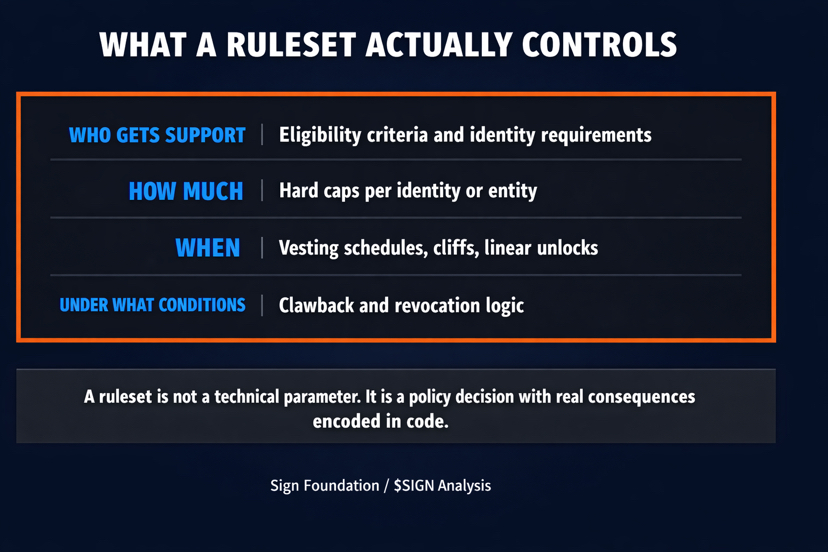
the New Capital System is built around a concept called a ruleset. a ruleset defines eligibility, caps, schedules, and conditions for a capital program. welfare distributions, agricultural subsidies, SME stimulus, energy credits, education vouchers. all of them run through a ruleset that determines who gets what, how much, when, and under what conditions.
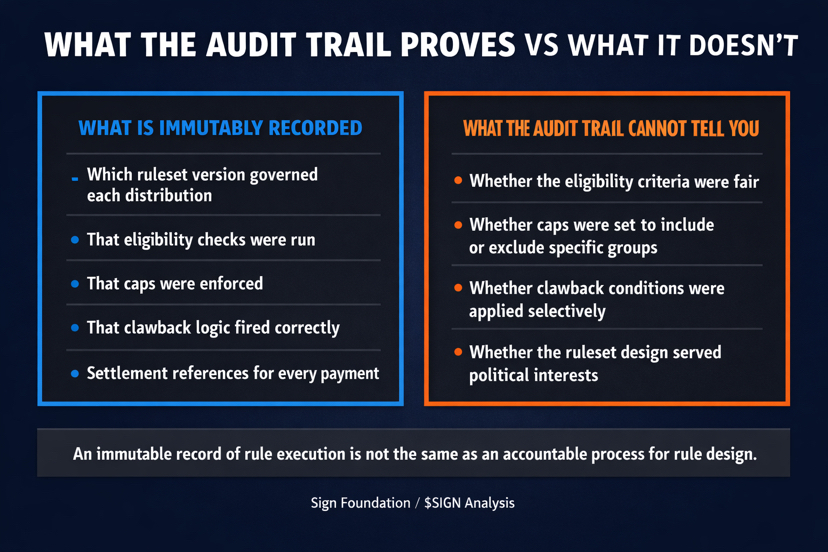
the documentation describes rulesets as versioned. every distribution is anchored to a specific ruleset version hash. the audit trail is immutable. you can replay any historical distribution and confirm exactly which rules governed it at the time.
that’s genuinely valuable. it means no distribution can be quietly altered after the fact. the evidence is permanent.
$SIGN #SignDigitalSovereignInfra
what the documentation doesn’t address is the political economy of ruleset authorship.
a ruleset that defines eligibility for a welfare program encodes a government’s definition of who deserves support. a ruleset that enforces caps per identity encodes a government’s view of how much support any individual should receive. a ruleset with revocation and clawback logic encodes the conditions under which support can be taken back after it was given.
these are not technical parameters. they are policy decisions with real consequences for real people.
the audit trail proves the ruleset was followed. it doesn’t evaluate whether the ruleset was fair, whether the eligibility criteria were designed to include or exclude specific populations, or whether the clawback conditions were applied selectively.
an immutable record of rule execution is not the same as an accountable process for rule design.
#SignDigitalSovereignInfra $SIGN
the Middle East context makes this specific. Gulf states running subsidy programs at national scale, energy credits, food subsidies, SME support, housing assistance, all have existing frameworks for determining eligibility. moving those programs onto the @SignOfficial capital system infrastructure makes the distribution layer more efficient, more auditable, and harder to defraud.
it also makes the ruleset the single most consequential document in the system.
whoever controls the ruleset controls who receives capital and who doesn’t. the documentation describes the Program Authority role as defining eligibility rules and distribution policies, approving large batch distributions, and managing program budgets. that’s the right governance design. it creates accountability for ruleset decisions.
what it doesn’t resolve is what happens when the Program Authority is also the entity whose political interests are served by specific eligibility definitions. the audit trail will show the rules were followed. it won’t show whether the rules were designed to produce a particular outcome.
TokenTable has already processed $130M in token distributions. the infrastructure works at scale. the evidence layer is real.
what i keep thinking about is the gap between execution accountability and design accountability. the New Capital System is excellent at the former. every distribution is traceable. every eligibility check is anchored. every ruleset version is permanently recorded. the documentation calls this replacing opaque beneficiary selection and weak post-distribution accountability with rule-driven, evidence-anchored capital flows.
that’s accurate. and it’s a meaningful improvement over how most governments run these programs today.
what rule-driven capital flows don’t automatically produce is rule-design accountability. the system enforces whatever rules are written. the question of who writes them, through what process, with what oversight, and with what recourse for people who believe the rules were designed against them, is a governance question that lives outside the protocol.
honestly the more i think about it the more i believe the New Capital System is the most powerful component in the entire S.I.G.N. stack. not because it’s the most technically complex. because it’s the one where the gap between what the protocol guarantees and what governance actually requires is widest.
a programmable capital layer that makes sovereign subsidy programs more efficient, auditable, and fraud-resistant, or a rule enforcement engine whose value depends entirely on the legitimacy of the process that produces the rules?