


The latest data around Spot Bitcoin ETFs is sending a clear message: investors are stepping back. A $296 million outflow is not just a number. It reflects a shift in mood. The market is no longer chasing upside blindly. It is pausing, reassessing, and waiting for clarity.
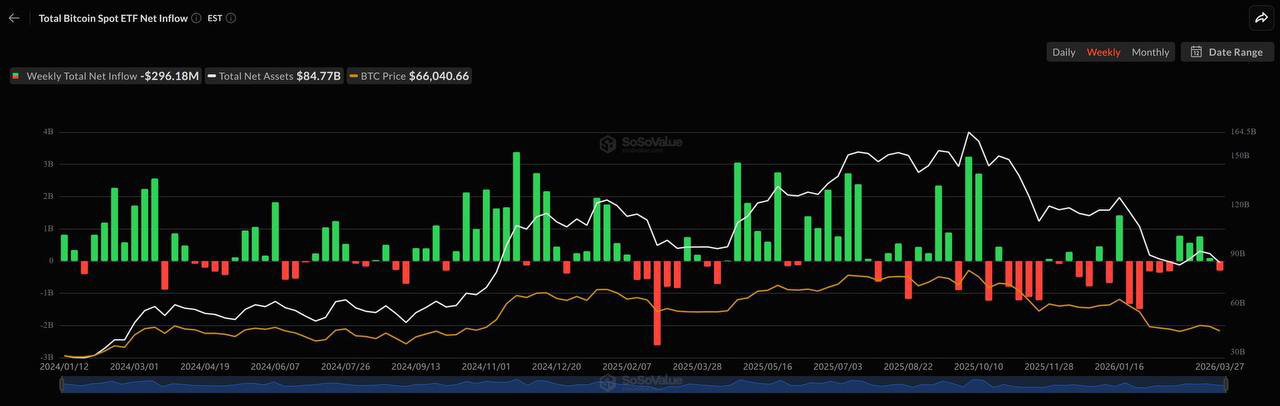
To understand this move, you need to zoom out a bit.
Over the past months, Spot Bitcoin ETFs became one of the biggest narratives in crypto. Big names like BlackRock and Fidelity entering the space gave investors confidence. It felt like institutional money had finally arrived in a serious way. Flows were strong. Sentiment was bullish. Bitcoin looked like it had a solid floor.
But markets do not move in straight lines.
What we are seeing now is a reaction to broader macro uncertainty. Interest rates remain a big question. The policy stance of the Federal Reserve is still unclear. Inflation is not fully under control. And global tensions are adding another layer of risk. When all of this combines, investors tend to reduce exposure to volatile assets.
Bitcoin sits right in that category.
Even with ETF access, it is still seen as a risk asset.
So when uncertainty rises, money flows out. Not because the long-term story is broken, but because short-term risk feels higher.
Another important angle here is “directional risk.” This simply means investors are less confident about where the market goes next. Earlier, the bet was clear: Bitcoin up. Now, it is less obvious. Price has been moving sideways. Momentum has slowed. That makes traders cautious. Instead of holding positions, they prefer to wait on the sidelines.
ETF flows often reflect this behavior faster than the broader market.
They are clean, transparent, and heavily used by institutions. So when you see outflows like $296 million, it is not random. It is a signal. Big players are adjusting their exposure.
At the same time, this does not mean panic. It is more of a cooling phase. After strong inflows, some profit-taking is normal. Investors lock in gains, reduce risk, and prepare for the next move. This cycle happens in every market.
There is also a psychological factor. When flows turn negative, it affects sentiment. Retail investors notice it. Headlines amplify it. Suddenly, the narrative shifts from “strong demand” to “weakening interest.” Even if the fundamentals remain unchanged, perception alone can influence price action.
Still, it is important to keep perspective. Spot Bitcoin ETFs have already changed the structure of the market. They made access easier. They brought in new types of investors. And they created a more stable demand base compared to previous cycles driven purely by retail hype.
So what happens next depends on macro conditions. If inflation cools and the Federal Reserve signals rate cuts, risk appetite could return quickly. In that scenario, ETF inflows may resume just as fast as they slowed down. On the other hand, if uncertainty continues, we may see more sideways movement and mixed flows.
Think of this moment as a reset. The market is digesting gains. It is adjusting to new information. And it is waiting for a clearer direction.
The real takeaway is simple. The $296 million outflow is not the end of the story. It is part of the process. Markets breathe. They expand and contract. Right now, we are in a contraction phase driven by caution, not collapse.
And in crypto, that distinction matters a lot.