

i keep coming back to a simple tension in blockchain design that systems built to do everything often struggle when asked to do one thing exceptionally well. This becomes especially visible in environments where evidence not just transactions is the core unit of value. The moment you shift from moving tokens to recording, verifying, and referencing high volumes of structured proofs, the limitations of general-purpose Layer 2 solutions begin to surface.
That is where Sign-chain’s design feels deliberate rather than derivative.
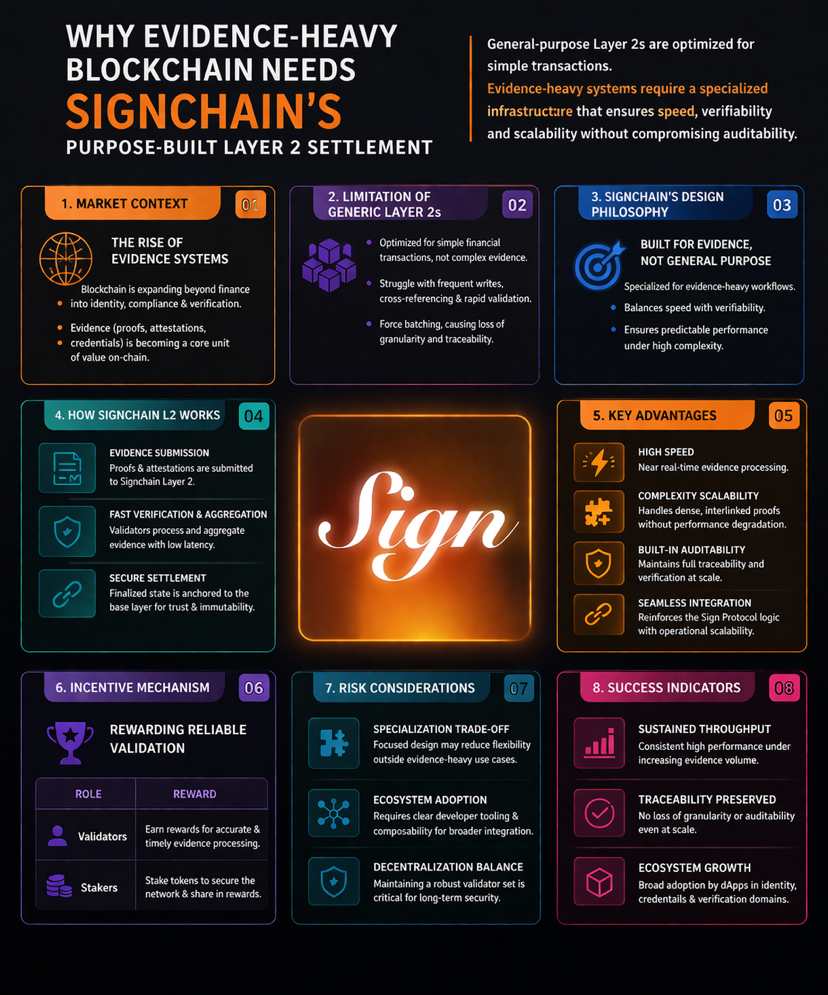
Sign is nit trying to compete with generic Layer 2 on breadth.it narrows the focus. It optimizes for a specific class of operations: evidenc heavy workflows that require both speed and verifiability under real-time constraints. This distinction matters more than it might initially seem. In theory, any Layer 2 can handle data. In practice not all data behaves the same.e
Evidence has weight. It carries context, dependencies and often long term implications.
What stands out to me is how Signchain treats this not as a throughput problem alone, but as a structural one. Traditional L2 architectures are primarily optimized for financial transactions..simple state transitions with clear finality. But evidence systems introduce different pressures frequent writes, layered attestations, cross-referencing, and the need for rapid validation without sacrificing auditability.
Generic L2s can support this, but not gracefully. They treat it as an edge case. Signchain treats it as the baseline.
This shift in assumption drives a different set of technical decisions. Instead of abstracting everything into a one size fits all all execution environment, Signchain leans into specialization. It restructures how data is committed, how proofs are aggregated, and how settlement is finalized. The goal isn’t just faster throughput. it is predictable throughput under conditions that would typically strain conventional systems.
Speed alone is easy to chase. Sustained performance under complexity is not.
In high-throughput evidence systems, latency isn’t just an inconvenience; it changes behavior. If verification takes too long, systems batch more aggressively. If batching increases, granularity decreases. And once granularity is lost, traceability starts to erode. This is the quiet tradeoff most systems make without acknowledging it.
Signchain attempts to break that cycle by reducing the need for compromise in the first place.
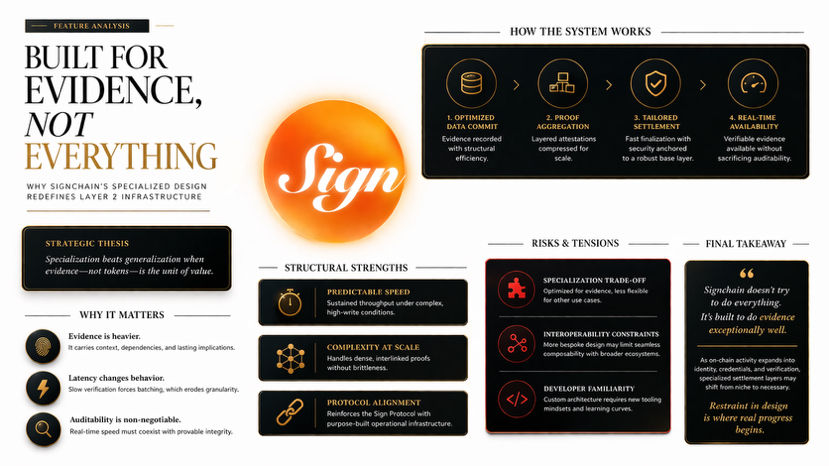
Its tailored settlement layer allows evidence to be processed closer to real time while still anchoring security to a more robust base layer. This hybrid positioning fast where it needs to be, secure where it must be…is not new in concept, but the execution here is purpose built. It reflects an understanding that evidence workflows cannot afford the same delays or abstractions tolerated in financial transactions.
There’s also an architectural clarity in how Signchain fits within the broader Sign Protocol ecosystem. It doesn’t try to replace the protocol; it reinforces it. The protocol defines the logic of attestations, while Signchain ensures those attestations can scale operationally without degrading performance. It’s an infrastructure layer that acknowledges a hard truth: protocol design alone doesn’t guarantee usability at scale.
Infrastructure does.
Another aspect that deserves attention is how this approach reframes scalability. Most discussions reduce scalability to transaction per second metrics. But in evidence heavy environments, scalability is also about relational density. how many interconnected proofs a system can handle without becoming brittle. This is where generic L2s often hit friction. They scale volume, but not always complexity. #SignDigitalSovereignInfra
Sign, by contrast appears designed to handle both.
That said, specialization introduces its own trade-offs. A bespoke settlement layer can achieve efficiency within its domain, but it may sacrifice flexibility outside of it. Interoperability, developer familiarity, and ecosystem composability can become more constrained compared to generalized environments. This is not a flaw. it’s a design choice. But it’s one that requires clarity from builders about what they are optimizing for.
You gain precision. You give up universality.
From a strategic standpoint, I see Signchain as part of a broader shift in how blockchain infrastructure is evolving. The early phase prioritized general-purpose platforms. The next phase is increasingly about vertical optimization..systems designed for specific workloads where generic solutions fall short under pressure.
Evidence systems are one of those workloads.
And they are only becoming more relevant. As on-chain activity expands beyond finance into identity, credentials, compliance, and verification, the need for reliable, high-throughput evidence processing will grow. Not incrementally, but structurally
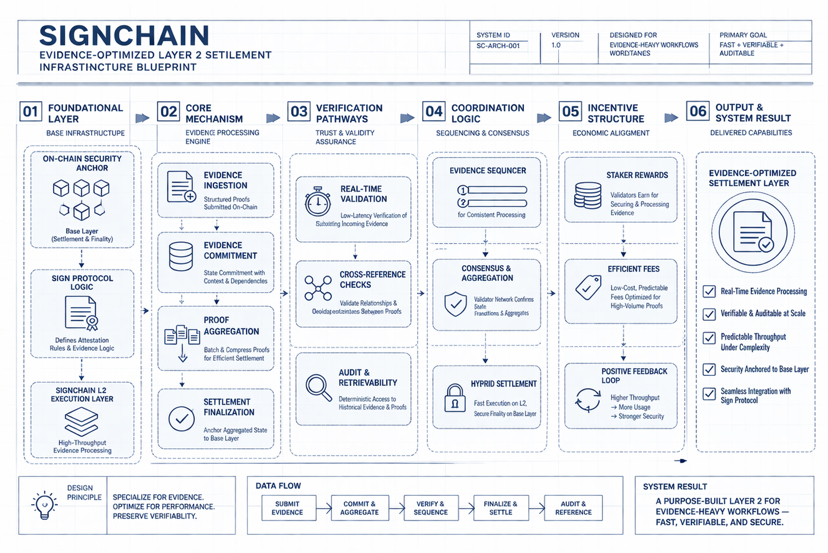
What Signchain represents, in my view, is an acknowledgment of that trajectory. It doesn’t attempt to solve every problem. Instead, it focuses on solving one category of problems exceptionally well and builds the infrastructure accordingly.
That kind of restraint is rare. And often, it’s where real progress begins.
The question going forward is not whether custom settlement layers will exist..they already do. The real question is how many domains will demand them.If evidence-heavy systems continue to expand, then Signchain’s approach may not feel niche for long. It may start to look necessary.