
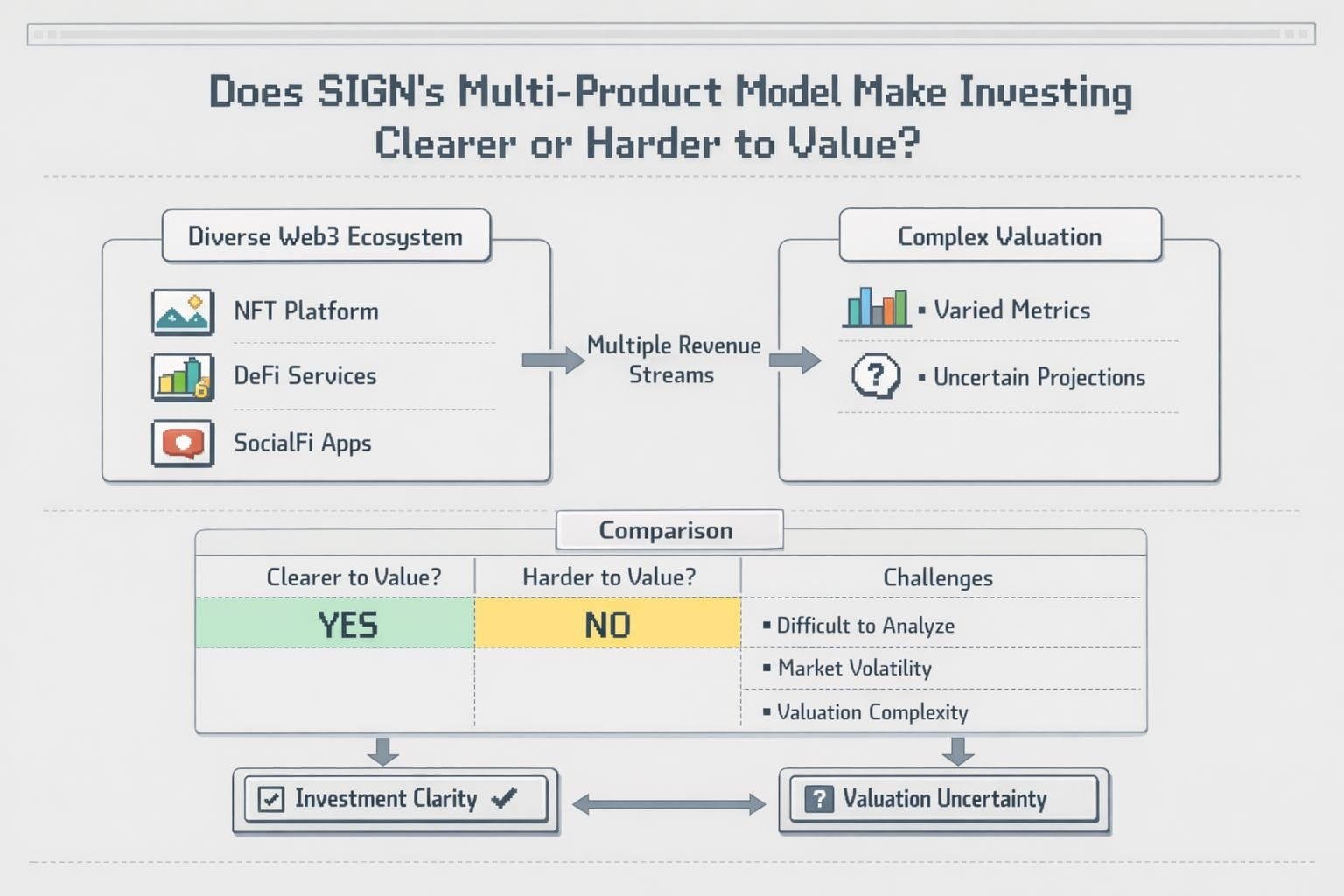
After reviewing SIGN’s product map, it’s evident this is no longer a single-product project with one simple narrative. The stack now includes Sign Protocol, TokenTable, EthSign, and the broader S.I.G.N. framework. This raises a key question: does the multi-product approach clarify the investment story, or does it make it harder to value?
In my view, it does both—but on different levels.
Clarity: At an operational narrative level, the thesis becomes much clearer. Sign Protocol acts as the evidence and attestation layer for verification and audit trails; TokenTable handles allocation, vesting, and distribution; and EthSign provides agreement and signature workflows. Together, they form an infrastructure for trust, capital workflows, and execution, not just a single feature. This makes the narrative easier for investors to grasp: SIGN is not just “a trust layer,” but a stacked system with trust, distribution, and workflow layers.
The model also shows that products are interconnected, not siloed. TokenTable leverages Sign Protocol for verification, and Sign Protocol depends on product adoption to demonstrate real value. This suggests the team isn’t building products just to inflate TAM—each product consumes the same core data and trust, creating a coherent ecosystem.
Valuation complexity: At the same time, this makes valuation harder. You’re no longer evaluating a single product, but an entire architectural stack for money, identity, and capital at the sovereign/institutional level. This can lead to market polarization: either assigning a high premium for potential infrastructure dominance or a steep discount because the scope is broad and complex. The multi-product model also complicates token capture mechanics—strong adoption in one layer doesn’t necessarily translate to value for the token, and different customer segments (crypto users, organizations, governments) measure value differently.
Despite this, the stack maintains a coherent axis around evidence: Sign Protocol underpins the system, TokenTable uses it for allocation and distribution, and EthSign links workflows to identity and verification. SIGN has also processed millions of attestations and distributed tokens to tens of millions of wallets, showing the stack is more than just a concept—it has real usage.
Conclusion: SIGN’s multi-product model clarifies the thesis but doesn’t simplify valuation. The narrative is easier to understand because the roles of each layer are clear, but investors still need to answer: which layer drives adoption? which captures value? how much of the system does the SIGN token actually consume? Execution will be key: if TokenTable drives repeated usage, Sign Protocol becomes the default evidence layer, and EthSign enables real workflows, the thesis strengthens. Otherwise, it risks being a compelling diagram that’s difficult to value.