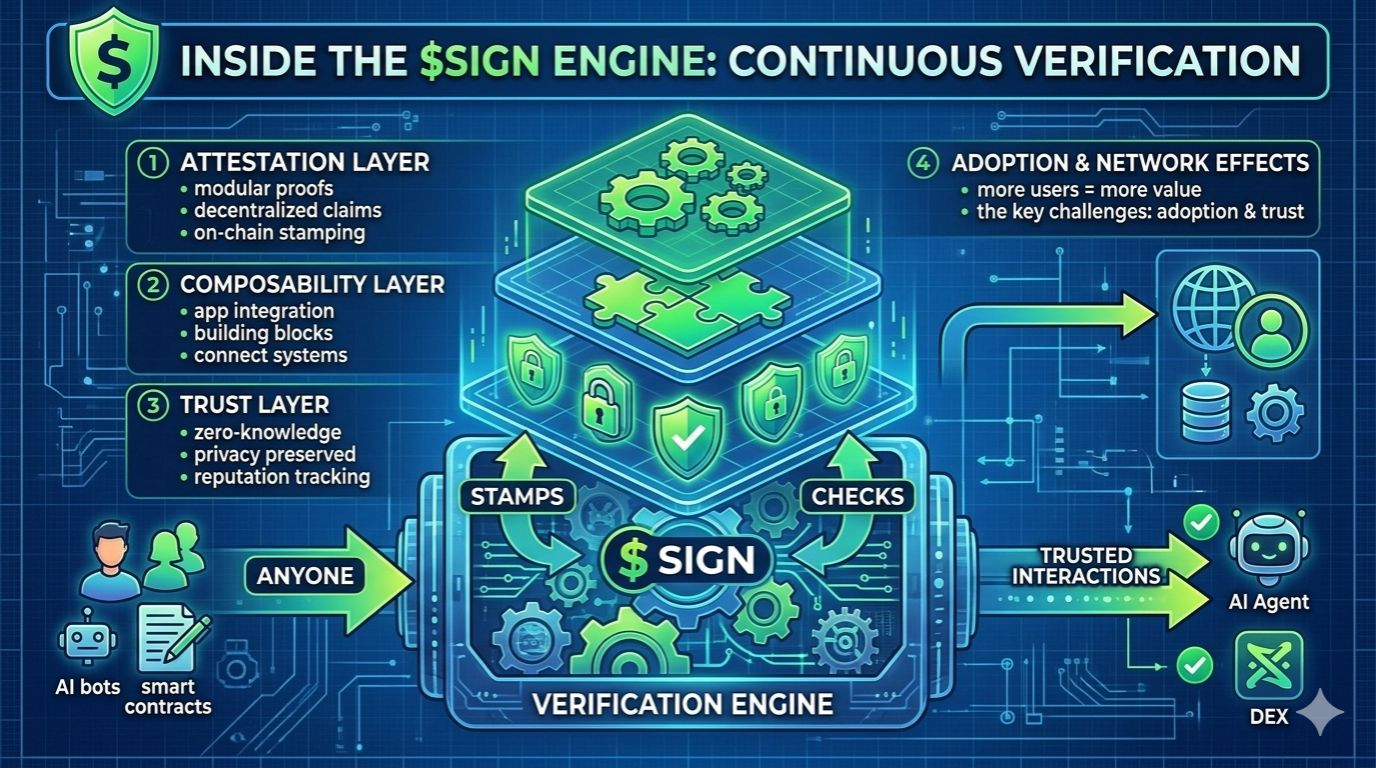
Honestly, the first time $SIGN caught my eye, it wasn’t because of a hyped-up launch or some crazy price spike. I barely even registered those. It was just me, late at night, aimlessly flipping through governance threads, probably half awake, and wading into debates about online identity. All those conversations sort of mingled together—same old noise, really—except the stuff about “verification” actually felt different. Not more aggressive or louder, just grounded in reality. Like, oh, finally, someone’s naming the weird pain I’ve been dealing with but never bothered to articulate.
After a bit, yeah—it started to make sense.
I mean, we’re smack in the middle of this wild “verification crisis.” Not just in crypto, but all over. Feels like every feed is loaded with AI-generated junk, bots trying to act like real people, fake badges, spoofed wallets—honestly, who can tell what’s legit anymore? And try proving you are who you say you are… it’s a headache. I remember back when I tried joining a gated DAO. Had to link three wallets (one of them was totally empty, which made me nervous), sign random messages—still wound up flagged as “unverified.” Total pain. The whole process felt brittle, like nobody trusts anybody, not even themselves.
That’s where SIGN slots in, at least from my angle. It’s not just another “Web3 identity” thing—I’m tired of hearing that phrase anyway—but more like... real verification infrastructure. The layer that sits underneath everything, kind of invisibly, making sure stuff actually works and checks out.
And At its heart, it’s not some mind-blowing puzzle. The real snag is figuring out how to make sure info is legit between systems that just... don’t trust one another. That’s it. Simple on paper, but man, it gets tricky fast, without handing all the power to one authority? Whether you’re showing off credentials, tracking on-chain activity, or confirming someone actually did what they claim, most current answers either get too centralized (ugh) or turn so abstract, they’re useless in practice.
So, $SIGN tries a new angle:So, “modular on-chain attestations.” It’s kind of a mouthful, right? But here’s what it means: anybody can toss out claims—regular folks, big companies, even those automated smart contracts. And not just tossing them out, they can check each other too. They stamp these attestations on-chain, so there’s a trackable, verifiable record, but nobody’s forced to expose all their private data. It doesn’t just cover identity; it handles reputation, credentials, proofs you participated in something—sort of a bundled system other apps can plug into.
I messed around with an attestation tool months ago—can’t remember the name right now, maybe something with an “O”?—and thought, “Nice tech, but who’s ever gonna bother with this?” Most ideas stall there. But what made SIGN stick in my brain was the composability. It’s meant to be infrastructure, not just a standalone flashy product. Like, build whatever you want on top and stop wasting time cobbling stuff together from scratch.
That’s the bit that makes it feel fresh.
Lots of “identity” projects I’ve seen focus on the user-facing stuff—badges, social graphs, endless profile pages. $SIGN, at least from the docs and community stuff I skimmed, is more backend-y. Less on the pretty interface, way more on making things verifiable and trustworthy. It’s subtle, almost invisible until you really pay attention.
But, yeah, there are still big question marks. Adoption is huge—a verification system is only useful if enough players actually care and trust it. If nobody piles in, it just sits there gathering dust. And privacy—what gets exposed, who controls it, what happens if a record is wrong or someone cheats the system?
Lately, I’ve been wondering what happens as AI agents get more involved. Bots are already all over the place, quietly running stuff on-chain without anyone really noticing. If those interactions scale up, verification layers stop being just handy—they start feeling critical. Stakes go up. If the system’s off, it isn’t just annoying—it could rewind or damage entire networks.
Zooming out, it seems like verification is turning into this ongoing process, not a single checkbox. Continuous. Layered. Almost woven into everything. Maybe that’s the shift—it’s not a static identity label; it’s a thing you keep proving, updating, and reshaping as you move around.
Kind of wild. Makes you wonder where this all leads.