

At three in the morning, I sat in a hotel next to Dubai DIFC (International Financial Centre), rubbing my temples that felt like they were about to explode, staring at the screen where five lawyers were still online in the Zoom meeting.
We are handling a cross-border joint venture payment that isn't actually that large—a milestone payment of 5 million dollars. The funds are in the hands of the investors here in the Middle East, with the recipient in Singapore. According to the betting agreement signed a few months ago, as long as the first phase of the technical product is delivered, this money should be sent from a neutral third-party escrow account.
The product was clearly delivered last week, so what happened? Since Monday, it has been an endless tug of war. The compliance officer here in the Middle East insists that Singapore provides three different institution-certified paper audit certificates to prove that the code is fine and that no prohibited open-source libraries were used; the lawyers in Singapore find the demands excessive, and both sides are billing hourly. Just in these few days, the legal fees have already burned through tens of thousands of dollars. Meanwhile, that $5 million is stuck in the so-called 'absolutely neutral' multinational bank escrow account, and no one can touch it.
At that moment, I looked at the suit-clad elites on the screen arguing red-faced over a legal term, and I could only feel a sense of absurdity. It’s already 2026, humanity can recover rockets, but for a slightly complex B2B large fund settlement with conditional triggers between countries, we still have to rely on this 19th-century documentation system to maintain trust. This extremely perverse 'trust friction' is the norm in current multinational business.
After the meeting ended on a sour note, I went downstairs to smoke, and suddenly recalled the New Capital System and TokenTable mentioned in the white paper I had browsed a few days ago.
To be honest, in the past, everyone in the circle thought TokenTable was just a SaaS tool for Web3 projects to issue tokens and manage employee stock options with linear unlocking (Vesting), a pure hub for opportunists. But standing here on the streets of Dubai at 3 AM, after being brutally beaten by the inefficiency of the real-world finance, I suddenly understood the true destructive power of this system in the eyes of capital-exporting countries like those in the Middle East.
It is not a currency issuance tool at all; it is a cold-blooded, efficient, emotionless 'multinational fund judge'!
Just think about it, the sovereign wealth funds in the Middle East are now throwing money all over the world, investing in AI, infrastructure, and various cutting-edge technologies. What do they fear the most? They fear that the money will be sent over, but the other party doesn't perform; they also fear that to guard against the other party, complex bank escrows will drag efficiency down to zero, or even have their funds unilaterally frozen by some powerful Western clearing systems.
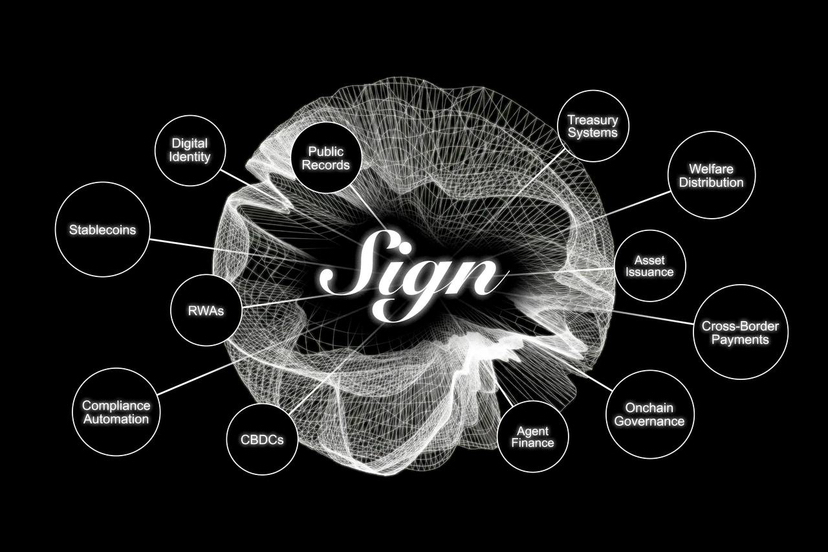
If we were to move this mess we have tonight onto the Sign Protocol architecture, what would it look like? There would be no need for any third-party bank escrow; the funders would directly deposit money (like regulated stablecoins) into the TokenTable smart contract. This contract would be an unalterable 'Executable Law.'
We have hardcoded the loan conditions on-chain: as long as the product is delivered and a designated third-party security agency issues a foundational proof (Attestation) on the Sign network, triggering the preset Hook (hook logic), the money will automatically be transferred to the Singapore company's account within milliseconds.
No bank holidays, no compliance officer holding up your process because of a bad mood, no lawyers taking cuts from both sides. The code is there, the conditions are met, the money goes. This is the ultimate solution to deal with multinational geopolitical friction and trust crises.
These geeks in infrastructure truly understand the dirty work of B2B. They have transformed those vague, dispute-prone clauses in traditional contracts into cryptographically verified 'true or false' statements.
I could even deduce the commercial landscape after this system is rolled out: when those controlling hundreds of billions in the Middle Eastern consortiums begin using this system for multinational fund dispatch, to ensure the absolute security of this 'automated funding channel,' they will definitely run the underlying high-privilege nodes themselves. And in Sign's game rules, to run such national-level/corporate-level nodes, you must deposit a vast amount of collateral as a default guarantee.
What kind of retail speculation is this? This is clearly a 'digital lubricant' used by top global capital to reduce transaction friction. This passive lock-up, supported by real multinational mergers and the sovereign investment demand, is the dirty work that big funds are truly doing beneath the surface.
Extinguishing my cigarette, I sighed. The business in the real world still has to continue battling with those lawyers, but I know that the death knell for this old financial system has already sounded in the smart contracts on-chain.

DYOR
