
It’s a bit strange, right?
We join early… but still feel late.
You follow a project, interact, stay active…
and when rewards come, it just doesn’t add up.
Someone random wins big.
Someone real gets ignored.
And you just sit there thinking… “what did I miss?”
This isn’t rare anymore. It’s almost expected.
Airdrops used to feel exciting.
Now they feel… unpredictable.
Not because people don’t participate.
But because systems can’t always tell who actually did.
Bots blend in.
Multiple wallets look normal.
Real users get lost in the noise.
And slowly, that excitement turns into quiet doubt.
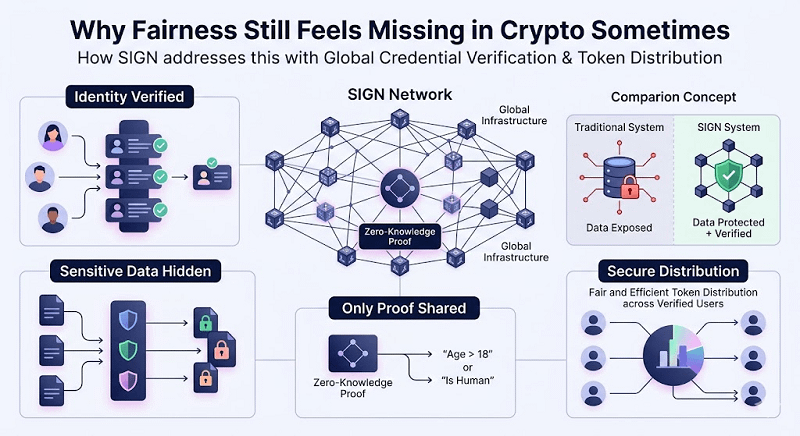
That’s where @SignOfficial starts to feel different.
Not in a dramatic way.
More like fixing something small that kept bothering everyone.
At its heart, $SIGN is trying to answer a very simple problem:
How do you prove something is real… online?
Not just identity like a username or profile.
But actual proof of what you’ve done.
Your actions.
Your participation.
Your presence over time.
Because right now, those things exist… but they’re scattered.
Think about your own activity.
You join communities.
You interact.
You support projects early.
But none of that really follows you in a meaningful way.
Every new project treats you like a stranger again.
That’s the gap.
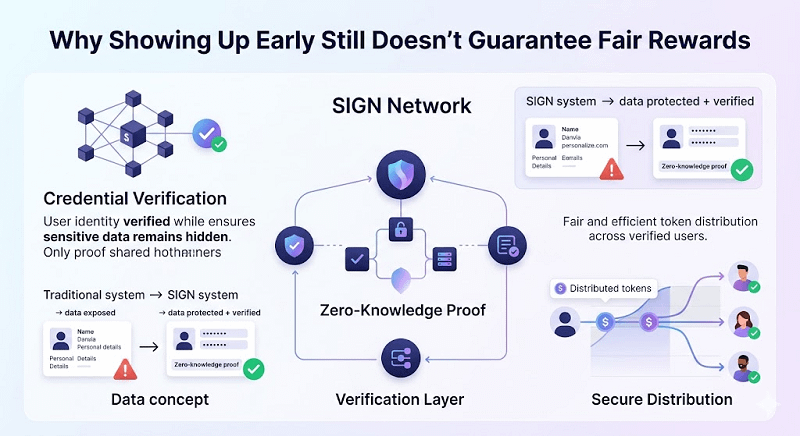
#SignDigitalSovereignInfra is basically trying to close that gap.
Not by adding complexity…
but by organizing proof in a way that actually sticks.
So instead of starting from zero every time,
your past starts to mean something.
Now bring this back to airdrops.
Imagine a system where:
• Real users stand out clearly
• Fake activity becomes harder to hide
• Rewards feel connected to actual effort
That alone changes the mood completely.
Because fairness isn’t just about distribution—
it’s about feeling seen.
And this goes beyond rewards.
In fast-growing digital regions—like parts of the Middle East or South Asia—
people are actively building in Web3.
They contribute, they learn, they engage.
But proving that journey isn’t always easy.
There’s no clean record. No simple way to show credibility.
So even genuine users end up looking the same as everyone else.
That’s where SIGN quietly fits in.
It gives structure to what was previously invisible.
It turns random interactions into something verifiable.
Something you can carry forward.
And that changes how people are treated inside these ecosystems.
Because when systems start recognizing real effort,
people start trusting them more.
Not blindly. Just… naturally.
Maybe that’s the thing crypto underestimated.
It removed the need for trust in theory.
But people still want a sense of fairness in practice.
They want to feel like:
“If I show up, it counts.”
Not sometimes. Not randomly.
Just… consistently.
@SignOfficial doesn’t try to oversell this.
It simply focuses on a problem most users already feel but rarely explain.
The disconnect between doing something…
and being recognized for it.
And when you look at it that way,
it’s not really about infrastructure or technology.
It’s about fixing a small emotional gap in the system.
The gap where people quietly wonder:
“Does any of this actually matter?”
Maybe the future isn’t about making systems more complex.
Maybe it’s about making them… fair enough to feel right.