
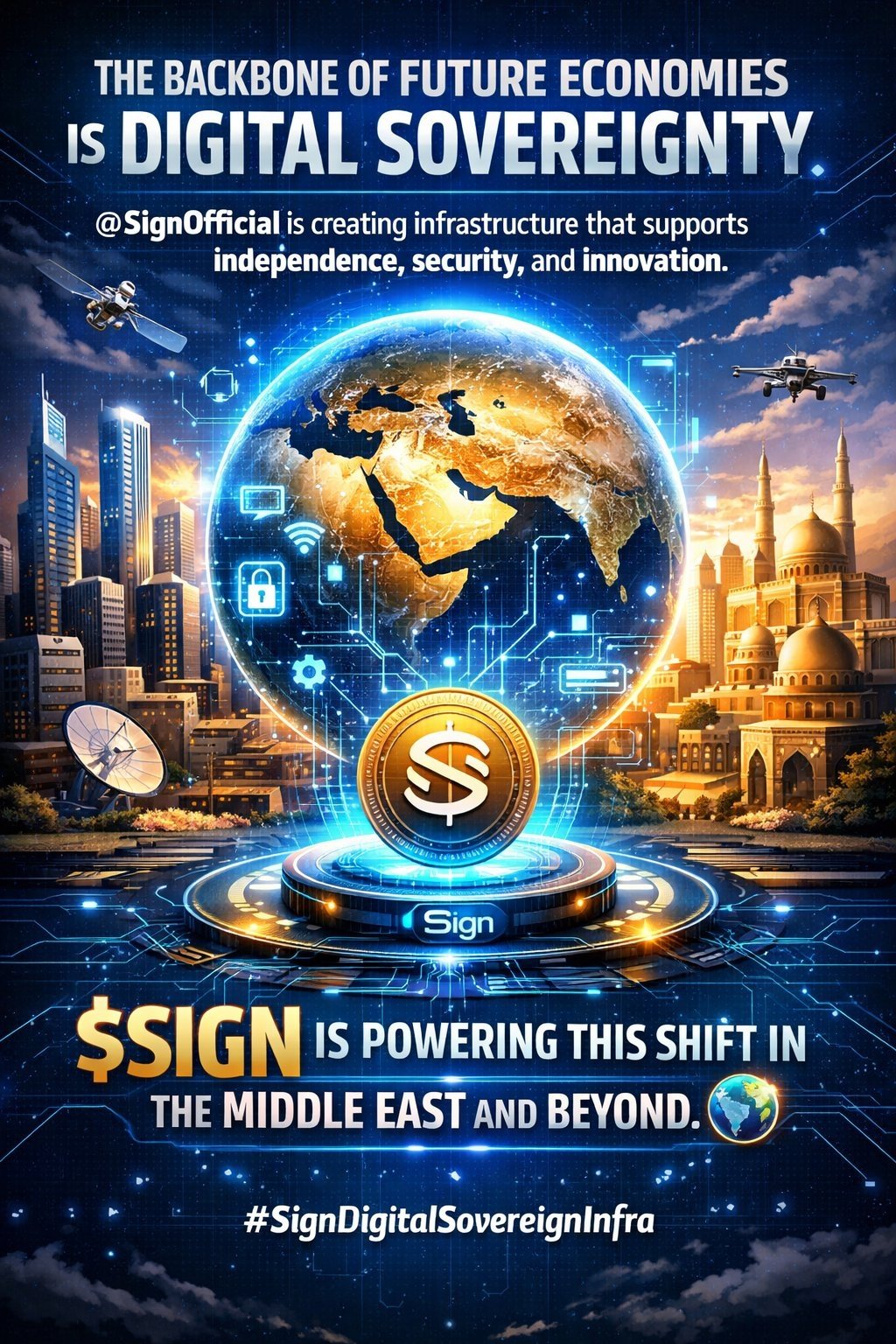
The architecture of the global economy is undergoing a quiet but profound redesign. Beneath the surface of market cycles, geopolitical tensions, and the noise of speculative capital, a deeper structural shift is taking place—one that reframes not just how value moves, but who controls the systems through which it flows. At the center of this transformation lies the concept of digital sovereignty: the capacity for nations, institutions, and individuals to assert control over their digital infrastructure, data, and economic rails.
In this emerging paradigm, infrastructure is no longer neutral. It encodes power. And as the world becomes increasingly digitized, sovereignty itself is migrating from physical borders into programmable systems. Within this context, projects like $SIGN are positioning themselves not merely as blockchain platforms, but as foundational layers in what could become a federated, multi-chain blueprint for the internet of value.
To understand the significance of this shift, one must first recognize that the current digital economy is structurally asymmetric. A handful of centralized platforms govern the majority of global data flows, identity frameworks, and financial interactions. These platforms operate as invisible intermediaries, extracting value while offering convenience, effectively turning users and even governments into tenants within privately owned digital domains.
Digital sovereignty challenges this model. It proposes that economic actors—whether states or individuals—should not merely participate in digital systems, but co-own and co-govern them. This is not an abstract ideal. It is an infrastructural demand emerging from a world where data is currency, networks are jurisdictions, and code increasingly functions as law.
In this sense, $SIGN can be interpreted as part of a broader movement to re-architect the underlying mesh of chains that will support sovereign digital economies. Its ambition, at least in principle, is to create infrastructure that allows regions—particularly in the Middle East—to operate with greater independence from external technological dependencies. This includes secure data frameworks, decentralized identity layers, and financial rails that are resilient to both political and systemic shocks.
The Middle East is a particularly compelling arena for such experimentation. Over the past decade, the region has accelerated its transition toward knowledge-based economies, investing heavily in digital infrastructure, fintech, and sovereign wealth-backed innovation ecosystems. Yet this transition has also exposed a paradox: while capital is increasingly local, the infrastructure through which that capital flows remains largely external.
Digital sovereignty, therefore, becomes not just a technological ambition but a strategic necessity. It is about reducing reliance on foreign-controlled systems while maintaining interoperability with the global economy. It is about building systems that can federate—connecting seamlessly with other networks—without surrendering control.
This is where the promise of blockchain-based infrastructure becomes particularly potent. Unlike traditional systems, which are hierarchical and permissioned, blockchain networks offer a more modular architecture. They allow for the creation of interoperable layers—identity, settlement, governance—that can operate independently yet synchronize when necessary. In theory, this creates a lattice of semi-autonomous systems, a mesh of chains that mirrors the complexity of the real world while preserving local control.
$SIGN’s positioning within this landscape suggests an attempt to operationalize that vision. By focusing on infrastructure rather than applications, it aligns itself with a more durable layer of the stack. Applications may come and go, but infrastructure—if it achieves sufficient adoption—becomes embedded. It becomes the invisible substrate upon which entire economies run.
Yet this ambition invites scrutiny. The history of blockchain is littered with projects that promised to redefine infrastructure but ultimately failed to achieve meaningful adoption. The challenge is not merely technical; it is socio-economic. Infrastructure requires coordination. It demands trust from users, institutions, and regulators—an alignment that is notoriously difficult to achieve in decentralized systems.
Moreover, the concept of digital sovereignty itself is not without tension. While it promises independence, it also risks fragmentation. If every nation or region builds its own sovereign stack, the result could be a balkanized digital landscape, where interoperability becomes an afterthought rather than a design principle. The dream of a unified internet of value could devolve into a patchwork of competing systems, each optimized for local control but limited in global reach.
This tension—between sovereignty and interoperability—is perhaps the central challenge of the next phase of digital infrastructure. It requires a delicate balance. Systems must be robust enough to support local autonomy, yet flexible enough to integrate into a global network. They must enable control without creating isolation.
In this regard, the metaphor of federation becomes particularly useful. A federated system is not fully centralized, nor is it entirely fragmented. It is composed of independent units that agree to shared protocols, allowing them to cooperate without relinquishing their autonomy. In the context of digital economies, this could mean networks that maintain their own governance structures while adhering to common standards for data exchange, identity verification, and financial settlement.
If $SIGN can contribute to such a federated architecture, its impact could extend beyond any single region. It could serve as a model for how digital sovereignty can be implemented without sacrificing global connectivity. It could demonstrate that independence and integration are not mutually exclusive, but complementary.
However, this outcome is far from guaranteed. The success of any infrastructure project depends not only on its technical design but on its ability to attract a critical mass of participants. Developers must build on it. Institutions must trust it. Users must find value in it. Without this network effect, even the most elegant architecture remains inert.
There is also the question of governance. Decentralization is often framed as a solution to the concentration of power, but in practice, it introduces new complexities. Who sets the rules? How are disputes resolved? How does the system evolve over time? These questions become even more intricate when applied to infrastructure intended to support sovereign economies.
In traditional systems, governance is enforced through legal frameworks and institutional authority. In decentralized systems, it is encoded into protocols and consensus mechanisms. This shift from legal to technical governance is both empowering and precarious. It allows for greater transparency and predictability, but it also reduces flexibility. Code, once deployed, is difficult to change without consensus—a process that can be slow and contentious.
For regions seeking digital sovereignty, this presents a paradox. They must rely on systems that are, by design, resistant to unilateral control. In other words, to achieve sovereignty in the digital realm, they must participate in networks that limit their ability to exercise it in the traditional sense.
This paradox underscores a deeper truth: digital sovereignty is not about absolute control. It is about negotiated control. It is about participating in systems where power is distributed, but not dissolved. It is about shaping the rules of the network rather than owning the network outright.
From this perspective, $SIGN’s role becomes less about dominance and more about coordination. It is not building a singular system to replace existing infrastructure, but rather contributing to a broader ecosystem of interoperable networks. Its success will depend on its ability to integrate into this ecosystem, to act as a node within a larger mesh rather than a silo.
The economic implications of such a shift are significant. If digital sovereignty becomes the norm, the structure of global markets could change in subtle but profound ways. Capital flows may become more localized, as regions develop their own financial rails. Data governance could become more fragmented, with different jurisdictions enforcing their own standards. Innovation may accelerate in some areas while slowing in others, depending on how open or closed these systems become.
At the same time, new forms of cooperation could emerge. Federated networks could enable cross-border collaboration without requiring centralized intermediaries. Smart contracts could facilitate trust between parties that do not share a common legal framework. Digital identities could allow individuals to move seamlessly between systems, carrying their credentials and reputations with them.
These possibilities point toward a future where the global economy is less like a monolithic system and more like an interconnected web—a dynamic, evolving mesh of chains. In such a system, sovereignty is not a barrier to interaction but a condition for it. Each node retains its autonomy, yet contributes to the resilience of the whole.
And yet, one must remain cautious. The history of technological revolutions is often one of unintended consequences. Systems designed to decentralize power can end up concentrating it in new forms. Protocols intended to enhance transparency can be exploited in unforeseen ways. The promise of digital sovereignty could, in some cases, mask new dependencies—on codebases, on developer communities, on governance mechanisms that are opaque to most users.
For $SIGN and similar projects, the challenge is not only to build robust infrastructure but to cultivate trust. Trust is the invisible layer that underpins all economic systems. It cannot be fully encoded, nor can it be entirely eliminated. It emerges from a combination of transparency, reliability, and shared belief.
In the end, the question is not whether digital sovereignty will shape the future of economies—it almost certainly will. The question is how it will be implemented, and to whose benefit. Will it empower individuals and regions to participate more equitably in the global economy? Or will it create new forms of fragmentation and inequality?
The answer will depend on the choices made today—by developers, by policymakers, by communities. It will depend on whether systems like $SIGN can move beyond vision and into durable reality, whether they can navigate the tension between independence and integration, whether they can transform the abstract ideal of sovereignty into something tangible and functional.
Technology, after all, is not an end in itself. It is a medium through which human intentions are expressed. The infrastructure we build reflects the values we prioritize. If the future economy is to be truly sovereign, it must be grounded not only in code, but in a shared commitment to openness, fairness, and cooperation.
In that sense, digital sovereignty is less about control and more about trust. It is about creating systems where trust is not assumed but constructed—layer by layer, protocol by protocol. It is about recognizing that in a world of distributed networks, the strongest foundation is not dominance, but alignment.
And perhaps that is the deeper significance of this moment. As we move toward an increasingly digital economy, we are not just redesigning infrastructure. We are redefining the relationships that underpin it. Between states and citizens. Between platforms and users. Between code and belief.
If $SIGN and its peers succeed, they will not merely power a shift in infrastructure. They will help articulate a new social contract for the digital age—one where sovereignty is shared, trust is engineered, and the architecture of value reflects the complexity of the world it serves.
@SignOfficial $SIGN #SignDigitalSovereignInfra