

I keep coming back to every time I dig into on-chain data, and nobody in the industry seems particularely bothered by it. The ledger is permanent. We built an economy on top of immutable records and forgot to ask the one question that actually matters immutable proof of what, exactly? The transactions are real. The records can't be altered. Everybody agrees on that part. But agreement on what happened is completly useless if you have zero context for whether what happened was legitmate. A million dollar transfer went through okay. From whom? Verified how? Approved by who and under what conditions? The chain doesn't know. It never did. And most of crypto has decided to just pretend that's fine.
That's what actually got me reading about Sign Protocol. Not a price target someone dropped in a group chat, not a thread about tokenomics. The fundamental architectural gap it's trying to close. Because if you strip back all the noise around Web3, what you're left with is a world where execution is trustless but context is completely absent. Sign is trying to fix context. That's a harder problem than most builders want to admit.
Platforms get acquired. APIs get deprecated. Companies shut down or change their terms. The moment that middleman dissapears, the trust evaporates with them.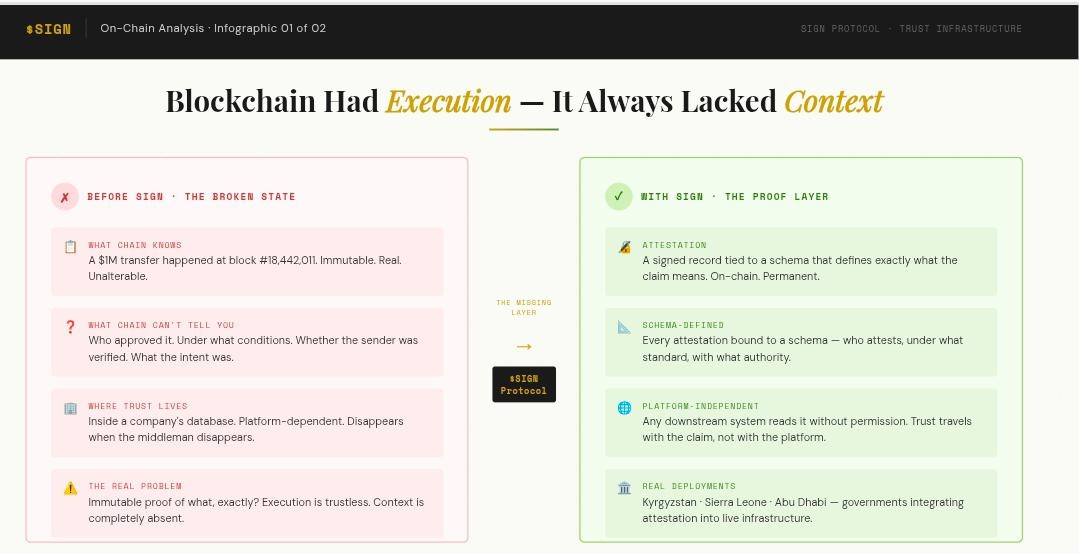
What Sign is building is structuraly different. The attestation doesn't live in a company's database. It doesn't depend on a platform staying online or staying honest. The signed record exists on-chain, tied to a schema that defines exactly what the attestation means, verified by whoever actually has standing to verify it. And critically any downstream system can read it without asking anyone's permission. That's not an incremental improvement. That's a different paradigm entirely.
The blockchain was always good at recording what happened. Nobody built the layer that explains why it should be trusted. Sign is building that layer.
I've watched the grant funding space for a few years now. The waste is staggering. Not because people are all crooked most aren't but because the verification process is manual, slow, and dependent on whoever's doing the checking being diligent that particular week. Milestone A is marked complete. Someone approved it. But did they actually check? Was the deliverable real? You'd be surprised how often nobody genuinely knows. Sign's attestation model means a milestone isn't just marked done a verified party signs off on it with their identity attached, on-chain, permanently. That changes the accountability equation in a way no spreadsheet process ever will
The government deployments are what make me take this more seriously than I otherwise would. Kyrgyzstan, Sierra Leone, Abu Dhabi these aren't speculative roadmap bullets. When a national institution starts integrating an attestation layer into real infrastructure, that's a completely different signal than another protocol promising enterprise adoption in Q4 of some future year. Governments are slow and conservative precisely because they can't afford to build on things that dissapear. If they're plugging in, they did due dilligence. That means something.
And yet I hold this loosely. Real deployments at the institutional level don't automatically translate to grassroots adoption at scale. There's a version of this where Sign becomes critical infrastructure for governments and banks while regular users never really interact with it directly. That's not necessarily a failure it might even be the intended path but it does raise questions about where the token value accrual actually happens and for whom.
Mostly 40 million wallets is a number that sounds impressive until you ask how many of those are actively using attestations in economically meaningful ways versus just holding the token. Volume of wallets and depth of usage are two very different metrics. I watch the second one. It tells you where real adoption is actually happening versus where the marketing wants you to look.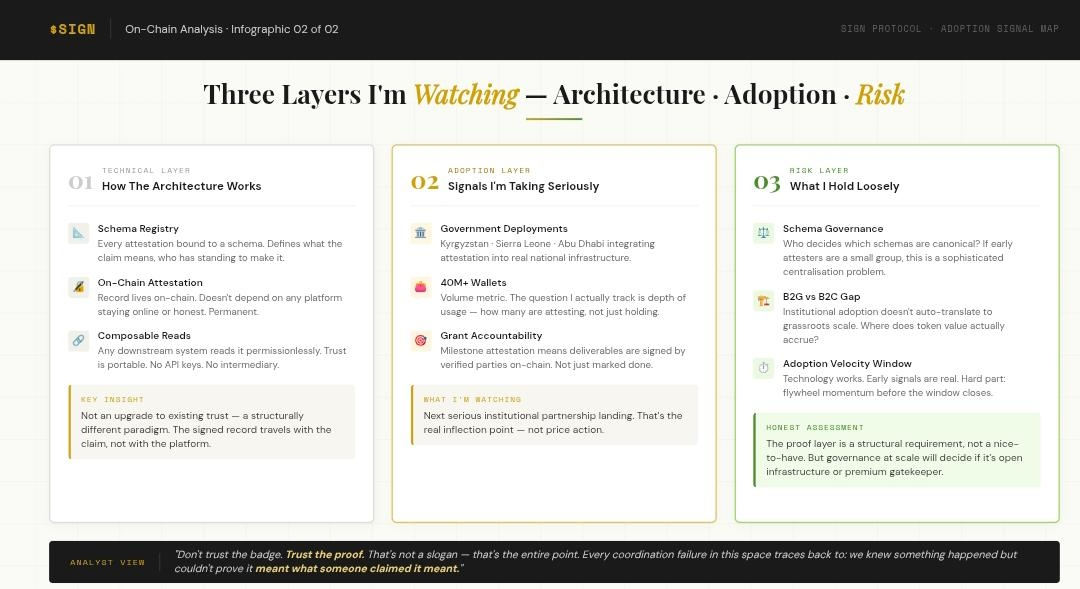
The schema question is also something I don't see discussed enough. Who controls which schemas are considered canonical? If the early attesters are a small group of institutions even trustworthy ones we've built a more sophisticated version of the same centralisation problem we started with. The technology is sound. The governance of who attests and by what standard is the part that will actually determine whether this becomes open infrastructure or just another premium gatekeeper dressed in better clothes.
Here's where I actually land on this. The proof layer Sign is describing portable, verifiable, schema-defined attestations that travel with the claim and not with the platform is genuinely the missing piece. Not a nice-to-have. Not an improvement. A structural requirement for any on-chain economy that wants to operate at real-world scale. Every coordination failure I've watched in this space traces back, eventually, to the same problem: we knew something happened but couldn't prove it meant what someone claimed it meant. That's the gap. Sign is one of the very few teams I see actually building into it rather than around it.
Whether they get the flywheel moving before the window closes that's the only question that matters now. The technology works. The early institutional signal is real. The hard part is always adoption velocity and schema governance at scale. I'm not chasing the price action. I'm watching where the next serious institutional partnership lands, because that's where the real inflection point shows up first. Everything else is just noise dressed up as signal.
Don't trust the badge. Trust the proof. That's not a slogan it's the entire point.