
I keep seeing the same narrative everywhere. Middle East is growing fast, capital is flowing, opportunities are huge. And I don’t disagree with that. But something about it feels incomplete.
Because if everything is moving that fast, why do things still take so long to actually get done?
I’m not talking about headlines. I mean real execution. Expanding across countries, closing deals, getting approvals. I’ve seen founders mention it takes months just to validate paperwork between regions. Same identity, same documents, but every system wants to verify it again in its own way.
That repetition adds up.
It’s not loud. It doesn’t show up on charts. But it slows everything down underneath.
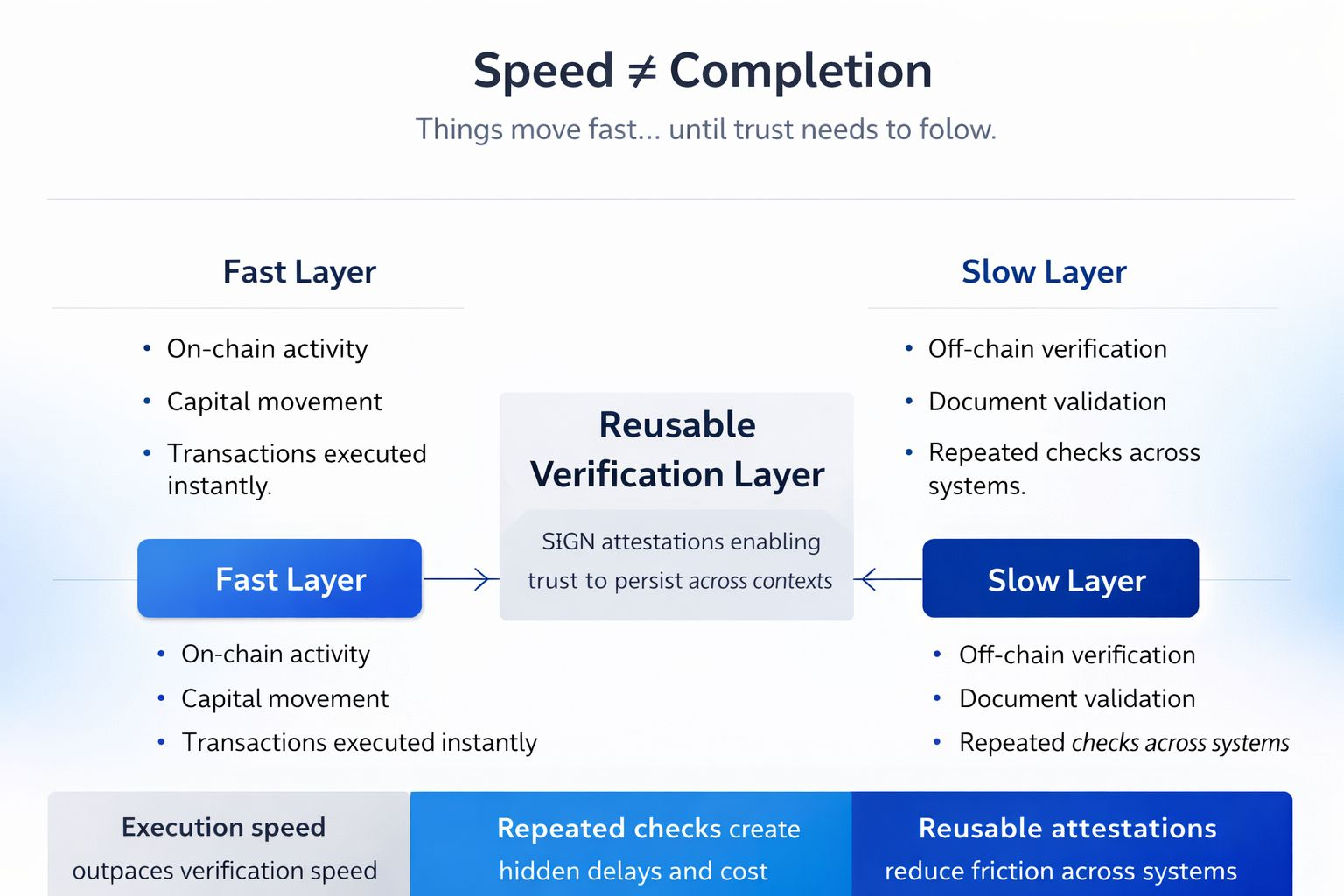
And I think that’s where SIGN starts to make sense, at least from how I فهم it. It’s not trying to compete with chains or become some big visible layer. It feels more like it’s targeting that gap between speed and trust.
Because right now, onchain activity is fast. But offchain verification is still fragmented. Who signed what, which version is valid, whether another system accepts it… those questions don’t move at blockchain speed.
So everything gets rechecked.
What SIGN seems to be doing is trying to make that verification reusable. If something is already proven, it shouldn’t need to restart every time it enters a new context. That sounds simple, but if it works, it removes a lot of hidden friction.
And that’s probably why it doesn’t look exciting.
Infrastructure like this rarely does. Early on, it almost feels unnecessary. Like something you could live without. Until you realize how much time and cost is being wasted without it.
If something like SIGN actually gets adopted at an institutional level, it probably won’t feel like a “crypto product” anymore. It’ll just become part of how systems operate in the background.
Quiet, invisible, but hard to replace.
I might be overthinking it. Maybe adoption takes longer than expected, maybe standards never fully align. That’s always a risk with this kind of idea.
But I do think this is one of those layers people ignore until they suddenly need it.
And by then, it’s not about hype anymore.
It’s about whether it actually works.