

🌍 Introduction: More Than Just Another Crypto Project
At first glance, SIGN might look like just another blockchain project trying to digitize signatures. You’ve seen it before—upload a document, sign it, store it on-chain, and call it innovation.
But that’s not what SIGN is really doing.
Underneath the surface, SIGN is quietly building something far more powerful: a trust infrastructure layer for the internet. Not just for individuals or companies—but for entire ecosystems, communities, and even governments.
This isn’t about documents.
This is about verifiable truth in a digital world.
---
🧠 The Core Idea: Turning Trust Into Code
Traditional systems rely on trust that is:
Repetitive 🔁
Fragmented 🧩
Slow 🐢
Every time you:
Apply for a job
Sign up on a platform
Verify your identity
You’re forced to repeat the same process again and again.
SIGN flips this model.
Instead of repeatedly proving who you are, SIGN allows:
> Trust to be issued once, and verified everywhere.
This is done through attestations—structured, verifiable claims issued by trusted entities.
---
🔗 What Are Attestations (And Why They Matter)?
An attestation is not just a document.
It’s a digital claim that says:
“This person owns this asset”
“This user has completed this task”
“This wallet belongs to a verified human”
Unlike PDFs or screenshots, attestations are:
✅ Cryptographically signed
✅ Easily verifiable
✅ Context-aware
Think of it like this:
👉 A university degree becomes more than a certificate—it becomes a live, verifiable credential.
👉 A DAO contribution becomes more than a record—it becomes a reputation asset.
---
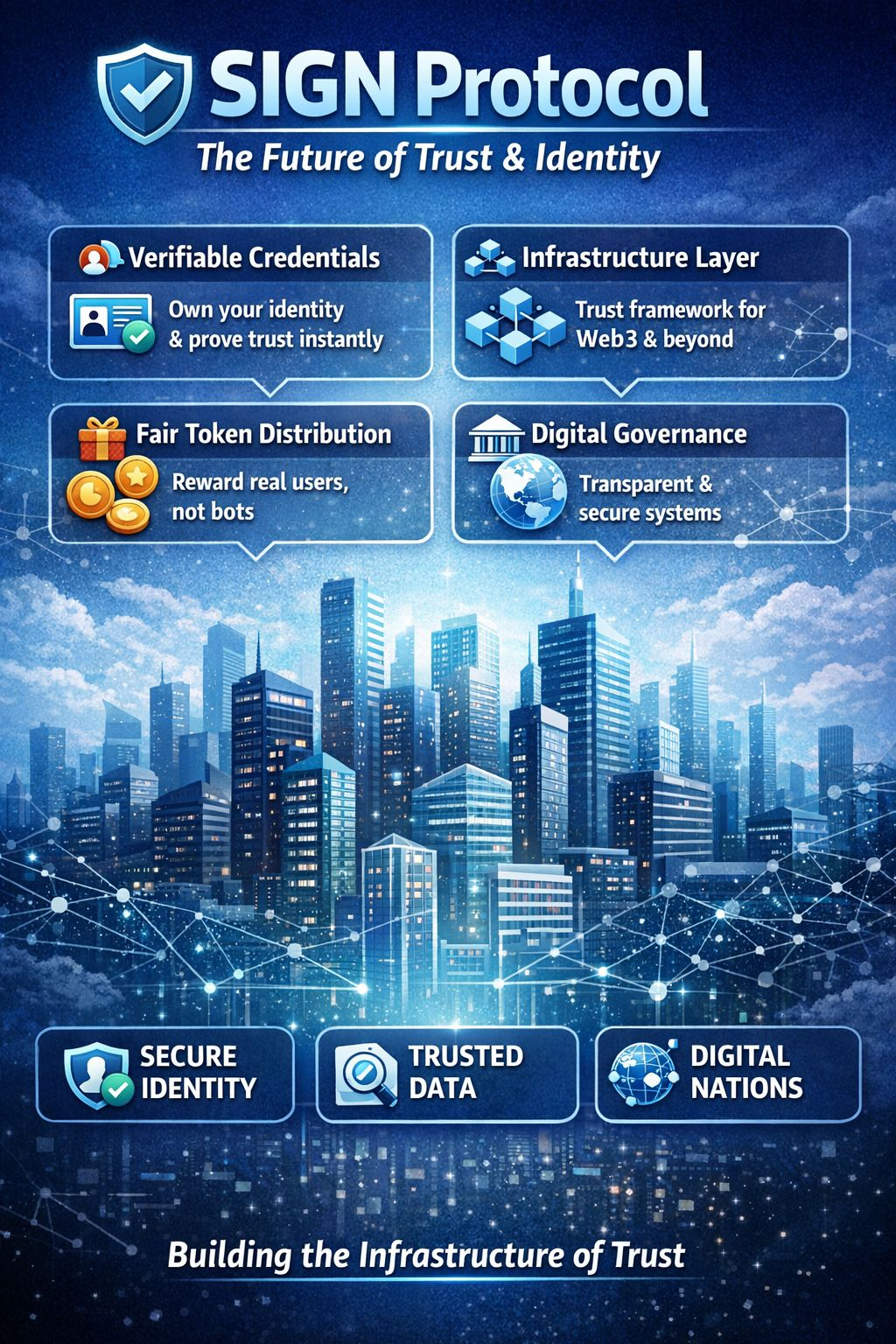
🏗️ SIGN as Infrastructure, Not an App
Most crypto projects build apps.
SIGN builds infrastructure.
That’s a huge difference.
Instead of competing with existing platforms, SIGN integrates into them and enhances:
Identity systems
Token distribution models
Governance frameworks
It acts like a trust layer beneath everything else.
Just like:
HTTP powers websites
TCP/IP powers the internet
SIGN aims to power trust across Web3 and beyond.
---
🪪 Identity Reinvented: From Repetition to Ownership
Let’s be honest—digital identity today is broken.
You don’t own your identity. Platforms do.
SIGN changes that by enabling:
Self-sovereign identity
Reusable credentials
Privacy-first verification
Instead of uploading your documents everywhere, you carry:
> A wallet of verified claims that you control.
This is a shift from:
“Prove yourself every time”
➡️ to
“Own your proof once”
---
🪙 Token Distribution: Fair, Transparent, Programmable
Airdrops and token distributions have always been messy:
Bots exploit systems 🤖
Real users get left out 😞
Criteria is unclear ❓
SIGN introduces a smarter model.
With attestations, projects can:
Verify real users
Reward meaningful contributions
Create transparent eligibility rules
This means:
No more guessing
No more unfair advantages
No more wasted tokens
It turns token distribution into a data-driven, trust-based system.
---
🏛️ The Bigger Vision: Digital Nations & Governance
Here’s where things get really interesting.
SIGN is not just about Web3—it’s about governance at scale.
Imagine:
Voting systems with verifiable identities
Public services with trusted eligibility checks
Cross-border digital credentials
This is where SIGN’s S.I.G.N. (Sovereign Infrastructure for Global Networks) vision comes in.
It enables:
Governments
Institutions
Communities
to operate with:
> Transparent, programmable trust systems
This is how digital nations are built—not with hype, but with infrastructure.
---
🔄 Real-World Use Cases That Actually Make Sense
SIGN is not theoretical. It solves real problems.
🎓 Education
Degrees issued as verifiable attestations
No more fake certificates
💼 Employment
Verified work history
Instant background checks
🌐 Web3 Communities
Reputation-based roles
Contribution tracking
🏥 Healthcare
Secure, shareable medical records
Patient-controlled data
🏠 Ownership
Land titles and assets as verifiable claims
Each use case shares one thing:
> Trust becomes programmable and portable
---
⚙️ Why SIGN Stands Out in a Crowded Market
Let’s be real—crypto is full of noise.
SIGN stands out because:
It doesn’t chase hype
It solves fundamental problems
It builds quietly but meaningfully
While others focus on:
Price action 📉📈
Short-term narratives
SIGN focuses on:
Long-term infrastructure
Real adoption
System-level change
---
🔐 Privacy Without Compromise
One of the biggest challenges in digital systems is balancing:
Transparency
Privacy
SIGN handles this intelligently.
Users can:
Prove something without revealing everything
Share only what’s necessary
Maintain control over their data
This is critical in a world where:
> Data is valuable, but privacy is essential.
---
🌱 The Network Effect: Why This Can Scale Fast
The power of SIGN increases as more participants join:
More issuers → more trusted data
More users → more use cases
More integrations → more value
This creates a compounding network effect.
Once trust becomes standardized:
> It becomes extremely hard to replace.
---
📊 Market Position: Early but Strategic
SIGN is still early in its journey.
But that’s where the opportunity lies.
It’s positioning itself at the intersection of:
Identity
Data
Governance
Web3 infrastructure
These are not small markets—they are foundational layers of the digital future.
---
🧭 Challenges Ahead (Let’s Be Real)
No project is perfect.
SIGN will need to:
Drive adoption beyond crypto
Educate users and institutions
Compete with existing identity systems
But the difference is:
> It’s solving a real problem, not creating artificial demand.
---
💡 My Perspective: Why SIGN Matters
Most people underestimate infrastructure projects because:
They’re not flashy
They don’t pump overnight
But historically:
> Infrastructure is where the real value accumulates.
SIGN is building:
Trust rails
Identity layers
Verification systems
These are things every digital system needs.
---
🔮 The Future: Where This Could Go
If SIGN succeeds, we could see:
A world where identity is owned, not rented
Airdrops that reward real contribution
Governments using blockchain for real services
A global standard for trust
And most importantly:
> A digital world that actually makes sense.
---
🛠️ Suggestions & Insights (For Investors & Builders)
📌 If You're an Investor:
Focus on long-term adoption, not short-term price
Watch partnerships and integrations
Look at real usage metrics
🧑💻 If You're a Builder:
Integrate attestations into your app
Use SIGN for user verification
Build systems that rely on trust, not assumptions
🌍 If You're Just Exploring:
Learn how digital identity works
Understand the shift from documents → data
Pay attention to infrastructure projects early
---
✨ Final Thoughts: Quietly Powerful
SIGN is not trying to be loud.
It’s not chasing attention.
It’s doing something far more important:
> Building the invisible layer that everything else will rely on.
And in tech, those layers often matter the most.
---
🚀 Closing Line
In a world full of noise, SIGN is building signal.
And that might be exactly what the future needs.