

There were two lands, both growing fast.
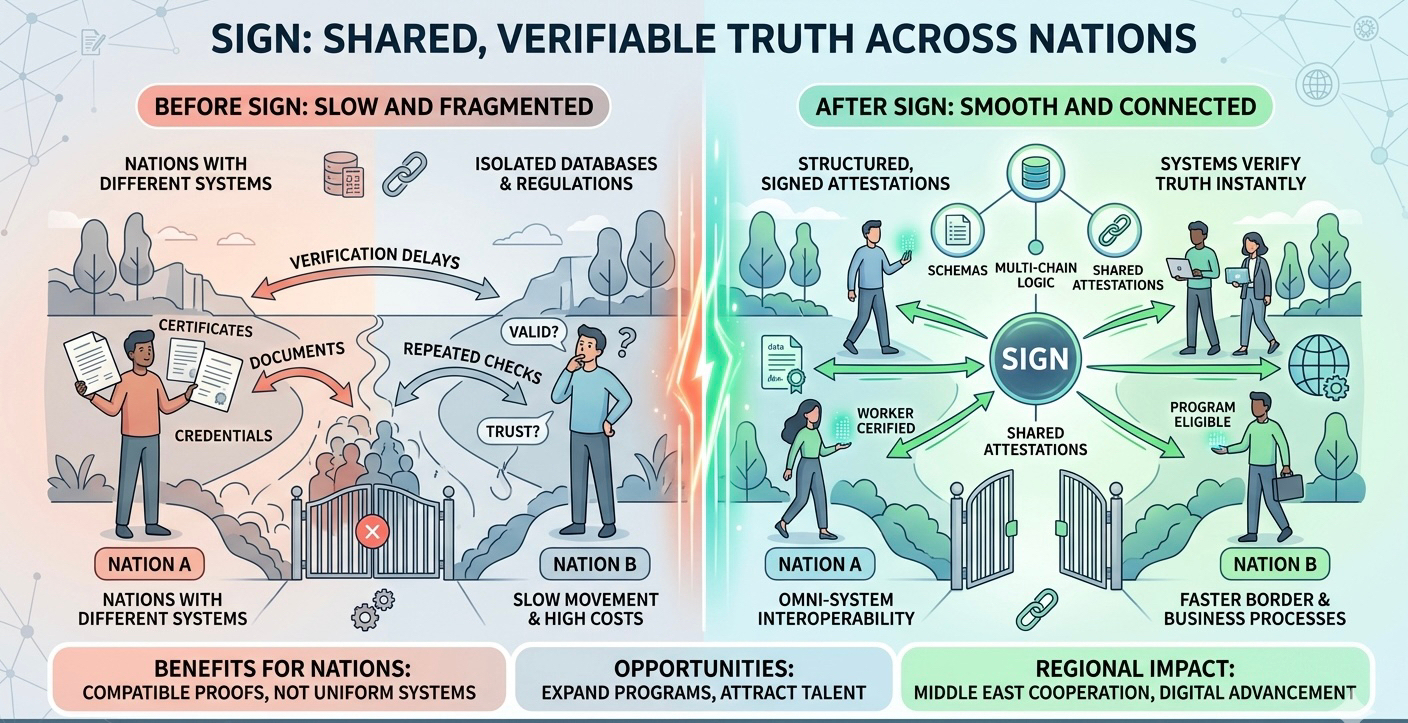
One had built strong systems. Clean databases, digital services, smart governance. The other had done the same, but in its own way. Different rules, different structures, different logic.
Both were powerful.
But when people tried to move between them… everything slowed down.
A worker carried certificates. “Is this valid here?”
A business brought documents. “Can we trust this?”
A program tried to include foreign participants. “How do we verify them?”
So many questions.
Not because the information was wrong…
but because systems could not agree on truth.
Each land trusted its own records, but not the other’s. So verification became long, heavy, repeated. Trust had to be rebuilt every time, at every border, inside every process.
Then, without noise, something new was introduced beneath both lands.
SIGN.
It did not ask them to merge systems.
It did not force one standard over another.
It offered something simpler… a shared way to prove.
Now, when a university in one land issued a credential, it became an attestation. Structured, signed, verifiable. Not just a document, but a piece of truth with origin and format.
When the second land needed to check it, they didn’t call, didn’t delay.
They just… verified.
And the answer was clear.
This is where SIGN starts connecting nations, not politically, not socially, but logically. Through attestations that can move across systems, across chains, across borders.
One proof, many uses.
And slowly, the gates between lands started behaving differently.
A developer applied for work across borders. Their skills were already attested. No long waiting. No repeated validation. Just a system reading what was already proven.
A startup expanded into a new region. Business credentials verified instantly. Compliance checks became faster, cleaner.
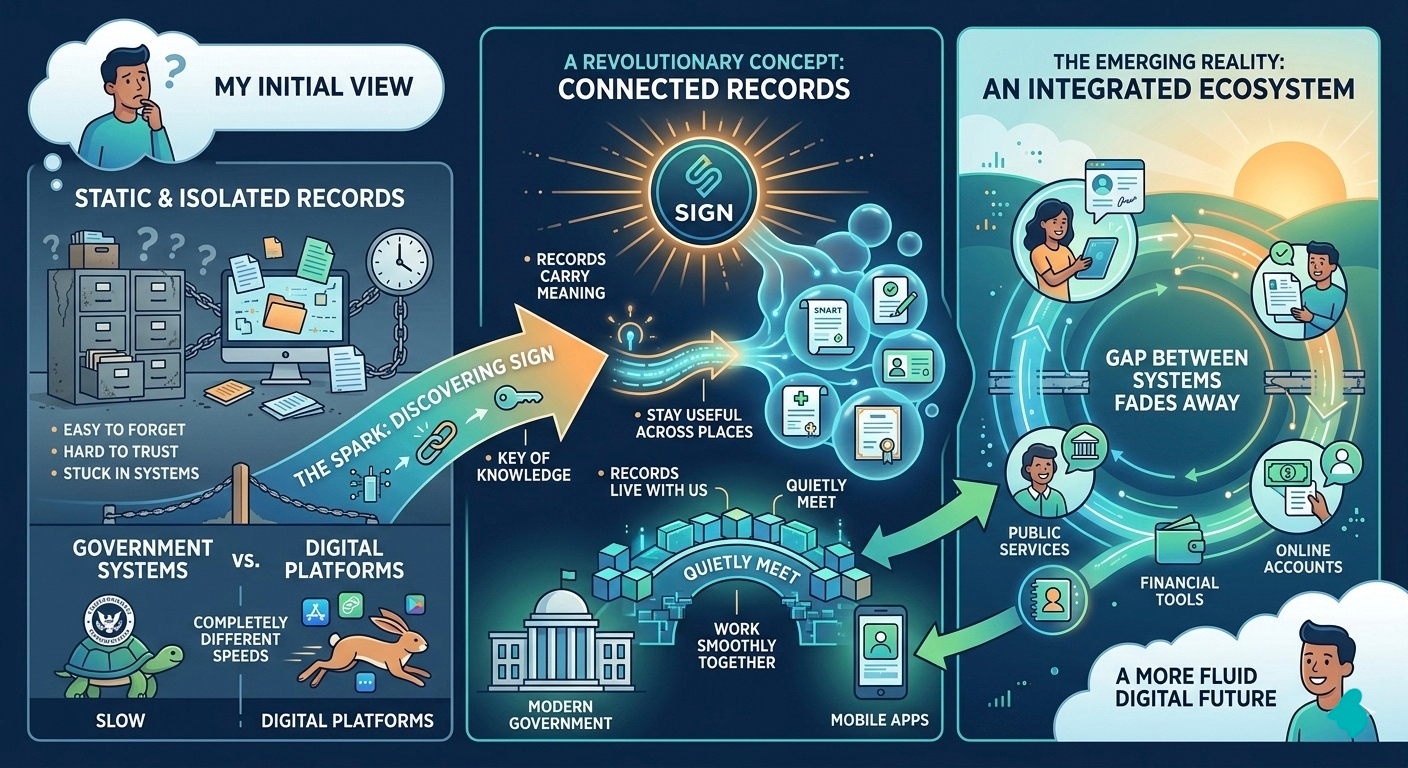
Even government programs began to stretch beyond borders. Eligibility could include foreign participants, because their data was no longer unknown. It was verifiable.
The lands did not become the same.
They became… connected.
This is the deeper layer SIGN builds. An omni system where different blockchains, different databases, different national infrastructures can all interact through one shared logic… proof.
It works because attestations are structured. Each one follows a schema. This means machines, not just humans, can understand them. Systems can check validity instantly, without interpretation, without confusion.
And because SIGN is multi chain, it does not stay locked in one network. It flows across ecosystems, adapting where needed, connecting where possible.
Truth is not trapped.
It travels.
In regions like the Middle East, where multiple countries are building strong digital futures at the same time, this becomes very powerful. Each nation moves at its own pace, with its own priorities. But with SIGN, they don’t need identical systems to cooperate.
They just need compatible proofs.
And that changes everything.
Because cooperation becomes easier.
Movement becomes smoother.
Opportunities become wider.
Back at the gate between the two lands, something feels different now.
No long lines. No stacks of papers. No arguments over validity.
A system checks an attestation.
It finds the source.
It confirms the truth.
And the gate opens.
Not because someone “decided” to trust.
But because trust was already built into the proof.
And maybe that is the quiet future SIGN is shaping.
Not a world where everyone becomes the same.
But a world where different systems, different nations, different economies…
can still understand each other.
Not through negotiation alone.
But through something much simpler.
Shared, verifiable truth…
moving freely,
without losing meaning.