
 A few days ago I needed a very simple document verified. Nothing serious. Just a basic approval. What surprised me wasn’t the delay itself, that part felt normal. It was how many times the same thing had to be checked again. One person looked at it, then another, then someone higher up just to be safe. The record was already there, clearly written. Still, nobody really trusted it on its own.
That kind of thing sticks with you. Not because it’s unusual, but because it’s everywhere once you notice it. Systems store everything. Files, entries, logs. Governments especially. But storage doesn’t settle anything. It just holds information in place. The moment someone else needs to act on that information, the whole cycle of verification starts again, almost like the record never existed in the first place.
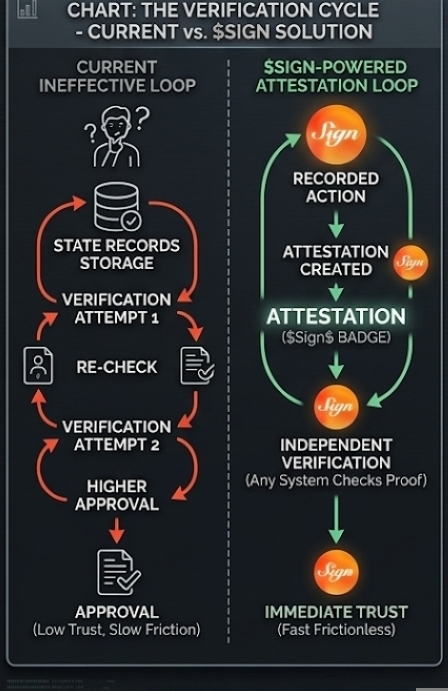
I used to think this was just inefficiency. Poor design, maybe outdated processes. Lately I’m not so sure. It feels more structural than that. Records describe what happened. They don’t carry enough weight to prove it independently. So people step in, interpret, confirm, and repeat. Over and over.
That’s roughly where $SIGN starts to make more sense to me, though not immediately. At first glance it looks like another piece of infrastructure sitting somewhere in the middle. Hard to place. Not quite a payment system, not exactly data storage either. It took a bit of digging before it clicked that the focus is somewhere else entirely.
The idea of an attestation sounds abstract until you reduce it. It’s basically a claim that can be checked later without going back to the person who made it. Not just “this happened,” but “this happened, and here’s who said it, under what conditions, and here’s how you verify that claim without asking them again.” That last part is where it shifts. Because right now, most systems still rely on going back to the source.
And maybe that’s the real friction. Not moving data, but re-trusting it every time.
If sovereign systems start using something like this properly, the behavior could change in ways that aren’t immediately obvious. A decision wouldn’t just sit as a record waiting to be interpreted. It would carry its own proof. Another system, another department, even another country could reference it directly. No back-and-forth emails. No “can you confirm this again.” Just check and move forward.
Though I keep hesitating when I think about how that actually plays out. Governments don’t move like that. They don’t adopt new coordination layers overnight. Even when something clearly reduces friction, there’s still hesitation. Part of it is control. Part of it is trust in the new system itself. You’re asking institutions to rely on proofs instead of processes they’ve used for years. That shift isn’t technical. It’s behavioral.
There’s also a quieter issue underneath. Creating these attestations is one thing, but why would they be reused? That’s where the value is supposed to build. If a proof gets referenced again and again, it saves time, reduces overhead, and slowly becomes part of how systems operate. But if it’s created once and then ignored, it doesn’t really change anything. It just adds another layer on top of existing complexity.
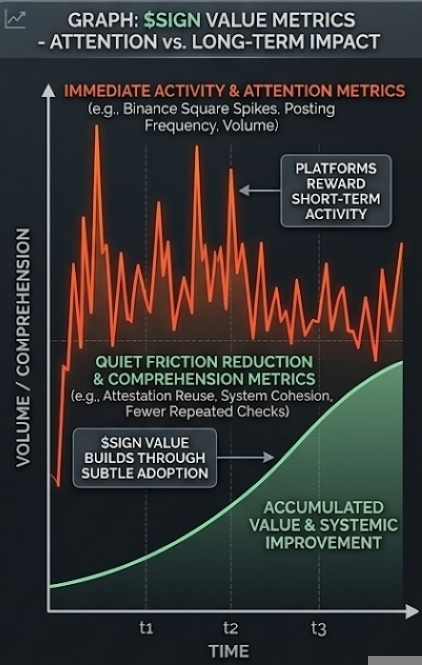
I’ve seen something similar in markets. Activity looks impressive at first. Numbers go up, dashboards look busy. But when you look closer, nothing connects. Each action is isolated. No accumulation. No memory that actually matters. It feels productive, but it doesn’t compound.
And that’s where it gets a bit awkward when you think about visibility. Platforms like Binance Square reward what can be seen easily. Engagement, reach, movement. Even the scoring systems behind the scenes tend to favor things that generate clear signals. A system that quietly reduces friction doesn’t really show up there. You don’t get a spike for “less confusion” or “fewer repeated checks.” Those improvements are real, but they’re subtle. Hard to rank. Hard to notice.
So there’s this strange mismatch. The layer that might matter most in practice is the one least likely to look impressive in public metrics. Meanwhile, attention flows toward things that produce immediate activity, even if that activity doesn’t hold much long-term value.
I don’t think that makes $SIGN weak. But it does make it easy to misunderstand. If you approach it like a typical token, looking for direct usage signals or short-term growth patterns, it feels incomplete. Almost quiet. But if you shift the lens toward coordination, toward how systems prove and reuse decisions, it starts to look different.
Still, I can’t fully convince myself either way. There’s something unresolved here. Maybe it’s the dependency on adoption. Or the fact that trust systems don’t fail loudly, they just slow everything down until people accept it as normal. Fixing that doesn’t create excitement. It just removes friction people have already gotten used to.
I guess the real question isn’t whether systems can store better records. That part feels solved already. It’s whether those systems can reach a point where a recorded action is enough on its own. Not something that needs interpretation, not something that needs repetition. Just… accepted, because it can be proven.
And I’m not sure we’re there yet.