
Money is a strange thing when you stop treating it as money and start seeing it as a promise someone signed.
When I first looked at stablecoins, I thought of them as digital dollars with better rails. Faster transfers, lower fees, global reach. That’s the surface story. But underneath, they’re really claims. A USDT token is a claim that somewhere, someone holds a dollar or something close to it. That claim only works because enough people believe it does, and because redemption hasn’t broken at scale.
That belief is holding strong right now. Stablecoins crossed 150 billion dollars in total supply recently, and daily transfer volumes often rival major card networks. But those numbers matter less for their size and more for what they reveal. People aren’t just trading crypto with stablecoins anymore. They’re using them as settlement layers, as collateral, as quiet infrastructure.
And yet, the foundation is still trust in issuers.
That’s where the idea behind @SignOfficial Protocol starts to shift the frame. Instead of money being a claim backed by reserves, it becomes a claim backed by signatures. Not signatures in the casual sense, but verifiable attestations onchain. You’re not holding a token because someone promises redemption. You’re holding something because a set of entities have signed off on its validity under specific conditions.
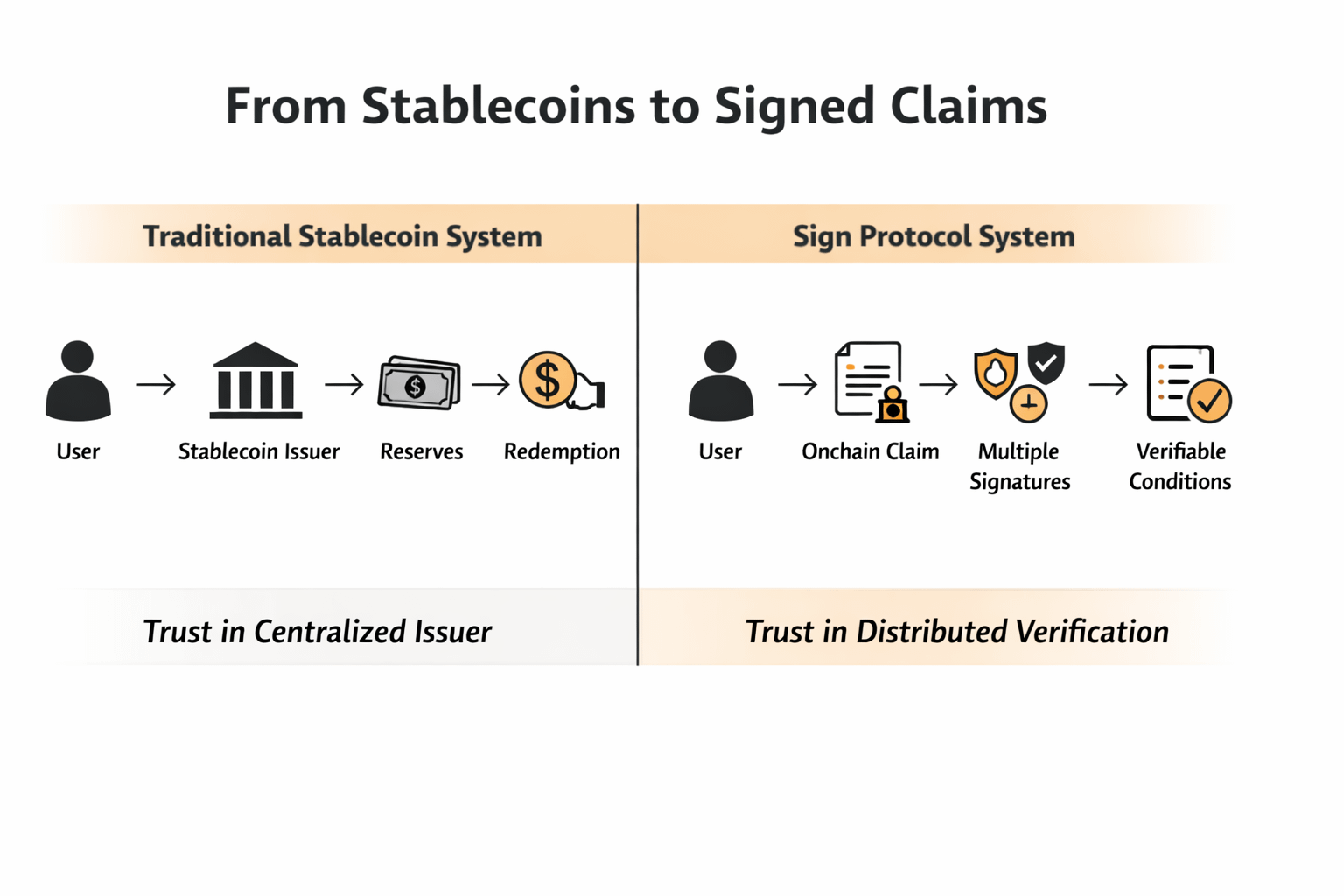
On the surface, that sounds abstract. Underneath, it’s simple. A stablecoin says, “this equals one dollar because we say so and you can redeem it.” A signed claim says, “this equals one dollar because these parties attest to it, and here’s the proof you can check yourself.”
That difference matters more than it first appears. If the claim is defined by signatures, then the rules of that claim can evolve. You can have conditional money. Funds that are only valid if certain conditions remain true. Collateral that updates based on real-time attestations. Payments that carry context, not just value.
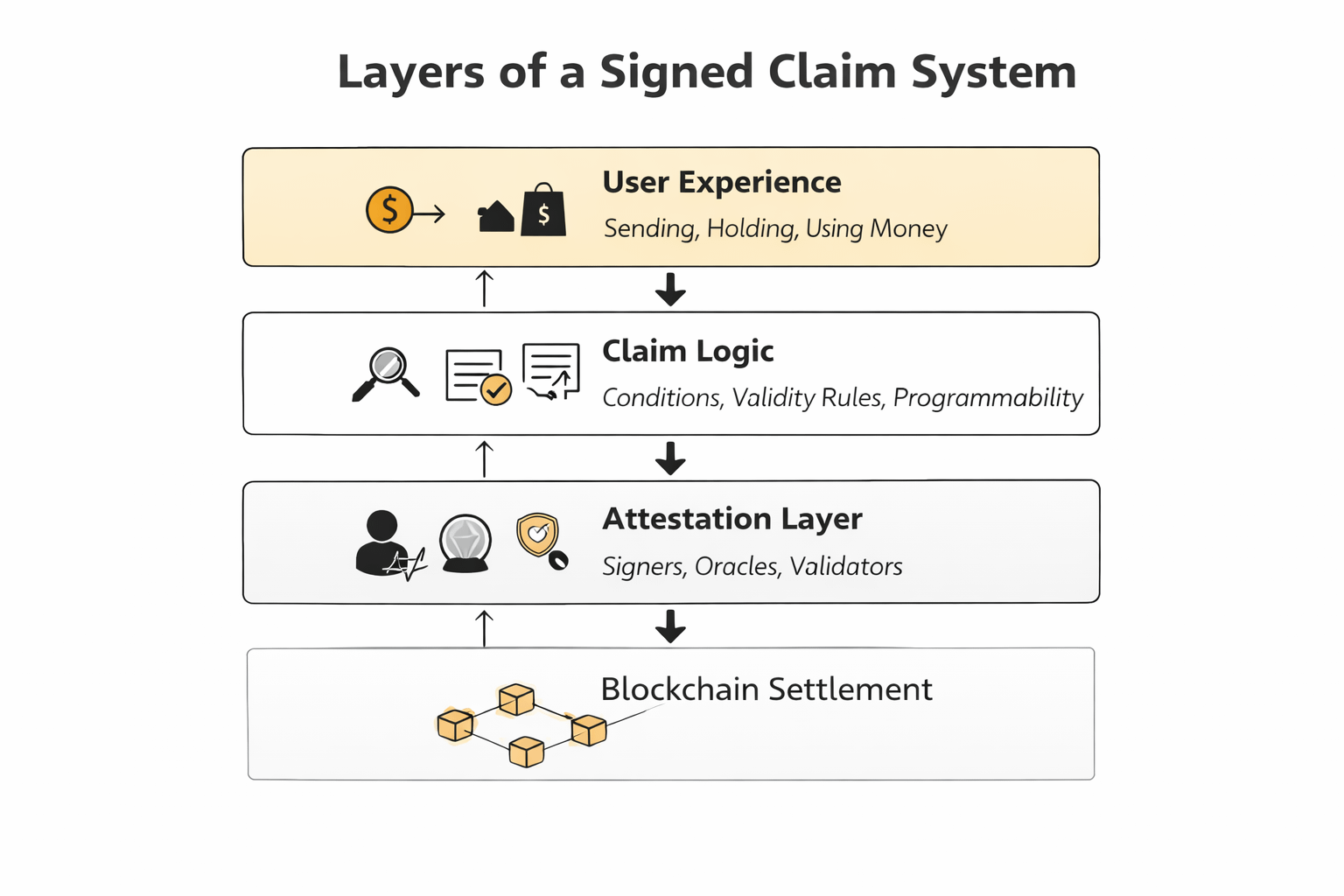
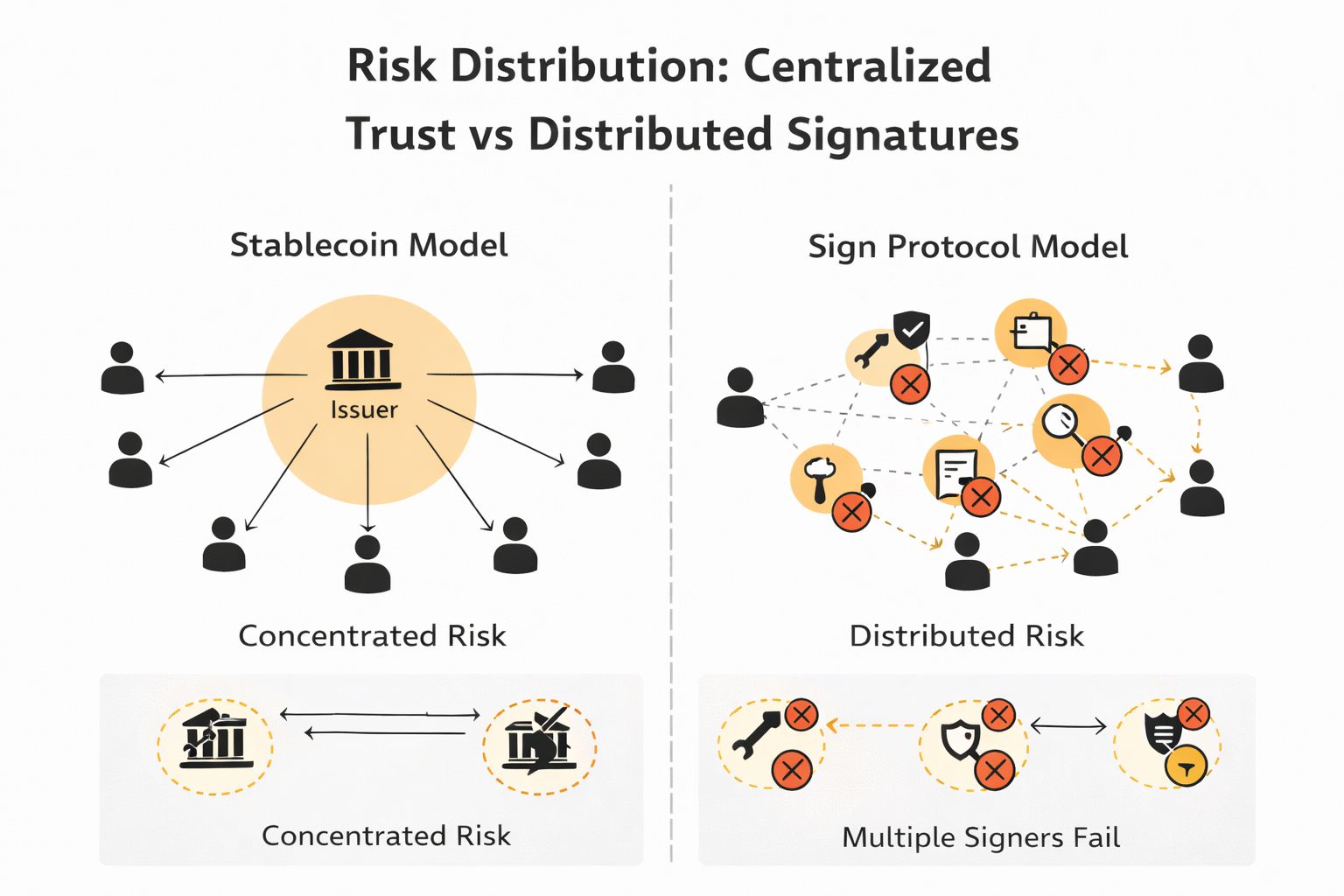
That momentum creates another effect. It moves trust from institutions to processes. Today, if Tether or Circle fails, the system shakes. With signed claims, the risk distributes across whoever is signing and verifying. That doesn’t remove risk. It changes its shape.
And the risks are real. If the signing parties collude, the system breaks in a different way. If the verification layer gets too complex, users stop checking and fall back on blind trust. We’ve seen this pattern before. Complexity quietly reintroduces centralization.
Meanwhile, the market is already nudging in this direction. Onchain attestations are growing. Protocols are experimenting with identity-linked assets, compliance-aware tokens, and proof-based collateral. Even in DeFi, overcollateralization rates hovering around 150 percent tell you something. We don’t fully trust the claims yet, so we overcompensate.
Understanding that helps explain why Sign Protocol feels less like a new product and more like a shift in how we define value. It’s not trying to replace stablecoins directly. It’s asking a deeper question. What if money itself is just a structured agreement, continuously verified?
If this holds, stablecoins as we know them might start to look like a transitional form. Useful, necessary, but incomplete. The next layer isn’t just faster money. It’s more expressive money.
And that connects to a broader pattern showing up across crypto right now. Everything is moving from static to dynamic. From fixed balances to stateful assets. From simple ownership to conditional rights. The texture of value is changing, becoming more granular, more context-aware.
It remains to be seen whether users will care about the difference. Most people just want their dollar to stay a dollar. But systems evolve underneath long before behavior catches up.
What struck me is this. If money becomes a collection of signed truths instead of a single promise, then stability won’t come from what backs it, but from how convincingly it can be verified.
