
By Steve Ngok, Chief Strategy Officer at DoraHacks
I shook Jensen’s hand at GTC 2026 last week. That was cool. But it’s not why I’m writing this.
What stayed with me happened in the margins. At booths, over conference coffee, in those fifteen-minute hallway conversations that quietly reshape how you think about an entire industry. My colleague Jonathan Breton and I spent four days at GTC not just watching demos, but talking to the people who built them. And the same confession kept surfacing, sometimes word for word:
I built something incredible. Now how do I get it in front of the right people?
Not just “people.” The right people.
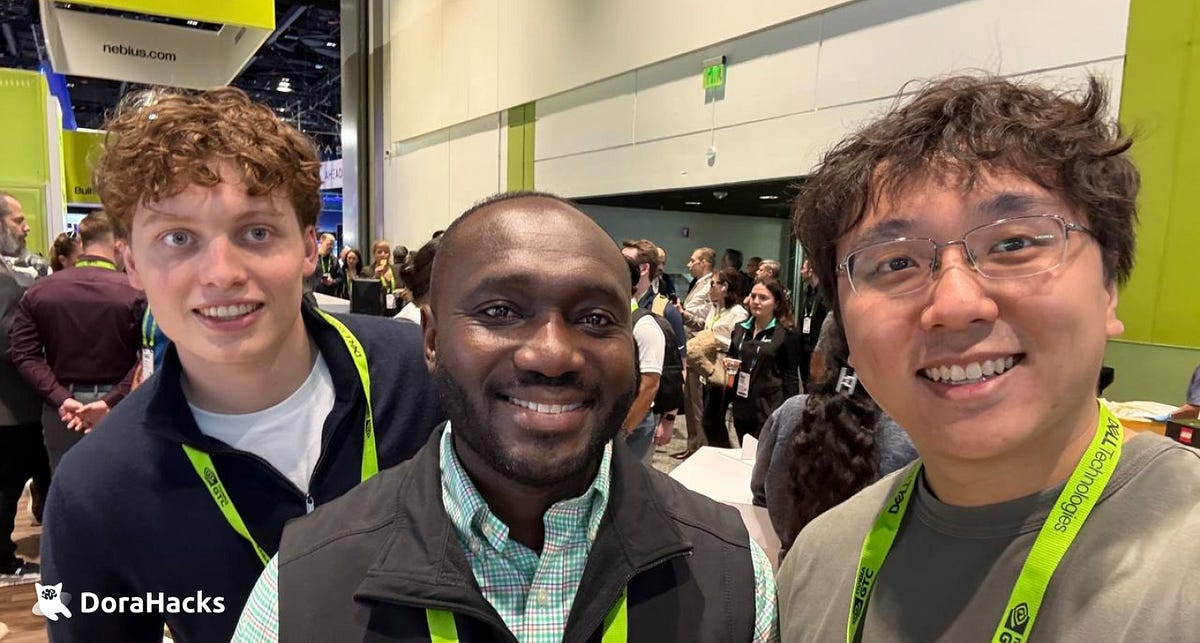
Here’s a specific example. Schneider Larbi, Senior Manager at Google Cloud, showed us an LLM-powered tool for drug discovery and antimicrobial resistance testing — built on NVIDIA Blackwell and Google’s models. It was genuinely impressive, the kind of thing that could compress months of pharmaceutical research into weeks. But showing it at GTC, to 300,000 attendees? How many of them are big pharma researchers? How many are bioengineering grad students who’d actually use this daily? How many are clinical engineers evaluating new tooling for their pipeline?
A fraction. A tiny fraction.
And that’s the gap nobody talks about. We’ve become extraordinarily good at building AI products — and remained stubbornly bad at distributing them. The default playbook is still “blast it on Twitter, write a blog post, maybe sponsor a booth.” Spray and pray. It worked when software was simple. It doesn’t work when your product requires domain expertise just to understand why it matters.
This is why I’ve become convinced that hackathons are the single most effective go-to-market motion for AI products in 2026.
Not hackathons as you remember them — pizza-fueled weekend sprints for college kids.
I mean something fundamentally different: what I call the “Show and Try” model — structured campaigns that route a product to a curated, high-intent audience who will actually become power users.
Schneider’s drug discovery tool shouldn’t just be demoed at GTC. It should be the centerpiece of a targeted hackathon reaching pharmaceutical researchers, biotech engineers, and computational biology students — people who won’t just try it, but integrate it into their work. That’s not a launch event. That’s a distribution engine.
I saw this pattern everywhere at the conference.
Prem Pradeep Motgi, Senior AI Infrastructure Architect at Google, built a reinforcement learning-based inference efficiency system. Brilliant work. The audience that needs it most? ML infrastructure teams at companies burning millions on GPU compute — not a GTC expo hall.
Jeff Adie, Distinguished Engineer at NVIDIA, leads Earth-2 — a real-time weather and climate prediction model capable of generating extreme weather alerts. The builders who should be extending it? Climate scientists, disaster response teams, insurance risk modelers.
Francesco Ciannella at NVIDIA built voice applications on Nemotron, including — and I loved this — a real-time Chinese cooking instructor. Patrick Bayne, Senior Solutions Architect at Databricks, vibe-coded a nationwide flight monitoring dashboard on Lakebase in what felt like no time.
Every single one of these builders shares the same challenge: the product works. The audience hasn’t been found yet.
The Real Problem: What Happens After
But finding the right people is only half the equation. The other half — the half that most organizations completely fumble — is what happens next.
You run a great event. Five hundred developers show up. Fifty build something remarkable. And then… nothing. Everyone goes home. The Slack channel goes quiet. The momentum evaporates. All that signal — who engaged, who built, who came back — is lost.
At DoraHacks(https://dorahacks.io/), we’ve been building what we call a dynamic ontology to solve exactly this: a system that connects hackathon engagement to startup program enrollment to enterprise sales pipeline. The conversion path has to be deliberate, not accidental.
I’ve been talking to teams at Datadog, Microsoft, and ElevenLabs who all run developer and startup programs — and they keep hitting the same wall. They can’t see who went from “hackathon participant” to “active builder” to “enterprise customer.” They have acquisition. They don’t have pipelines. That’s not a marketing problem. That’s an infrastructure problem.
One More Observation
This surprised me, so I want to share it. I had a long conversation with Cesar Guzman, engineering lead at Liverpool Mexico — one of the country’s largest retail chains. His team needs cheap, high-quality image generation for product SKUs at massive scale. Thousands upon thousands of product images.
I recommended he evaluate MiniMax, Kimi, and BytePlus. These Chinese AI models are winning internationally right now on a combination of price and quality that most Western providers aren’t matching. That’s not a controversial opinion — it’s just math. If you need volume and your budget is real, these models deserve serious consideration.
What GTC Reminded Me
GTC reminded me why I love this work. Not the keynotes. Not the handshakes. What stuck was simpler than that: every builder I met is sitting on something genuinely useful, and the distance between “built” and “adopted” is where the most interesting, most valuable problems live right now.
Shrinking that distance — deliberately, measurably, at scale — is what gets me out of bed.
If you’re building an AI product and your go-to-market plan still looks like “launch it and hope,” I’d welcome the conversation. Not to sell you something, but because I spent three days surrounded by proof that there’s a better way — and I think the companies that figure this out first will define the next era of AI adoption.
About DoraHacks
DoraHacks(dorahacks.io) is the leading global hackathon community and open source developer incentive platform. DoraHacks provides toolkits for anyone to organize hackathons and fund early-stage ecosystem startups.
DoraHacks creates a global hacker movement in Web3, AI, Quantum Computing and Space Tech. So far, more than 30,000 startup teams from the DoraHacks community have received over $92M in funding, and a large number of open source communities, companies and tech ecosystems are actively using DoraHacks together with its BUIDL AI capabilities for organizing hackathons and funding open source initiatives.
Website: https://dorahacks.io/
Twitter: https://twitter.com/DoraHacks
Discord: https://discord.gg/gKT5DsWwQ5
Telegram: https://t.me/dorahacksofficial
Binance Live: https://www.binance.com/en/live/u/24985985
Youtube: https://www.youtube.com/c/DoraHacksGlobal