Most crypto projects start with big promises. $SIGN feels different—it’s focused on something simpler but harder: making trust portable.
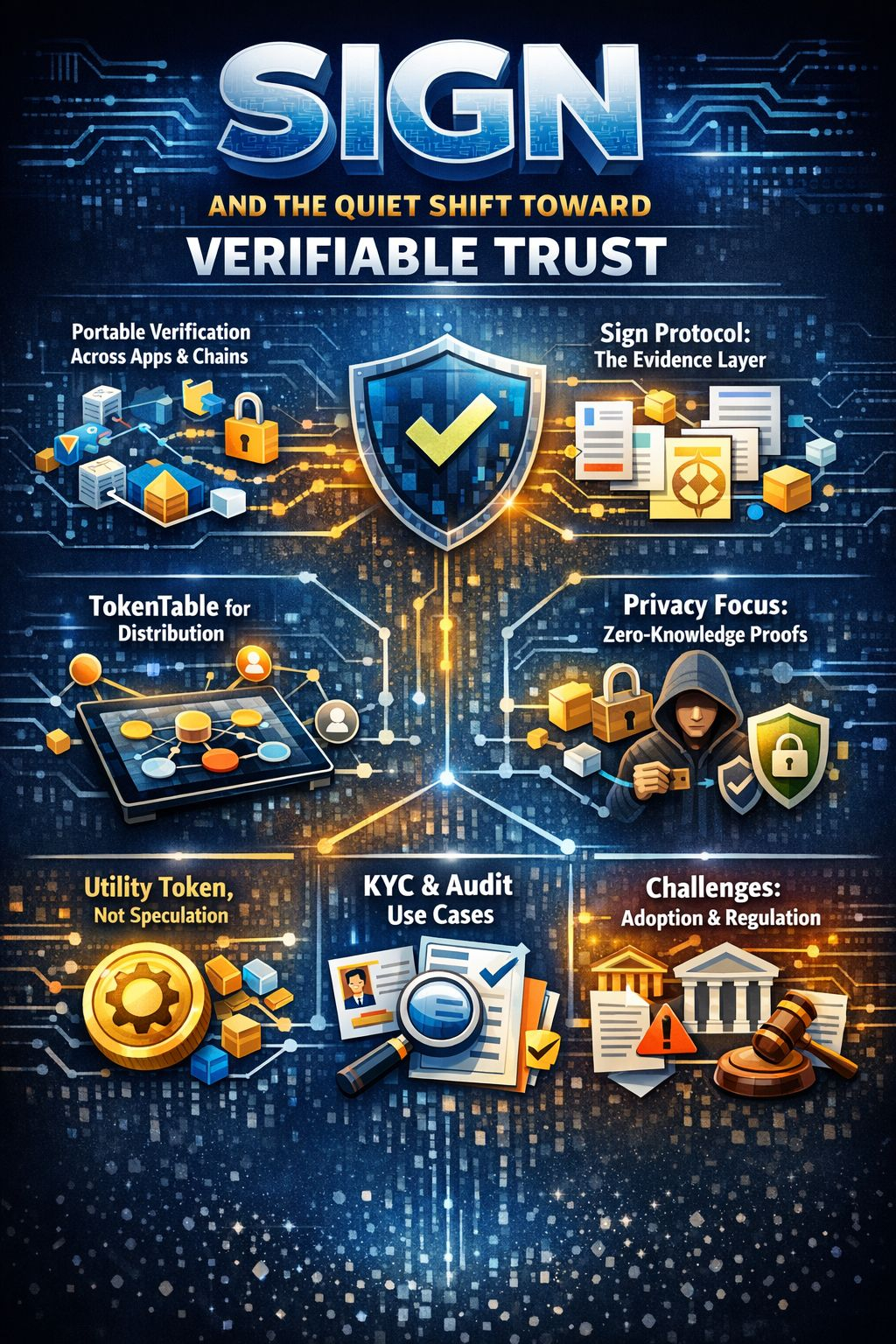
Today, verification is scattered across spreadsheets, screenshots, and private systems. It works… until it doesn’t. SIGN is building a shared verification layer that can move across apps, chains, and institutions without losing meaning. At its core is Sign Protocol, acting as an evidence layer that structures and secures attestations.
What makes SIGN interesting is how it functions as a system, not just a product. Sign Protocol handles structured claims (linking issuer, subject, and schema), while TokenTable manages distribution—who gets what, when, and under what rules. Together, they create a workflow where “prove it” and “pay it” are seamlessly connected.
The architecture stands out. By separating evidence from execution, SIGN avoids dependence on a single chain and gains flexibility. Features like selective disclosure and zero-knowledge proofs show a strong focus on privacy—allowing users to prove something is true without revealing everything behind it.
The token itself plays a practical role. It’s designed as a utility for coordination, governance, and validator participation—not as equity or a dividend asset. That balance is critical in crypto: the token must matter, but not at the cost of trust.
$SIGN is positioning itself in a key narrative: infrastructure for machine-readable trust. This connects with AI, identity systems, and decentralized coordination. Real use cases already exist—like KYC-gated airdrops and verifiable audit records—showing it’s more than just theory.
Challenges remain. Adoption, regulation, and incentive design will shape its future. Systems dealing with identity and capital must navigate compliance, control, and legal complexity across regions.
If SIGN succeeds, it won’t be through hype. It will show up as quiet, consistent usage: more attestations, smoother distributions, and systems that rely on it without users even noticing.
In the end, crypto isn’t just about assets—it’s about coordination. $SIGN N is trying to unify verification, distribution, and identity into one reliable system. If it works, the impact could go far beyond a single token.