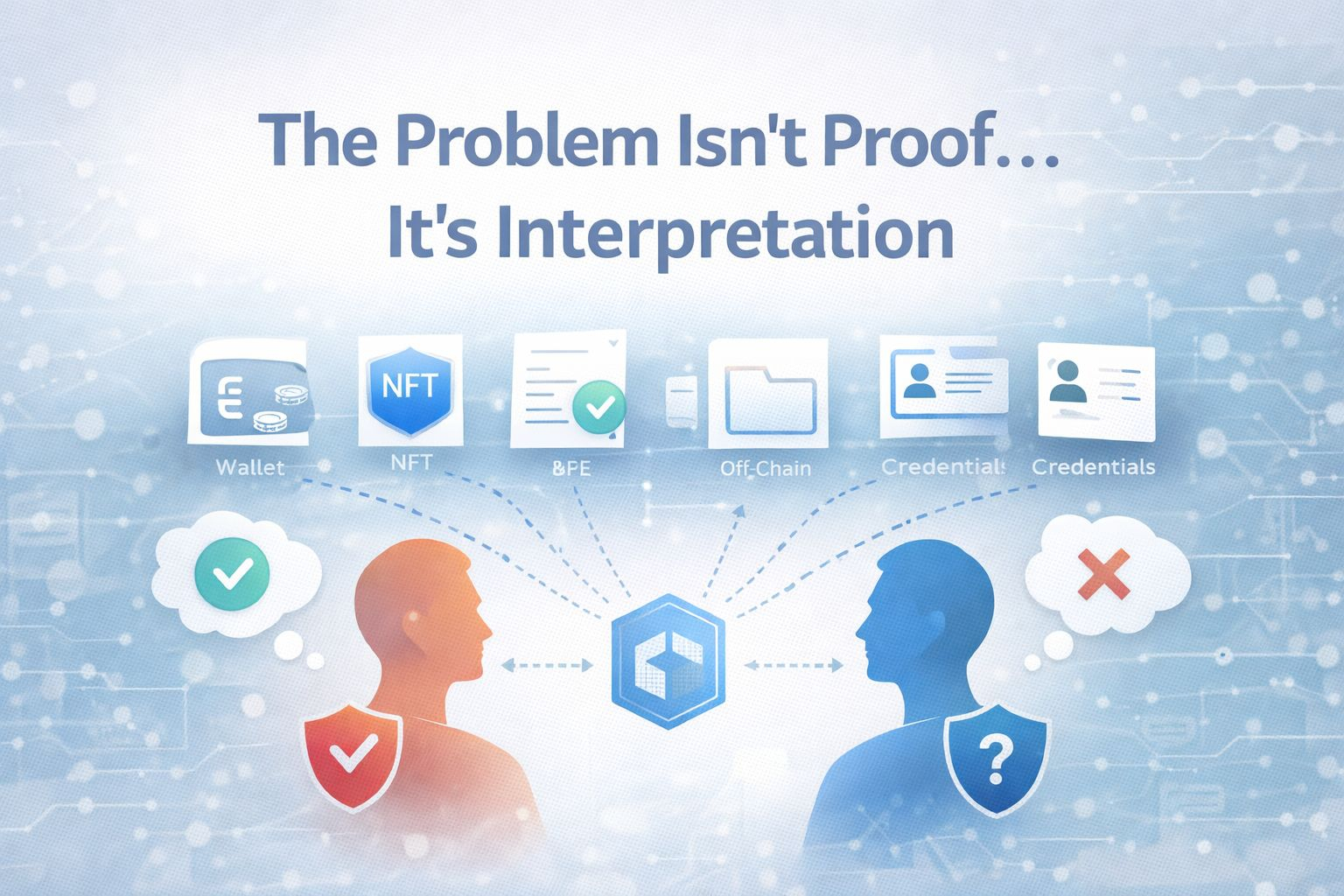
Everyone keeps saying Web3 needs more proof.
I’m starting to feel the opposite.
Maybe… we already have too much proof.
What we don’t have is agreement on what counts.
Look around and you’ll see it.
Wallet history.
NFTs.
On-chain actions.
Off-chain records.
Credentials. Contributions. Activity logs.
Proof is everywhere.
But ask a simple question:
which one actually matters?
That’s where things get uncomfortable.
Because the problem is not creating proof anymore.
It’s filtering it.
Right now, every system quietly makes its own decision.
One platform values transaction volume.
Another looks at social signals.
Another trusts only its own database.
Same user. Same actions.
Different conclusions.
So even if proof exists…
its meaning keeps changing depending on where you go.
That’s the hidden layer most people ignore.
Not verification…
but interpretation.
And interpretation is where control lives.
Looking at @SignOfficial from this angle feels different.
It’s not just about making things verifiable.
It’s about structuring proof in a way that systems can read it consistently.
Schema starts to matter here.
Not as a technical detail…
but as a language.
If proof is written in different “languages”…
then every system becomes its own judge again.
But if structure is shared…
interpretation becomes less arbitrary.
Still… this doesn’t remove the real tension.
Because even with structure, someone decides:
What schema is valid?
Which attestation carries weight?
Who is trusted to issue it?
You don’t escape the question.
You just move it to a deeper layer.
And that’s where this gets interesting.
Because most systems today hide this layer.
They act like decisions are objective…
when they’re actually predefined somewhere behind the scenes.
At least here, it becomes visible.
You can see the rules.
Question them.
Build on top… or reject them.
That doesn’t make it perfect.
It just makes it honest.
I think that’s why this feels less like a product…
and more like a framework for decision-making.
Not deciding truth itself…
but deciding how truth gets recognized.
And maybe that’s the real shift.
Web3 doesn’t need more proof.
It needs fewer silent assumptions about what that proof means.
Because in the end…
It’s not enough that proof exists.
What matters is who gets to interpret it — and whether that logic can be trusted to stay consistent.