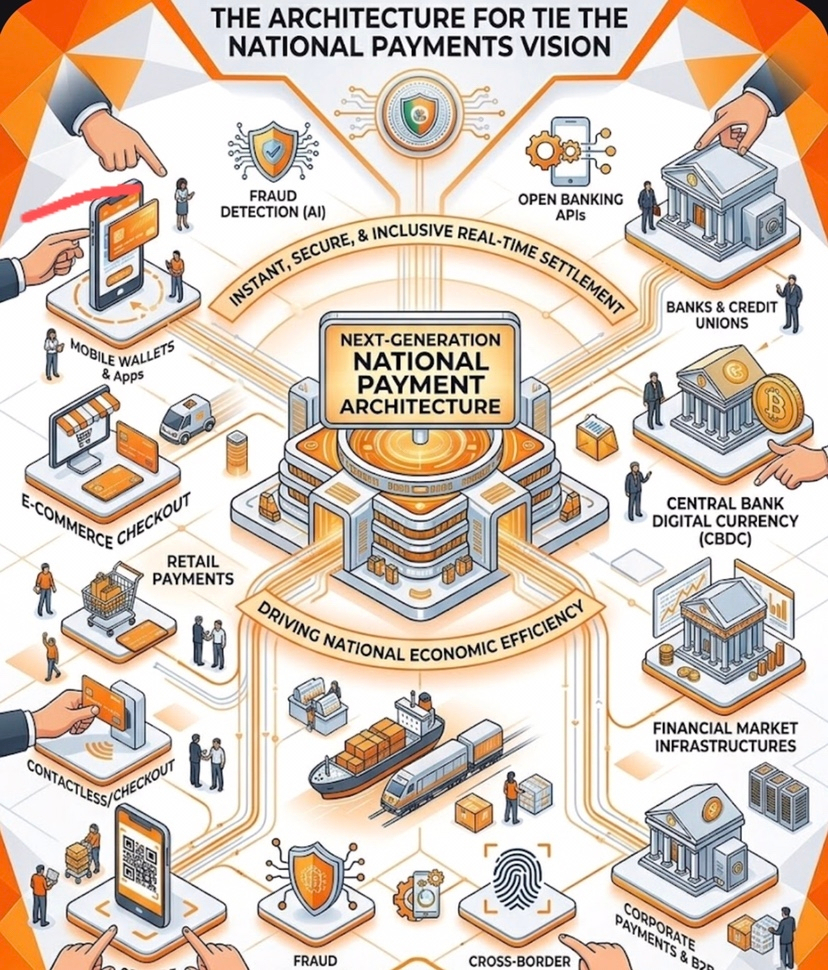
There is a quiet revolution happening all around us. It doesn’t make headlines every day, yet it shapes economies, empowers societies, and transforms how we live: the way a nation moves money.
Behind every tap, scan, or click lies a sophisticated system—the national payment architecture. Today, this is no longer just technical infrastructure. It has evolved into a strategic national asset, driving efficiency, transparency, and financial inclusion.
From Fragmentation to Flow: A New Financial Ecosystem
The next generation of payment architecture marks a decisive shift. Gone are the days of slow, siloed banking systems. In their place emerges a dynamic, interconnected digital ecosystem.
This ecosystem brings together:
Banks
Fintech innovators
Telecom operators
Government platforms
Small merchants
All connected through standardized frameworks that enable seamless, real-time value exchange.
The result? Money moves as freely as information.
Interoperability: Freedom to Transact
At the heart of this transformation lies interoperability.
No more being limited by your bank or wallet provider. Today, systems “talk” to each other. You can:
Send money instantly across platforms
Pay bills effortlessly
Conduct business without friction
This fluidity fuels economic activity and removes long-standing barriers in financial interaction.
Real-Time Payments: Speed That Empowers
Legacy systems took hours—or even days.
Next-generation systems operate in real time.
That means:
Instant clearing and settlement
Immediate access to funds
Stronger cash flow for businesses
Reduced reliance on cash
For small businesses and individuals, this is transformative. Liquidity improves, uncertainty drops, and economic momentum builds.
Security & Trust: The Digital Foundation
Speed without security is risk—and modern systems understand that.
Next-gen architectures integrate:
Advanced encryption
Multi-factor authentication
Biometric verification
AI-driven fraud detection
These systems don’t just react—they anticipate threats. Combined with resilient design, they ensure continuity even during cyberattacks or system failures.
Trust is no longer assumed—it is engineered.
Financial Inclusion: Bringing Everyone In
Perhaps the most powerful impact is inclusion.
Millions remain unbanked globally. But now:
A smartphone becomes a bank
Digital wallets replace physical barriers
Governments deliver aid directly
From rural farmers to urban entrepreneurs, participation in the formal economy is expanding rapidly.
Open Architecture: Innovation Unleashed
Open APIs and standards are unlocking a new wave of creativity.
Developers and startups can build:
Budgeting tools
Micro-lending platforms
Smart financial services
This fosters competition, drives innovation, and ensures services evolve with user needs.
Data: The New Economic Intelligence
Every transaction generates insight.
When used responsibly, data can:
Reveal economic trends
Improve credit scoring
Personalize financial services
But with this power comes responsibility. Strong governance is essential to protect privacy and ensure ethical use.
Cross-Border Payments: Breaking Global Barriers
International payments have long been slow and expensive.
Next-gen systems change that by:
Reducing transaction costs
Enabling faster settlements
Increasing transparency
For countries with large remittance flows, this is a game-changer—directly improving household incomes and national economies.
Future-Ready by Design
Modern payment systems are built to evolve.
With:
Cloud infrastructure
Modular architecture
Continuous upgrades
They can integrate emerging technologies like:
Digital currencies
Blockchain solutions
The system doesn’t just serve today—it anticipates tomorrow.
CBDCs & Stablecoins: A Strategic Convergence
A new financial frontier is emerging—the integration of:
Central Bank Digital Currencies (CBDCs)
Stablecoins
CBDCs bring:
Trust
Regulatory certainty
Monetary control
Stablecoins offer:
Flexibility
Innovation
Programmability
Together, they can redefine digital finance—if balanced correctly.
Building the Framework: Balance is Everything
To integrate these systems effectively, nations must focus on:
1. Regulatory Clarity
Clear rules for:
Licensing
Reserve backing
Transparency
This prevents fragmentation and ensures stability.
2. Seamless Interoperability
CBDCs and stablecoins must interact effortlessly across:
Wallets
Platforms
Payment systems
3. Hybrid Technology Models
Combining:
Centralized control (CBDCs)
Decentralized innovation (blockchain-based stablecoins)
4. Robust Risk Management
Including:
Asset-backed reserves
Real-time audits
Cybersecurity frameworks
5. Monetary Policy Protection
Ensuring stablecoins don’t weaken central bank influence.
Real-Time Settlement: The Power of Now
In a unified financial system, transactions settle instantly.
This means:
No delays
No uncertainty
Reduced counterparty risk
Funds are available immediately, enabling faster decisions and stronger economic confidence.
Liquidity, Transparency, and Resilience
Real-time systems unlock:
Better liquidity management
Full transaction visibility
Stronger regulatory oversight
With technologies like:
Distributed ledgers
High-performance payment rails
Cloud systems
These architectures remain scalable, resilient, and always-on.
User Experience: The Human Touch
Technology succeeds only if people use it.
The best systems are:
Simple
Accessible
Reliable
Whether it’s a rural farmer or a global enterprise, the experience must feel effortless—بسهولة and with confidence.
A Foundation for the Future
This isn’t just about payments.
It’s about:
Enabling opportunity
Driving innovation
Building inclusive economies
A next-generation payment architecture becomes more than infrastructure—it becomes a platform for national progress.
Final Thought
The true success of any financial system lies not in its complexity, but in its ability to serve people securely, efficiently, and fairly.
As technology, policy, and vision align, we are not just redesigning how money moves…
We are redefining how economies grow—and how societies thrive.