

I have a habit: when a target is in an extremely low-volume sideways trend, I tend to spend more time researching it rather than less. The reason is simple: shrinking volume means that emotional buying and selling have temporarily exited the market, leaving behind the state that is closest to the 'real bottom line'.$SIGN The past three days have been in this state—after a sharp drop from $0.03886 to $0.03085, it has been lying around $0.032 for a full three days, with the trading volume shrinking to around 8 million USDT. MA7 and MA25 are almost glued together, while the upper MA99 is consistently pressing down at $0.03398, with volume so low that it makes one wonder if the market has temporarily forgotten about this target. I have been staring at this timeline for a long time, and a question popped into my mind: during these three days of silence, has the issue that was resolved by @SignOfficial disappeared? Is the sanctions list still being updated? Is the deadline for the US-Iran strikes still hanging? Is the supply chain friction that caused Brent crude to break $100 still there? All of these are still present. The price is stagnant, but the roots of demand have not diminished at all. In professional terms, prioritizing survival, I do not rely on sideways movement to find buying reasons; I rely on sideways movement to confirm whether the judgment of 'what are we really waiting for' has changed.
First, let me lay out the data completely.$SIGN Current price $0.03213, today a slight increase of +1.20%, 24h high $0.03696, low $0.03122, trading volume 264 million pieces, transaction amount 8.5485 million USDT. From the historical high of $0.13 to now, the decline exceeds 75%, MA99 continues to press down at $0.03398, and the three days of sideways movement have almost glued MA7 and MA25 together around $0.032, with volume maintained at a very low level, and support below at $0.03085. What I care most about in these numbers is not today’s slight rise, but tomorrow—the unlocking node on March 31, with about 49.17 million pieces unlocking amid this extremely reduced volume, when liquidity is thin, supply pressure will be magnified. The market reaction at this moment is the answer I have been waiting for over the past three days. The upper MA99 is pressing down, and the lower support is at $0.03085; this compressed range will have a directional choice tomorrow. I won't guess the direction; I will wait for the market to show it itself.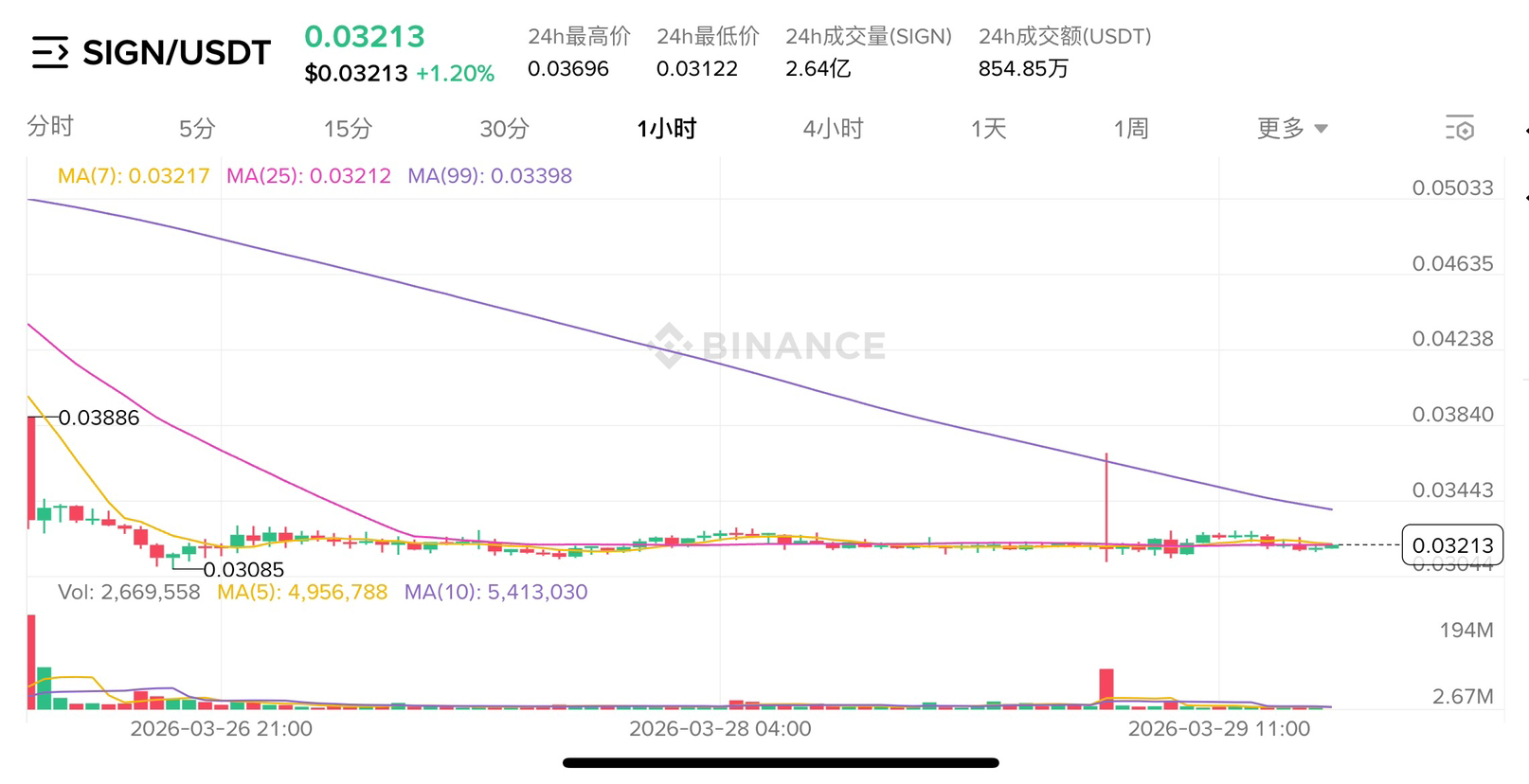
Now let me talk about the thing I clarified during these three days of silence. I have been studying $SIGN for a long time, with fundamental recognition and directional acknowledgment, but I found that I had a cognitive bias that had not been broken: I was always framing this project with "big narratives"—sovereign-level infrastructure, geopolitical issues, cross-border compliance. These terms sound grand, but grand things have a problem: they are too far from most people's daily cognition and easily become narratives that "sound reasonable but are hard to verify." But during these three days of market silence, I shifted my focus from the "big narrative" back to a more specific detail: how is the TokenTable product actually being used? I checked, and projects like Kaito, DOGS, and ZetaChain use it for token distribution, processing over $4 billion, covering 40M+ wallets. This is not a "potential future use case"; it is already a real business volume that has occurred. Then I asked myself a question: if TokenTable disappeared tomorrow, what would happen to the token distribution processes of these projects? The answer is: they would need to find a new distribution system that can handle the same scale, compliance requirements, and multi-chain scenarios, and there are very few alternatives in the market. This cost of replacement is what I believe to be the most genuine moat of the Sign ecosystem, not arising from "how grand the sovereign narrative is," but from "how high the cost of replacing it is for those who are already using it." #SignGeopoliticalInfrastructure
After clarifying this detail, my understanding of the overall architecture of S.I.G.N. has shifted. Previously, I always viewed this system from the perspective of "what big problems it can solve," but now I am starting to look at it from the angle of "who is already using it, and whether it can be easily replaced once used." The $4 billion processing volume and coverage of 40M+ wallets of TokenTable are already in use; the full-chain operation of Sierra Leone's resident identity card is already in use; the growth of Schema from 4,000 to 400,000 and attestations from 685,000 to over 6 million are already in use. What does this accumulation of "already in use" mean at the price of $0.03213? It means that the cost of replacement is rising, it means that ecological stickiness is forming, it means that this infrastructure is not waiting for the first user but is waiting for more users to realize that "the cost of not using it is higher than using it." Sign Protocol's omni-chain attestation transforms the act of "certification" from dependence on intermediaries to a cryptographically verifiable on-chain fact, and EthSign turns protocol signing into on-chain traceable proof. These two things, combined with TokenTable's distribution capability, form a complete pipeline from "certification to distribution," and this pipeline has already been stress-tested by real business volumes, not just a paper vision.
Another thing I focused on during these three days of sideways movement is whether the macro background has been quietly changing. The deadline for U.S.-Iran strikes has been extended to April 6, Brent crude oil remains above $100, and the frequency of updates to the sanctions list has not decreased. This means that the urgency of the demand for "cross-border compliance certification" during these three days of $SIGN sideways trading has not only not decreased but has continued to accumulate pressure. Last night, I saw a piece of news stating that a freight financing platform in a certain Gulf region paused part of its business due to issues with compliance verification channels, involving a substantial amount, but because it wasn’t "sensational" enough, it didn’t trend. This matter speaks to me more than any analytical report: the friction that Sign Protocol is trying to solve is something that is genuinely causing losses every day under this macro background, not a future demand waiting for geopolitical crises to arise but a reality that is happening now. However, I am also very clear that "demand genuinely exists" and "the market is willing to price it now" are two things that can diverge for a long time. During the divergence period, holding positions requires patience and a very clear understanding of one’s risk boundaries.
Let me clearly state the things that make me uneasy, without hiding anything. The first: tomorrow's unlocking node is the biggest uncertain variable after these three days of sideways trading. The unlocking of 49.17 million pieces in a market with a transaction amount of 8.548 million USDT comes at a time of extremely thin liquidity. Regardless of the direction, the volatility will be more intense than in the past three days, and I will not make any position adjustments before the unlocking answer comes out. The second: the upper MA99 continues to press down at $0.03398, which is a technical resistance. Even if the unlocking is smoothly digested, the upward path is not a smooth one; it requires volume support to effectively break through, but I currently cannot see where and when that volume will come. The third: the result of the political node on April 6 is a double-edged sword for the "geopolitical infrastructure" narrative. A de-escalation would reduce the urgency of the narrative, while an escalation would suppress prices due to overall risk aversion. Both outcomes have uncertain impacts on the short-term market. I place these three uneasy matters on the table, alongside the logic recognized by the fundamentals, and observe them together without leaning toward either side.
What is my final judgment? The three days of sideways trading did not change my recognition of the direction, but it made me clarify a detail further—$SIGN's moat does not come from "how grand the sovereign narrative is," but from "the cost of replacing it is increasing for those who are already using it." This detail is more concrete than any grand narrative and is also harder to question. However, my judgment on the timing of entry has not changed: the market reaction to tomorrow's unlocking window is the most recent verification node. I wait for this answer to see if the market can maintain support under the unlocking pressure. If it can, the logic moves one step forward; if it cannot, I will continue to wait. I will not rashly act because of the three-day sideways movement that "feels stable" because three days of silence is a compression before a directional choice, not proof of bottom confirmation. Waiting itself is also position management—not because I am bearish, but because timing and direction are equally important. No calls, everyone do your homework, don’t get too excited.