
Honestly? I been sitting with $SIGN Protocol’s role in public infrastructure, and it feels like it’s trying to fix something most people don’t even question Public service delivery today is messy fragmented databases, repeated verification, slow processes. What Sign is doing is reframing this entire flow around verifiable credentials.
If you look closely, the real inefficiency isn’t just technical
it’s structural.
Today’s systems are built on repeated trust validation.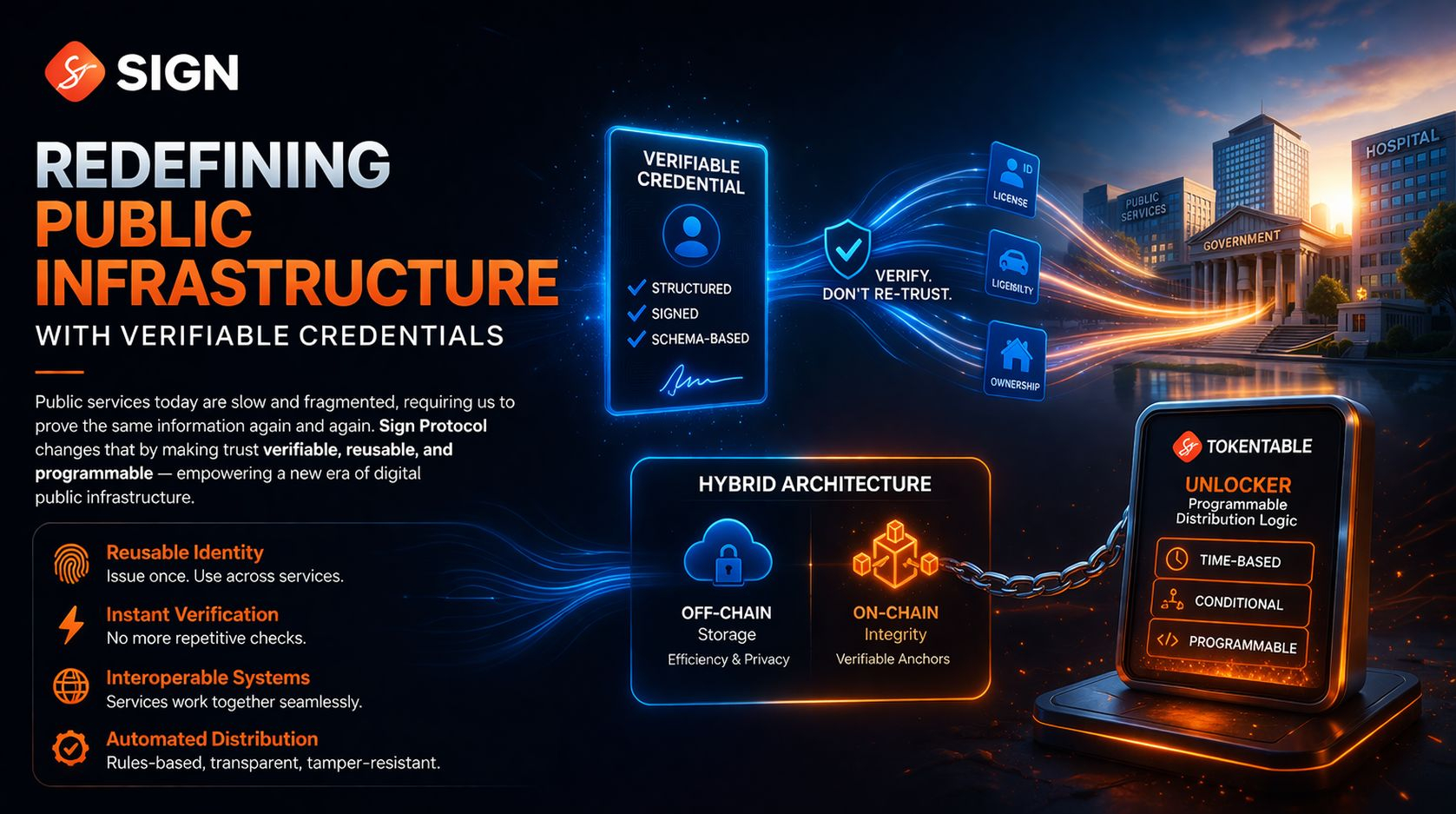
Every institution acts as an isolated authority, forcing users to repeatedly prove identity, eligibility, or ownership.
This creates friction at every step.
Sign Protocol introduces a different model
verify once reuse everywhere
Credentials become verifiable attestations
cryptographically signed, schema-based proofs that carry both structure and authenticity.
This changes the equation completely:
Trust is no longer assumed between systems.
It is proven, instantly and independently.
The architecture reflects this philosophy.
Instead of forcing everything onto a blockchain, Sign adopts a hybrid infrastructure model:
Off-chain layers handle scale, privacy, and data efficiency
On-chain layers anchor truth and ensure integrity
This separation is critical.
It allows real-world usability without sacrificing verifiability.
However, it also introduces complexity.
When multiple layers interact, maintaining data consistency, synchronization, and reliability becomes a serious engineering challenge.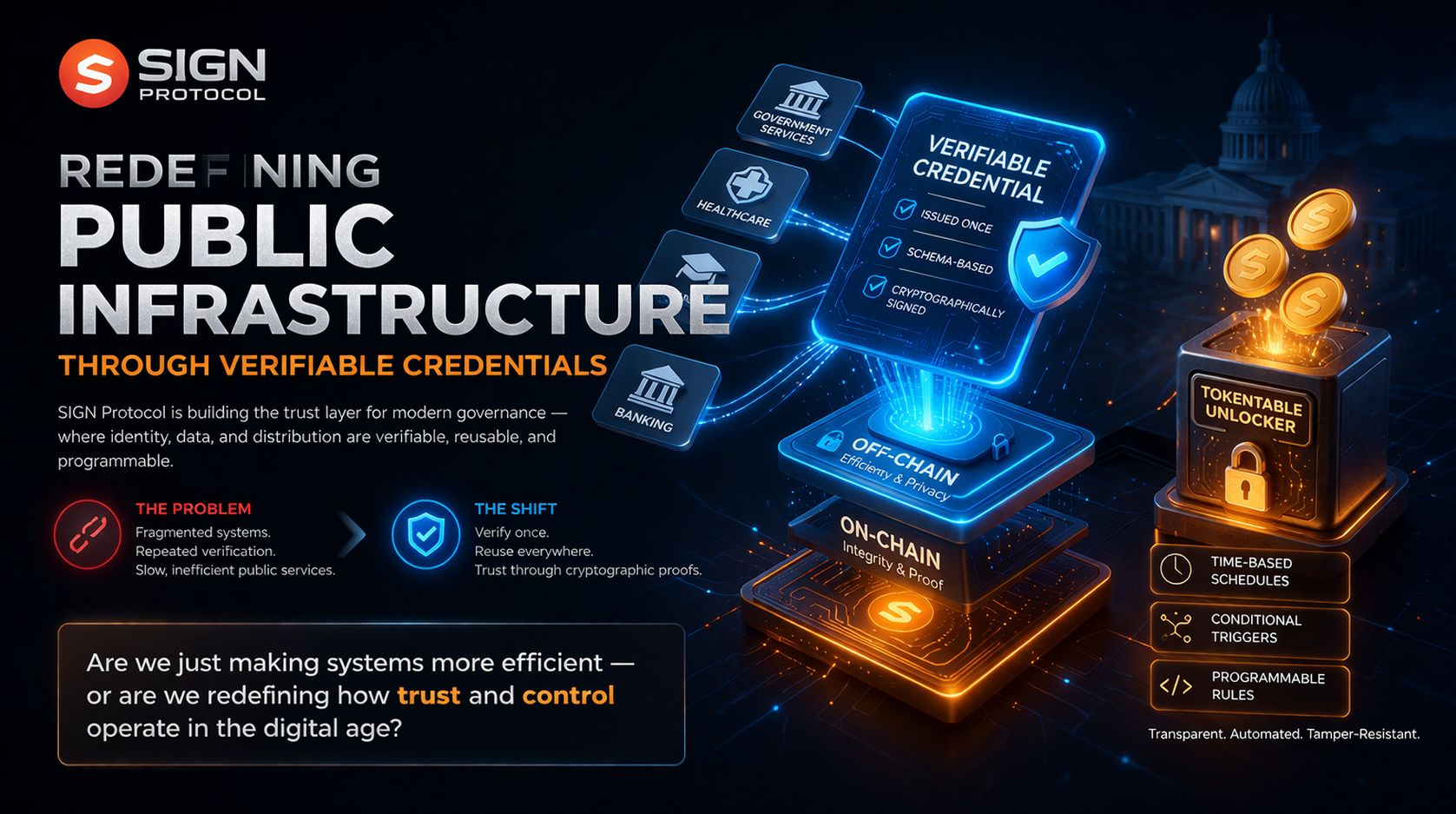
The success of this model depends not just on design but on execution.
Then comes TokenTable’s Unlocker
one of the most underrated but powerful pieces of the system.
At first glance, it looks like a vesting mechanism.
But at a deeper level, it represents programmable distribution logic.
Instead of human-controlled token releases,
distribution becomes rule-based:
Time-driven unlocks
Conditional triggers
Custom logic integrations
This transforms token flows into systems that are:
predictable, transparent, and resistant to manipulation
In short control shifts from discretion to deterministic code.
When all these components come together,
a larger transformation becomes visible.
Sign Protocol isn’t just improving infrastructure
it is attempting to standardize the flow of trust itself.
Identity becomes portable
Verification becomes instant
Systems become interoperable
Distribution becomes autonomous
This is not iteration
It is infrastructure-level redesign
But this raises a deeper question one that goes beyond technology:
If governments and institutions begin to rely on programmable verification layers like this…
Are we simply making systems more efficient?
Or are we gradually redefining how trust, authority, and control operate?
Because when trust becomes infrastructure,
it stops being passive.
It becomes programmable power.