
There is a quiet frustration many people experience but rarely articulate: the need to repeatedly prove things that are already true. A degree earned years ago, skills demonstrated across multiple jobs, or even simple participation in online communities—these facts don’t disappear, yet proving them often requires starting from scratch each time. Why does something so fundamental feel so inefficient in a digital world that promises seamless connectivity?
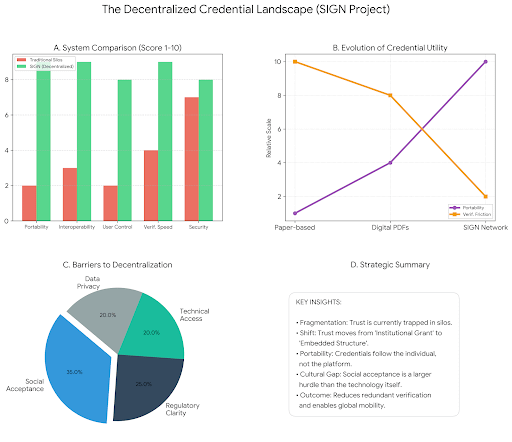
The issue is not the absence of information, but the fragmentation of trust. Credentials exist in many places, controlled by different institutions, platforms, and systems that do not naturally communicate with each other. A university may confirm a degree, a company may validate experience, and a platform may reflect reputation—but none of these signals easily travel beyond their original context. As a result, verification becomes repetitive, slow, and sometimes unreliable.
Historically, this fragmentation has been tolerated because institutions acted as anchors of trust. If a recognized authority issued a credential, it carried weight within certain boundaries. But as work, education, and communities become increasingly global and digital, those boundaries are becoming more visible. A credential that holds value in one region or platform may mean little in another, not because it lacks legitimacy, but because it lacks portability.
Previous attempts to address this problem often focused on digitization rather than transformation. Certificates became PDFs, badges became clickable icons, and verification moved online. While these changes improved convenience, they did not fundamentally solve the issue of interoperability. Most systems still relied on centralized control, meaning users remained dependent on issuers to confirm their own achievements. In some cases, this even introduced new risks, such as data silos, limited access, or single points of failure.
Projects like SIGN approach the problem from a different angle—not by improving existing silos, but by questioning whether silos should exist at all. The idea is to treat credentials as independent, verifiable records that are not confined to any single platform or authority. Using blockchain as a foundation, SIGN enables credentials to exist in a shared environment where verification does not require direct interaction with the original issuer every time.
At a conceptual level, this shifts the role of trust. Instead of being something granted and repeatedly confirmed by institutions, trust becomes something embedded in the structure of the credential itself. A record, once issued, can be verified by anyone with access to the network, reducing the need for intermediaries. This also introduces the possibility of portability—credentials that move with individuals rather than remaining locked within systems.
SIGN also connects this idea to token distribution, which adds another layer to how participation and contribution are recognized. In theory, this allows communities to not only verify identity or achievement but also to align incentives in a transparent way. Credentials and rewards become part of the same ecosystem, potentially reshaping how value and reputation are linked.
Yet, this approach raises as many questions as it attempts to answer. One of the most immediate challenges is social acceptance. Trust is not purely technical; it is deeply influenced by perception and familiarity. Even if a decentralized system is more efficient or secure, institutions and individuals may hesitate to rely on it without established norms or regulatory clarity. The transition from traditional verification to decentralized models is not just a technical shift—it is a cultural one.
There are also practical concerns around data permanence. Blockchain systems are designed to be durable and resistant to change, which is beneficial for integrity but complicated for personal data. What happens when a credential needs to be updated, revoked, or contextualized? Real-world achievements are not always static, and representing them in immutable systems introduces nuanced challenges.
Accessibility presents another layer of complexity. While decentralized systems aim to reduce dependence on centralized authorities, they often introduce new dependencies on technology. Users need a certain level of understanding, access, and comfort with digital tools to participate effectively. This raises the possibility that such systems could empower some while leaving others behind, particularly those already underserved by digital infrastructure.
At the same time, the potential benefits are difficult to ignore. For individuals navigating cross-border opportunities—freelancers, remote workers, or independent creators—the ability to carry verifiable credentials across platforms could reduce friction and open new possibilities. Communities that operate without centralized oversight may find value in systems that provide transparent and tamper-resistant records of participation.
Still, it may be useful to view SIGN not as a definitive solution, but as part of a broader exploration into how trust can evolve in digital environments. The limitations it faces are not unique; they reflect deeper tensions between decentralization and usability, transparency and privacy, innovation and adoption.
Perhaps the more interesting question is not whether systems like SIGN can technically solve credential verification, but whether they can align with the messy, human realities of trust. If proof becomes easier to generate and verify, does that automatically make it more meaningful—or does it risk becoming just another layer of noise in an already complex digital identity?
#SignDigitalSovereignInfra @SignOfficial $SIGN