The Global Infrastructure for Credential Verification and Token Distribution is not something I look at for hypeI look at it because it quietly explains why certain tokens move before the crowd even realizes there’s a narrative forming. Most traders obsess over price action, but I’ve learned the harder way that price is often just the final expression of something already decided at the infrastructure layer. When a system starts verifying identities, permissions, or reputations on-chain, it’s not just organizing datait’s deciding who gets access to capital, incentives, and distribution flows. And that, more than any chart pattern, is what creates asymmetric opportunities.
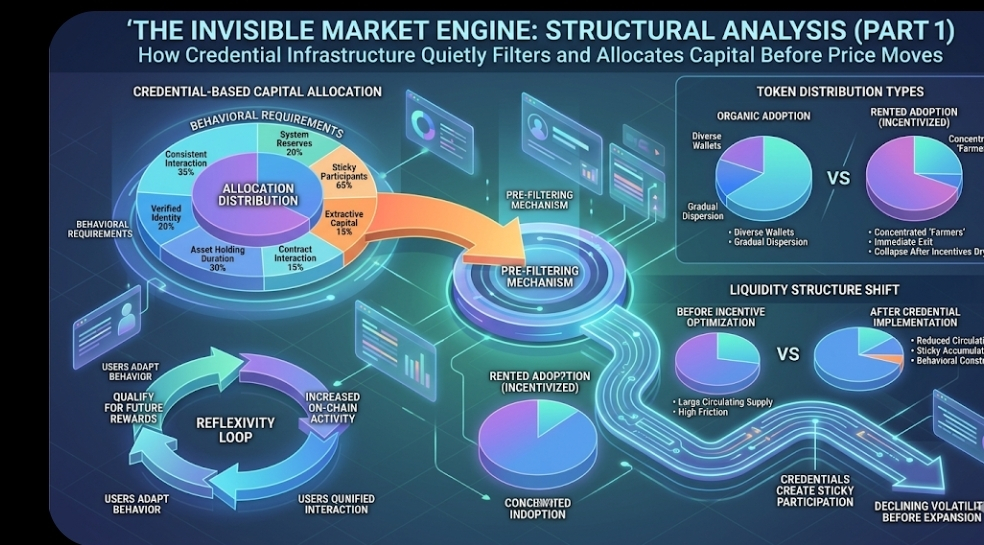
From a trading perspective, the first thing I watch is not the token itself, but the behavior around it. Are wallets interacting repeatedly, or is activity one-off and extractive? Credential systems tend to create repeat behavior because once a wallet is “recognized,” it becomes eligible for ongoing benefitsairdrops, access tiers, liquidity incentives. That changes the psychology. Instead of mercenary capital rotating in and out, you start seeing sticky participation. And sticky participation doesn’t show up immediately in price—it shows up in declining volatility before expansion. That quiet compression phase is where most people get bored. That’s usually where I start paying attention.
There’s also an uncomfortable truth here: credential systems introduce soft centralization, even when marketed as decentralized. Someone decides what counts as a valid credential. Someone defines the rules for distribution. As a trader, I don’t ignore that—I lean into it. Because wherever there is discretion, there is predictability. If I can identify who benefits from the system being perceived as “fair,” I can anticipate how tokens will be distributed, when incentives will be adjusted, and when liquidity will be redirected. It’s not about ideologyit’s about flows.
Right now, what stands out in the market is how these systems are being used as pre-filters for capital allocation. Instead of spraying tokens across random wallets, projects are getting more precise. They’re rewarding wallets that behave in specific ways—holding certain assets, interacting with specific contracts, maintaining activity over time. That creates a feedback loop: users adapt their behavior to qualify, and in doing so, they generate the very on-chain activity that justifies the token’s valuation. It’s reflexive. And reflexivity, when it’s engineered, is incredibly powerful.
You can often see this forming before price reacts. Look at wallet clustering: are the same groups of addresses showing up across multiple interactions tied to the protocol? That’s not organic growththat’s coordinated participation, or at least aligned incentives. Look at gas patterns: are users willing to pay higher fees to maintain activity? That signals perceived future reward. Look at token distribution changes: are more tokens ending up in wallets that don’t immediately sell? That’s a shift from extraction to positioning. These are the signals that matter before a breakout.
What most people miss is how this affects liquidity structure. When tokens are distributed based on credentials, they don’t immediately hit the market. They accumulate in wallets that are conditioned to wait. That reduces circulating supply in a very real waynot through lockups, but through behavior. And behavioral supply constraints are harder to model, which is why they create sharper moves when demand finally shows up. By the time the chart looks “strong,” most of the positioning is already done.
There’s also a darker side to this. Credential systems can create illusions of adoption. If incentives are strong enough, users will perform actions just to qualify, not because they believe in the protocol. On-chain, it looks like growth. In reality, it’s rented behavior. As a trader, the difference is everything. Real adoption sustains trends. Incentivized activity creates spikes that fade once rewards dry up. The trick is to watch what happens when incentives are reduced. If activity holds, you’re looking at something real. If it collapses, it was never demandit was just farming.
Another layer people underestimate is how these systems influence narrative timing. When a protocol controls both verification and distribution, it can stage its growth. It can build a base of credentialed users quietly, then trigger distribution events that suddenly bring attention. To the outside market, it looks like organic momentum. From the inside, it’s structured release. If you’re only watching headlines, you’re late. If you’re watching on-chain preparation, you’re early.
In the current market environment, where capital is more selective and narratives burn out faster, this kind of infrastructure matters more than ever. We’re no longer in a phase where any token with a story can run. The market is filtering harder. Credential systems are part of that filtering. They decide which wallets get rewarded, which users get retained, and ultimately which tokens maintain demand beyond the initial hype. That’s why I treat them as signal, not noise.
From a psychological angle, this also shifts how traders behave. When people know that future rewards depend on past behavior, they start thinking longer termeven if they don’t realize it consciously. They hold a bit longer. They interact a bit more. They hesitate to fully exit. That subtle change in behavior can stabilize price action in ways that traditional tokenomics can’t. It’s not enforcedit’s implied. And implied incentives are often more effective than explicit ones.
If I had to reduce it to something actionable, it’s this: I don’t chase tokens that are already moving. I look for systems where behavior is changing before price does. Credential verification and structured distribution are some of the clearest places to see that shift early. When I see consistent interaction, tightening supply behavior, and incentives that reward continuity instead of churn, I know something is buildingeven if the chart hasn’t caught up yet.
Because in this market, the real edge isn’t in predicting price. It’s in understanding what makes people hold, act, and return. And increasingly, that’s not being decided by hype or narrativesit’s being engineered at the protocol level, quietly, through systems most traders still ignore