

I’ve been thinking about this Sign Protocol thing, and honestly… it just clicks.
At the end of the day, money on-chain is just signed claims. That’s it. Who owns what. Who sent what.... What’s valid..... What isn’t..... Strip away the branding, the hype, the token logos it’s signatures all the way down.
And I like that.
When I look at digital currencies and stablecoins through that lens, everything gets simpler. Cleaner. You’re not “running a financial system.” You’re creating, verifying, and syncing signed states across different environments.
On the public side whether you’re building on a Layer 1 or running a Layer 2 Sign Protocol fits naturally. Every transaction? A signed attestation. Every balance update? Signed. Mint. Burn. Signed. Publicly verifiable. Anyone can check it.
That’s where trust actually comes from.
I don’t need to believe anyone. I don’t need a press release. I can see the signatures. I can verify them myself. Done.
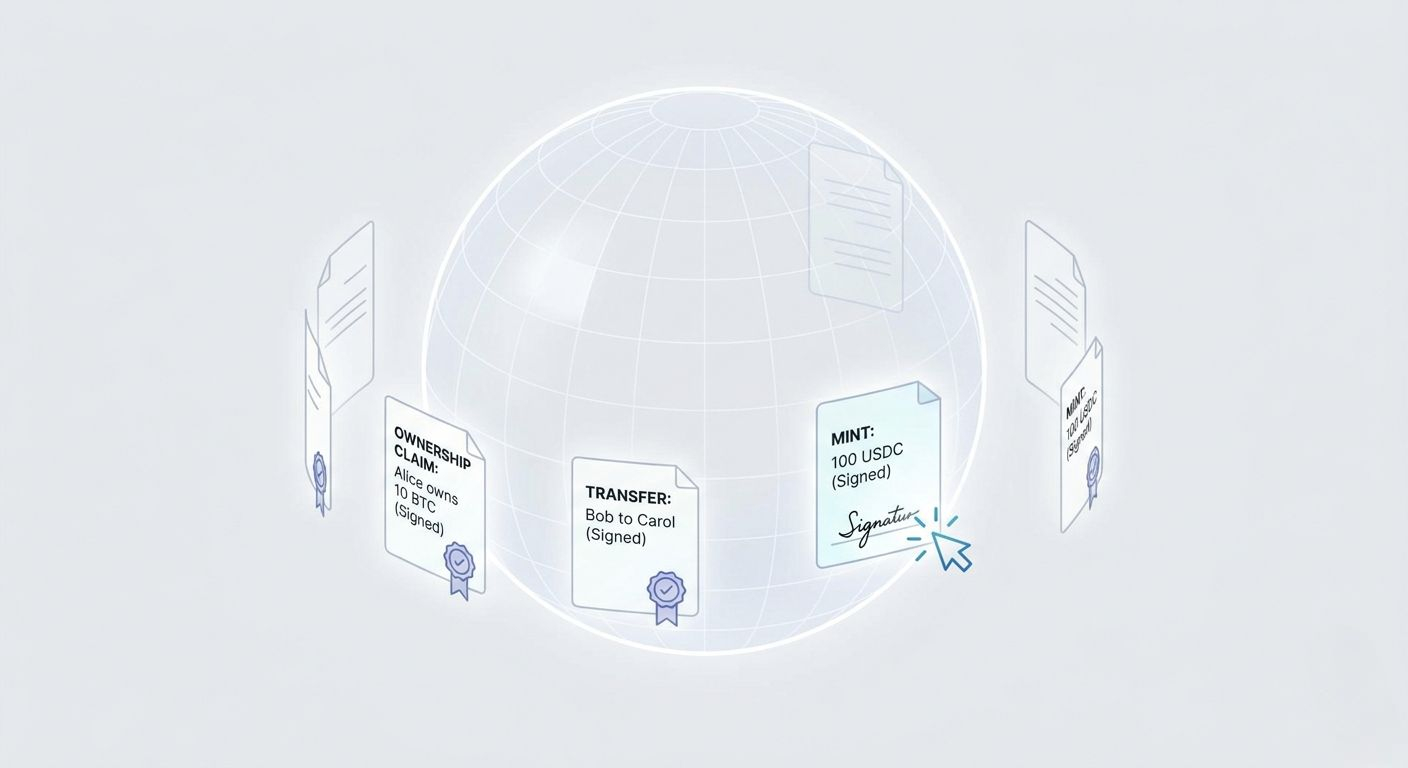
Now the permissioned side that’s where it gets interesting.
Let’s say you’re running on Hyperledger Fabric X with Arma BFT. Different environment. Controlled access. Not everyone can read everything. Not everyone can write. But here’s the thing… the logic doesn’t change.
It’s still signed state transitions.
Participants sign off on changes. The difference isn’t the data model it’s who gets to participate. That’s it. Same idea. Different gate.
And what I really like and people don’t talk about this enough is that Sign Protocol becomes the common language across both sides. Public chain? Signed data. Private network? Signed data.
Consistency matters.
A balance update is still a signed statement. A transfer is still a signed statement. That symmetry is powerful because it means I can move between systems without breaking the logic. I’m not duct-taping two blockchains together. I’m expressing one system of truth in two environments.
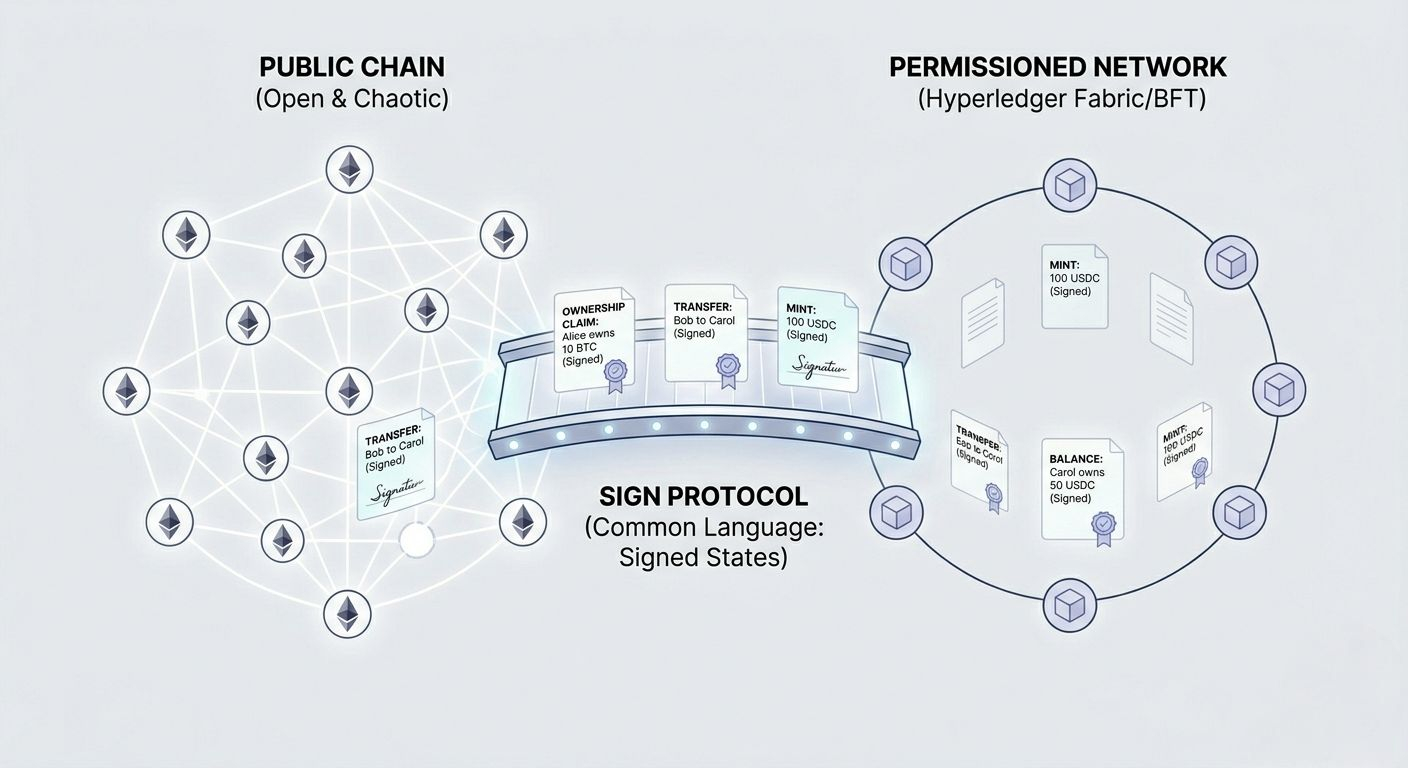
Public for openness. Permissioned for speed and control.
Simple. Clean. Makes sense.
Now about that 200,000+ TPS claim on the permissioned side. Look, high throughput is easy to put on a slide deck. I’ve seen this before. The real question is: what are you actually processing?
If you treat transactions as lightweight signed attestations instead of heavy on-chain computation, of course you can move faster. You’re validating signatures. You’re ordering events. You’re not executing complex smart contract logic every single time.
That’s a different workload entirely.
But let’s be real throughput numbers don’t impress me by themselves. What matters is whether the signed states stay consistent across both sides. If the public view and the permissioned view ever drift? That’s when things get messy.
And this is where things get tricky.
Syncing truth across environments isn’t glamorous, but it’s the hard part. Not scaling. Not TPS. Truth.
If both systems agree on what’s real balances, supply, state transitions then you’ve got something solid. If they diverge, even slightly, trust erodes fast. And once that happens, good luck rebuilding it.
What I appreciate about this approach is that it doesn’t try to reinvent physics. It doesn’t say, “Let’s build a magical new consensus universe.” It says: structure everything around signed data. Treat signatures as the product. Let the chain public or private be the transport layer.
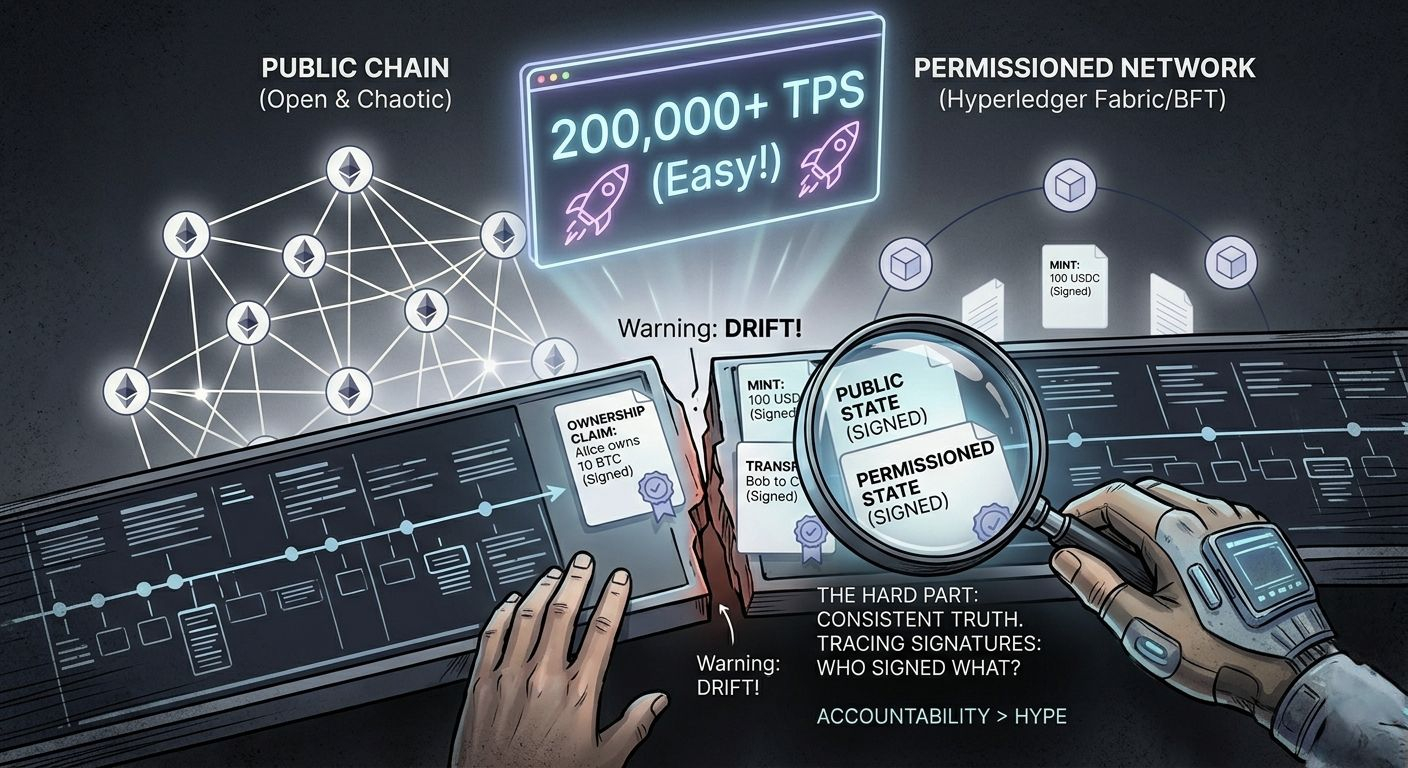
That mindset feels grounded.
It also forces discipline. You can’t hide behind complexity. If something breaks, you trace the signatures. Who signed what? When? Why? That’s accountability baked in.
And honestly? I prefer that over flashy architectures that promise the world but can’t explain their own state model without a 40-page whitepaper.
I’m not saying it’s perfect. Nothing is. Cross-environment consistency will always be the stress test. But anchoring everything around signed attestations feels like the right primitive to build from.
Not chains. Not buzzwords.
Signatures.
That’s the core.
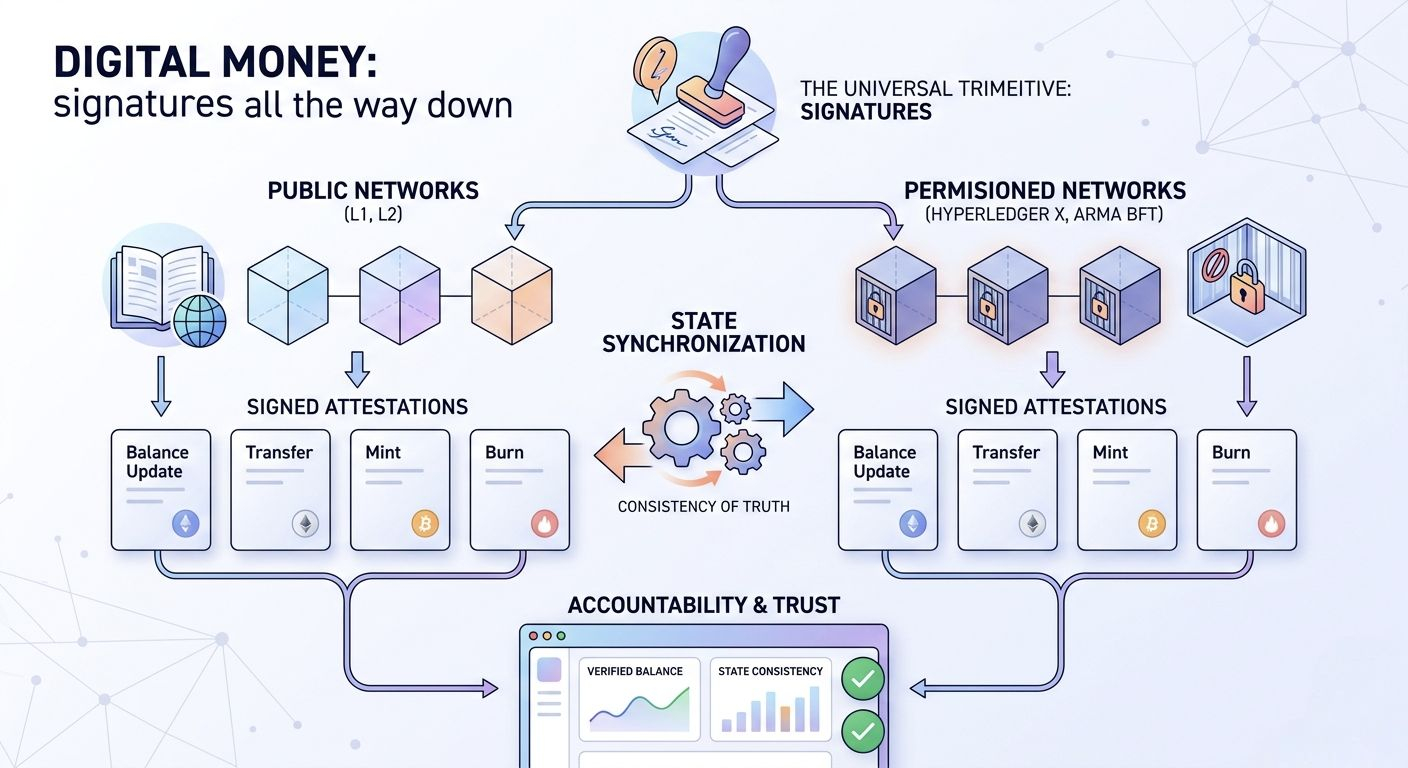
And yeah, I’m going to keep digging into this stuff. Tech moves fast. If you don’t keep learning, you fall behind. I’d rather understand the mechanics deeply than chase whatever trend screams the loudest this week.
Because at the end of the day?
Truth in distributed systems comes down to who signed what and whether everyone agrees on it.
#SignDigitalSovereignInfra @SignOfficial $SIGN
