

We often talk about the blockchain as a revolutionary technology, a parallel financial system, or the "new internet." But if we’re being honest, for a long time, it felt like an island.
A very secure, highly liquid, yet isolated island.
I’ve spent years analyzing infrastructure protocols, looking for the one that would finally bridge this gap. In my opinion, we’ve found it. It’s not a new decentralized exchange or another scaling solution. It’s the trust layer itself. Today, I want to talk about why Sign Protocol’s ability to verify real-world data is the ultimate game-changer for the entire industry.
The Oracle Problem: Reimagined
We all know the "Oracle Problem"—the classic difficulty of getting external data onto the blockchain without compromising decentralization. If a oracle brings in bad data, the smart contract executes a bad transaction.
For years, we solved this with price feeds for DeFi. That was easy. But the real world is infinitely more complex than just asset prices.
The real challenge wasn't just bringing data on-chain. The real challenge was attesting to the validity and ownership of that data in a way that is legally binding, cryptographically secure, and privacy-preserving.
This is where the distinction between Off-Chain and On-Chain data gets exciting. Until Sign Protocol, we treated the two worlds as incompatible. Sign changed the conversation by introducing the concept of Attestations.
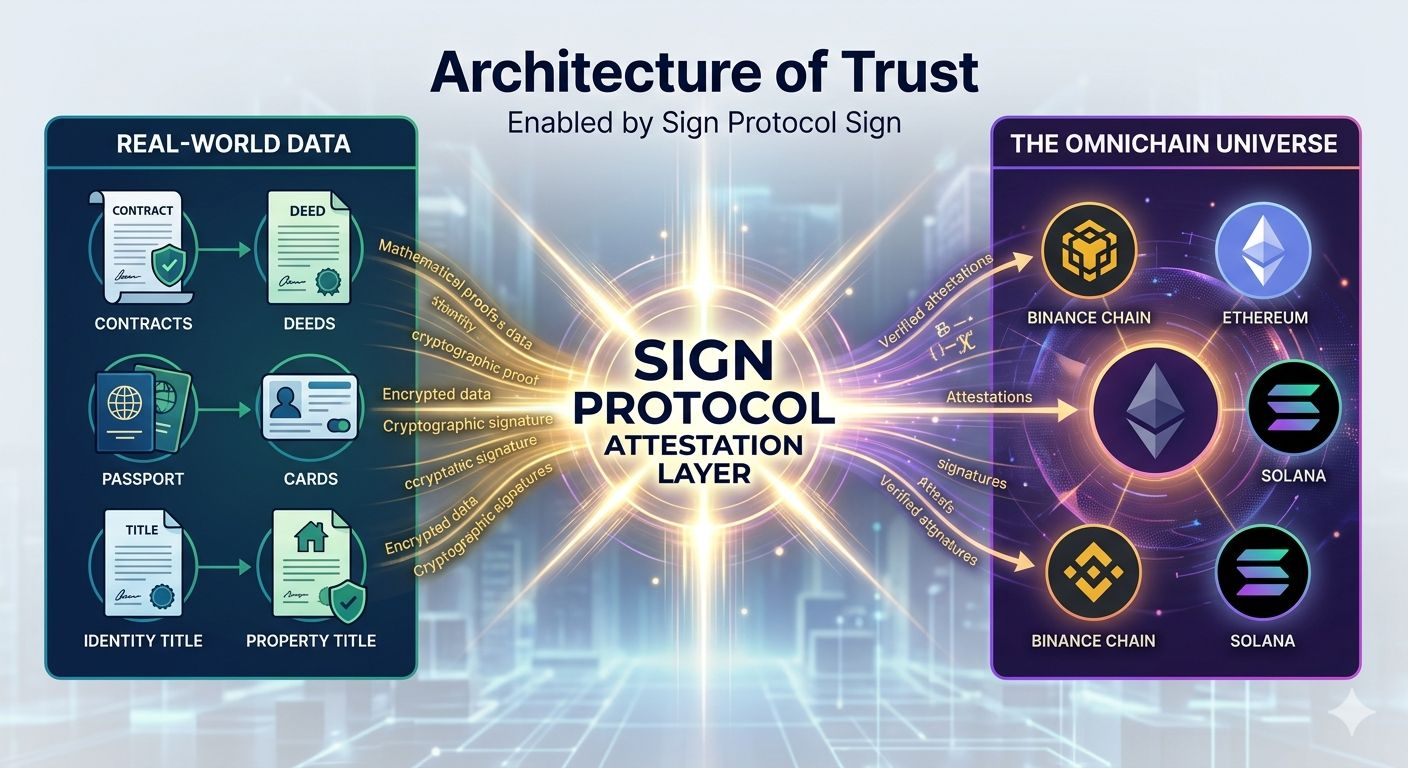
How Sign Flips the Script
When we say Sign is a game-changer, we mean it literally rewrites the rules of engagement.
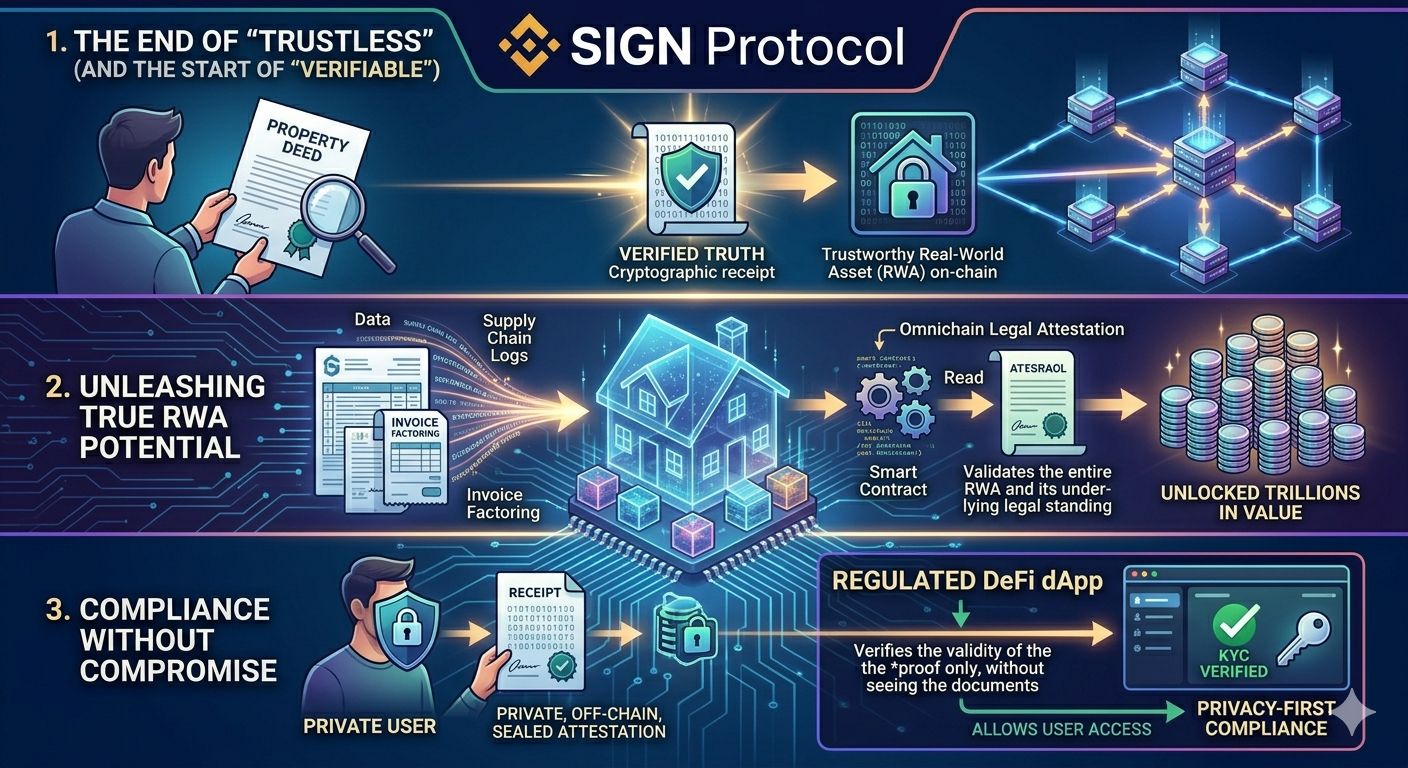
1. The End of "Trustless" (and the Start of "Verifiable")
We often use the term "trustless" in crypto, meaning we rely on code rather than middlemen. But when dealing with real-world assets (RWA), you need trust. Sign transforms "trust" into a cryptographic receipt. Instead of "trusting" that I own a property, Sign lets me present an attestation from a decentralized node network that has verified the physical deed. We move from blind trust to verifiable truth.
2. Unleashing True RWA Potential
Tokenizing a house is easy. The difficult part is verifying the ownership transfer, checking for liens, and managing the legal binding. Sign Protocol's Omni-chain attestations allow a smart contract on Binance Smart Chain to "see" and verify a legal attestation created off-chain. This isn't just a price feed; it’s the verification of a legal entity itself. This unlocks trillions of dollars in real estate, supply chain finance, and invoice factoring.
3. Compliance without Compromise
The RegDeFi wave is here. Institutions require KYC/AML verification. Before Sign, this was a nightmare—either you were centralized and compliant, or decentralized and non-compliant. Sign Protocol changes this. An institution can issue a private, off-chain attestation of KYC status. The user then presents this cryptographic proof to a dApp without revealing their personal documents. The dApp verifies the proof (the attestation) and allows the user to interact. This is privacy-first, institutional-grade compliance.
Why this is the 2026 Narrative
The market cycle of 2024-2025 was about scaling and infrastructure optimization. The 2026 cycle is about Integration.
The protocols that will capture the most value are not the ones that create new isolated systems, but the ones that make the entire global economy function better through decentralized technology.
By focusing on verified attestations rather than just decentralized data storage, Sign is solving the last mile of crypto adoption. When a real-world supply chain event (like a container arriving in port) can trigger an automated on-chain payment, the conversation around utility is over. We are no longer playing in a sandbox; we are upgrading global commerce.
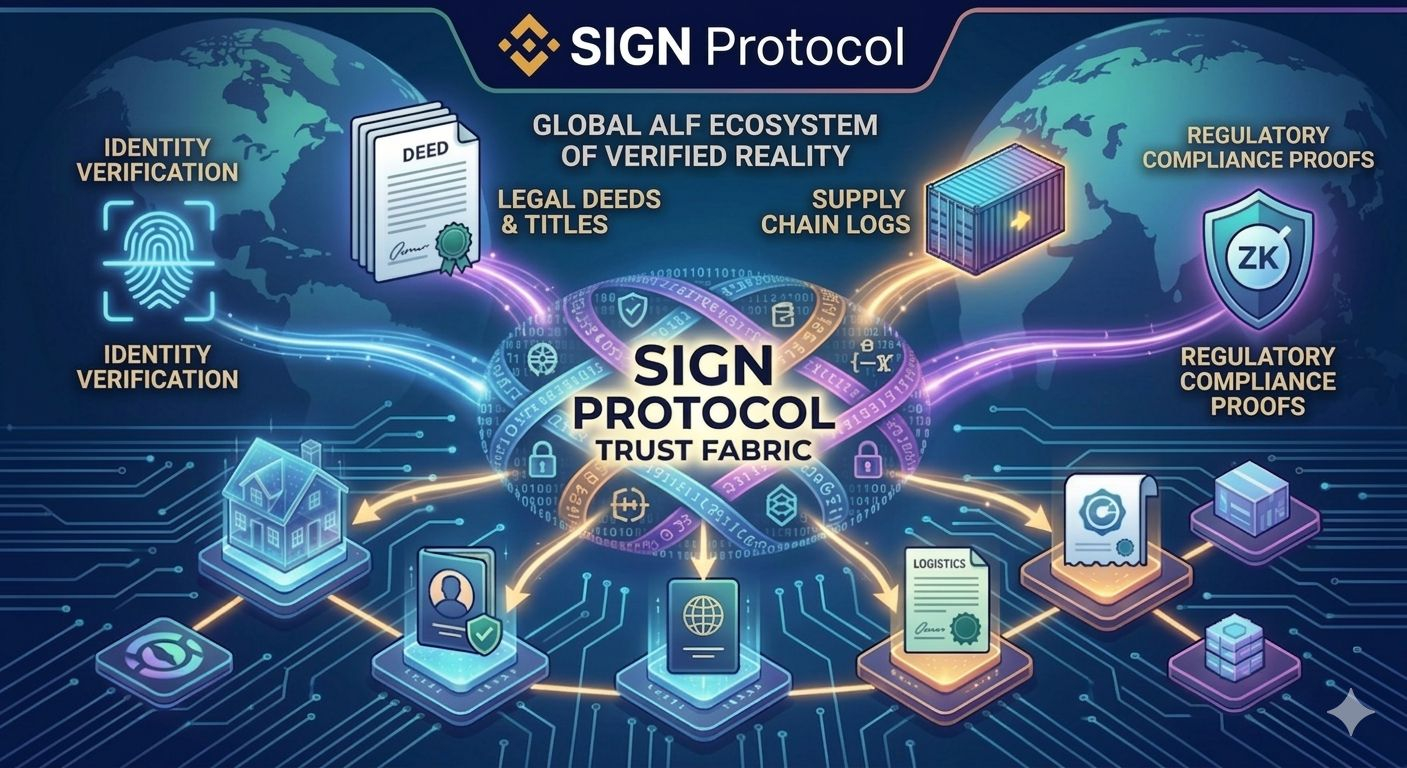
FINAL TAKE: The Future of Verified Reality
The true value of Sign Protocol isn't just in its technical elegance; it's in its ability to answer the ultimate question from the mainstream: "What can you actually DO with this technology?"
We can now build financial systems that respect real-world laws. We can create supply chains that are truly transparent. We can prove who we are without exposing our privacy.
Sign Protocol isn't just a middleware protocol. It is the architectural linchpin that allows the blockchain island to finally trade with the continent.
The game hasn't just changed; it’s finally beginning.