

I’ve been watching this space long enough to recognize a pattern most people scroll past without thinking.
Every cycle, the language evolves… but the assumption stays the same.
“Eligible.”
“Verified.”
“Fair distribution.”
And every time, you’re still expected to trust it.
Not verify it. Not inspect it. Just accept it.
That disconnect is exactly where @SignOfficial and $SIGN enter the conversation—quietly, but at the right layer.
The Invisible Layer Everyone Built… Differently
What became clear digging into Sign isn’t what it adds—it’s what it exposes.
Crypto solved ownership.
It solved execution.
But it never truly solved credibility.
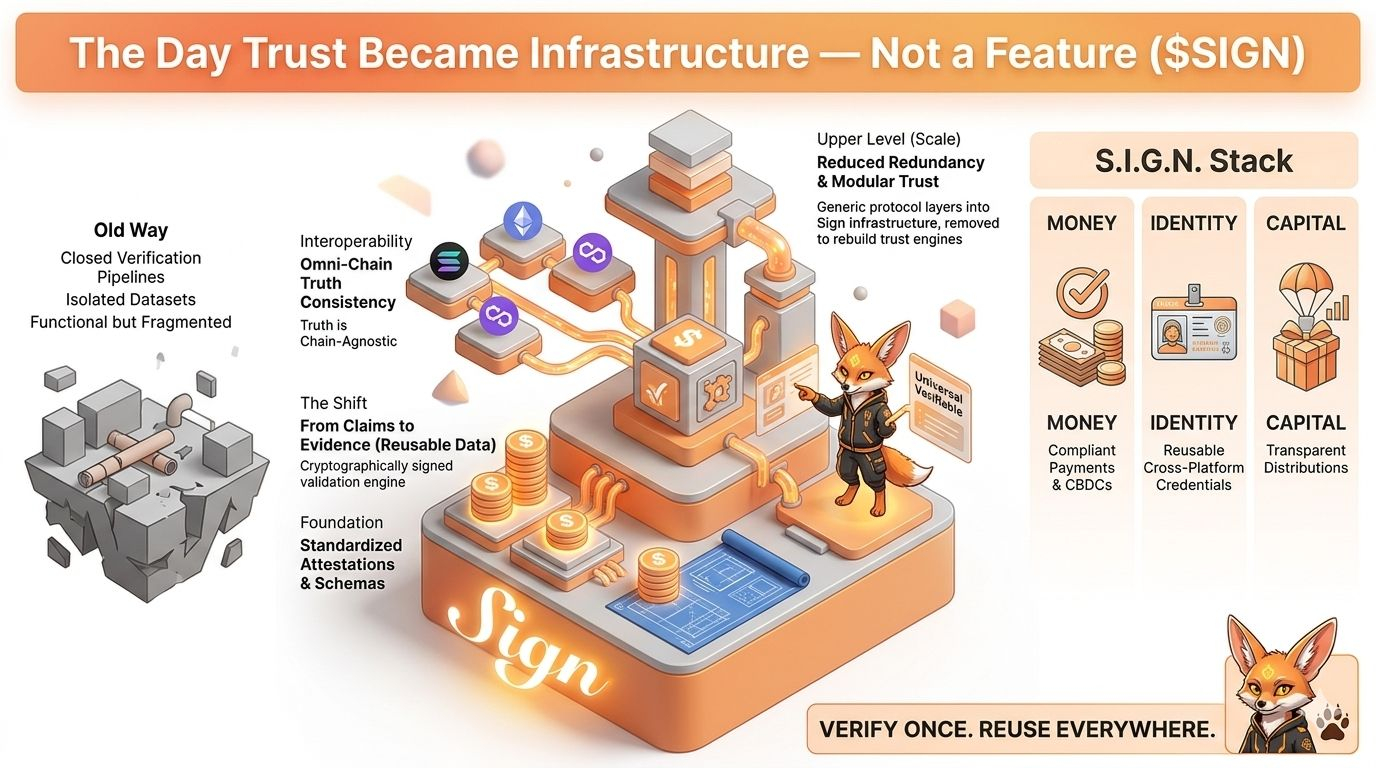
Instead, every protocol built its own version of truth:
Custom eligibility logic
Closed verification pipelines
Isolated datasets
Functional? Yes.
Composable? Not even close.
That’s the fragmentation Sign Protocol is targeting—not at the surface, but at the layer where truth itself is defined.
Where $SIGN Changes the Direction
Most systems today ask:
“How do we verify this inside our app?”
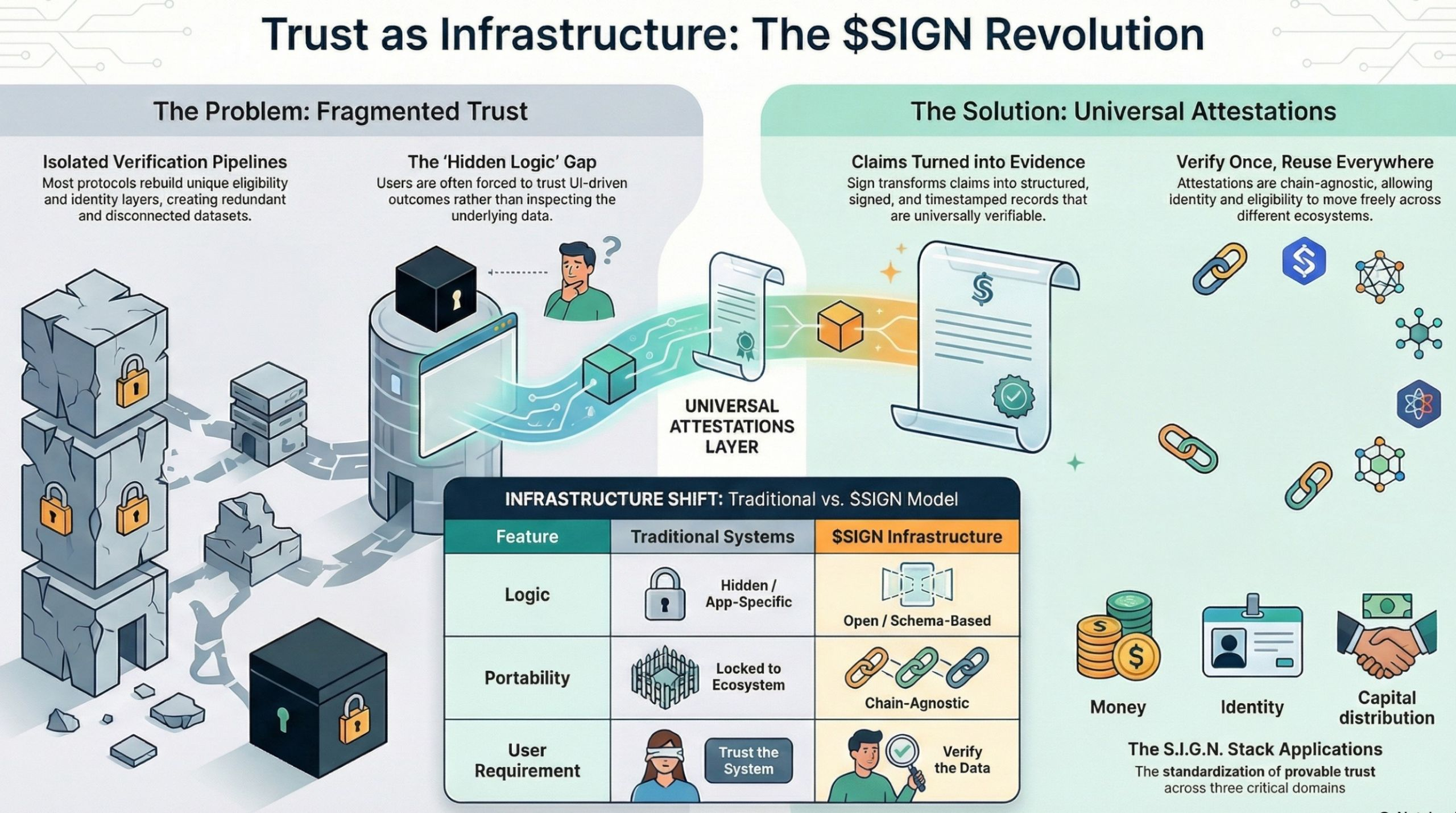
Sign flips that model entirely:
“How do we make this verifiable across every system?”
This is where attestations—the core primitive of $SIGN—become critical.
Not as a feature, but as infrastructure.
A claim stops being:
“User completed X.”
And becomes:
A structured record
Cryptographically signed
Timestamped
Universally verifiable
That shift removes verification from isolated backends…
and turns it into portable evidence.
From Claims to Evidence (The Real Upgrade)
In most ecosystems, you see outcomes—not proof.
Dashboards tell you you're eligible.
Smart contracts execute distributions.
But the logic behind it? Hidden or fragmented.
With $SIGN, claims are no longer UI-driven—they’re data-driven:
Defined through schemas (structure)
Stored as attestations (evidence)
Validated through open verification logic
Now you’re not trusting systems.
You’re interacting with verifiable truth.
The Structural Advantage No One Talks About
Here’s where it gets interesting at scale.
Every serious protocol today rebuilds:
Eligibility engines
Identity layers
Reward distribution logic
Verification pipelines
Not by choice—but by necessity.
Sign introduces a shared standard.
So instead of rebuilding trust logic:
Developers plug into existing attestations
Data becomes reusable across applications
Verification becomes modular
That’s not optimization.
That’s removing an entire category of redundancy.
Omni-Chain Isn’t a Feature — It’s the Point
Most “multi-chain” conversations focus on assets.
Sign focuses on truth consistency.
Because if verification differs between chains,
interoperability is only surface-level.
With Sign Protocol:
Attestations are chain-agnostic
Identity isn’t locked to one ecosystem
Eligibility doesn’t need to be recalculated everywhere
Truth becomes independent of environment.
That’s what makes $SIGN an actual interoperability layer—not just a technical bridge.
Privacy, Without Breaking Verification
Verification systems usually fail in two ways:
They expose too much
Or they prove too little
Sign addresses this directly through:
Selective disclosure
Flexible visibility
Privacy-aware attestations
You can prove something is true…
without exposing everything behind it.
And for identity, finance, or compliance systems—that’s non-negotiable.
The S.I.G.N. Stack — Where This Actually Lands
This isn’t just tooling. It’s infrastructure.
Sign positions itself across three critical domains:
→ Money
Verification for payments, stablecoins, CBDCs
(conditions, compliance, transaction logic)
→ Identity
Reusable, cross-platform credentials
(proof of uniqueness, reputation, linking)
→ Capital
Transparent distribution systems
(airdrops, grants, incentives)
Across all three, the requirement is identical:
Trust must be provable.
And that’s exactly what $SIGN standardizes.
The Shift Already Happening
The market is moving.
Not toward louder narratives…
but toward systems that are:
Auditable
Transparent
Reliable
Sign doesn’t compete on speed.
It doesn’t market throughput.
It focuses on something more fundamental:
Making systems provable by design.
Final Thought
Crypto started with:
“Don’t trust. Verify.”
But verification became fragmented, inconsistent, and often hidden.
$SIGN refines that idea into something scalable:
Verify once. Reuse everywhere.
If that model holds, the impact goes beyond airdrops or identity.
It changes how truth moves across systems—
without requiring those systems to trust each other.
And that’s the layer most people still aren’t watching.
Yet.