
A while back, I found myself digging into how deals actually move through Gulf-based investment ecosystems. Not the public-facing announcements or polished summaries—but the internal mechanics. What stood out wasn’t capital availability or even sector focus. It was something far less visible: the constant need for approval.
Not funding. Not execution. Just clearance.
Who’s eligible. Who’s already vetted. Who still needs sign-off from multiple layers before even entering the conversation.
It challenges the common assumption that markets are inherently open. In theory, capital flows freely and opportunity is accessible. In practice—especially across parts of the Middle East—entry is filtered long before transactions take shape. Participation itself becomes conditional.
And that condition isn’t a one-time hurdle.
It repeats.
Verification, compliance, KYC—these are usually framed as operational friction. Temporary barriers that systems eventually streamline. But the reality feels different. The same entities often go through identical checks across institutions and jurisdictions, even when their underlying status hasn’t changed.
It’s less about absence of data and more about lack of continuity.
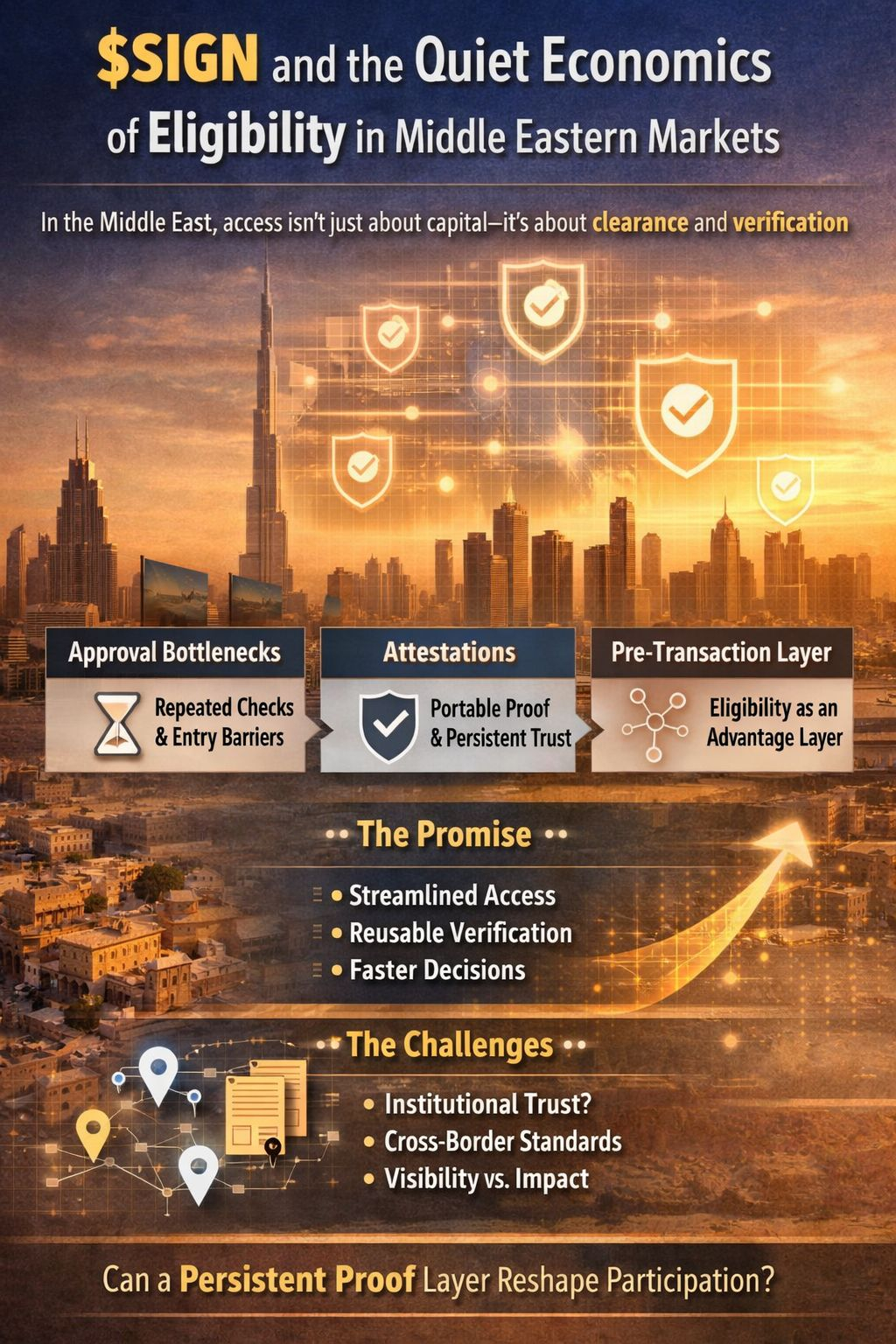
Each system resets the process.
That’s where $SIGN starts to feel like it’s addressing something deeper than infrastructure inefficiency. It’s not just about transparency or decentralization. It’s about persistence—how proof holds its value beyond a single interaction.
At its core, an attestation is simple. A verified claim, backed by a signature. But its significance lies in portability. Instead of restarting verification from scratch, systems can reference an existing, structured proof.
Not blind trust. But not zero-trust either.
Something in between.
And that middle ground starts to reshape how participation works.
Because today, access isn’t evenly distributed—even among participants that look identical on paper. Two firms with similar capital and intent can move at completely different speeds. One progresses smoothly because its history is easier to validate. The other stalls, repeating the same validation cycles.
That delay isn’t always visible. It doesn’t show up in valuations or metrics. But it compounds over time, influencing outcomes.
If attestations become reusable and widely recognized, that difference becomes more explicit. Eligibility itself starts to behave like a layer—something that accumulates, carries forward, and creates advantage.
Not a trading layer. Not a transactional one.
But a pre-transaction layer that quietly determines who gets to act—and how quickly.
In the Middle Eastern context, this dynamic feels especially relevant. There’s a strong push toward digital transformation, but also a deep emphasis on control. Identity verification, capital origin, and regulatory alignment are non-negotiable.
So any system that reduces the cost of proving these factors—without weakening oversight—introduces a new kind of efficiency.
But the open question is adoption.
Do institutions actually trust external attestations? Or do they default to internal verification processes out of habit, caution, or regulatory pressure?
Because technically viable doesn’t always mean institutionally accepted.
There’s also the issue of consistency. For attestations to function across borders, their meaning has to remain intact in different legal and regulatory environments. That’s not purely a technical challenge—it’s shaped by governance, policy, and interpretation.
What counts as “verified” in one jurisdiction may not fully translate in another.
And then there’s visibility.
Markets tend to reward what can be seen—volume, transactions, growth. Eligibility operates earlier in the cycle. It influences participation but doesn’t present itself as activity.
It’s foundational, yet often overlooked.
That creates an interesting tension.
If systems like $SIGN succeed, they may not dramatically change how transactions look on the surface. Instead, they alter the conditions beneath them—reducing friction, accelerating access, and structuring trust in a reusable way.
The impact would be real, but subtle.
Harder to measure. Easier to ignore.
Or perhaps that’s exactly why it matters.
Because if participation itself becomes more structured and portable, then advantage doesn’t just come from capital or timing—it comes from accumulated credibility.
And that shifts the market in ways that aren’t immediately obvious.
The question isn’t whether this layer is important.
It’s whether the ecosystem is ready to recognize—and rely on—it.
#SignDigitalSovereignInfra @SignOfficial $SIGN
