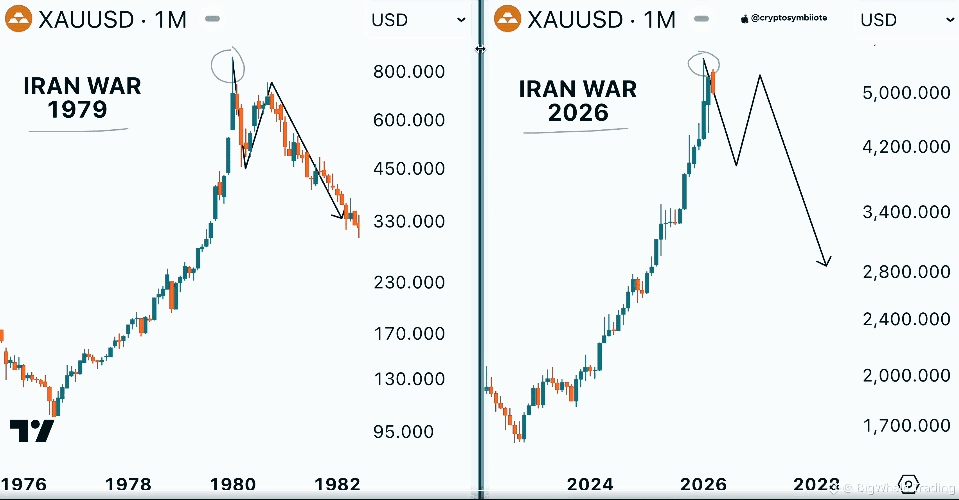
Gold is about to repeat the scenario of 1979 — this is what most people overlook.
In 1979, the Iran crisis caused oil prices to rise sharply, and gold experienced a very strong surge — from around 200 dollars to 850 dollars in a rapid wave. Many believed at the time that this represented the beginning of a new golden age.
But this perception was incorrect.
What happened next was harsh. Inflation spiraled out of control, forcing the Federal Reserve to take drastic measures. Interest rates were raised to around 20%, liquidity was withdrawn from the financial system, and gold could not maintain its gains — falling from $850 to about $300.
Moving to the year 2026.
The current environment shows some clear similarities:
Escalating geopolitical tensions related to Iran
Rising oil prices
Pressures on global supply chains
The return of inflation indicators to rise
And here is a perspective that many gold supporters overlook:
Gold does not work as a guaranteed safe haven during crises.
It tends to rise only until central banks intervene with tightening policies.
When liquidity is high and uncertainty is great, gold usually rises. But once inflation pushes central banks to tighten monetary policy, gold may face strong pressures.
The current market sentiment is also striking:
Individual investors are increasingly turning to gold, driven by its status as a 'safe' asset. Confidence is growing and the narrative is strong — which might sometimes indicate a higher level of risk.
Historically, the most painful moves were not during the crisis itself, but after policy responses:
Crisis → Rising gold
Central bank tightening → Liquidity contraction
Then → The possibility of sharp corrections
We may be approaching a crucial turning point.
The main question remains: Will investors continue to hold gold if central banks move towards tightening again?
History suggests that the outcome may not be different from what many expect.