
There’s a pattern I keep noticing in crypto, especially when it comes to infrastructure. We start with a powerful idea—like putting data on-chain for transparency and immutability—and then we slowly push it to an extreme where it stops making practical sense.
 For me, on-chain bloat is one of the clearest examples of that.
At a high level, storing data on-chain sounds perfect. Everything is verifiable, permanent, and publicly accessible. But the moment you move from theory to real-world usage—especially with attestations, credentials, or identity systems—the cracks start to show. Gas fees don’t just increase, they escalate fast when you attach large amounts of data to transactions. What seemed elegant at first becomes expensive, inefficient, and honestly unrealistic for anything that needs to scale.
This is where I personally start to push back on the narrative. Just because blockchain can store something doesn’t mean it should. That idea gets overlooked way too often.
Blockchains are incredibly good at certain things—finality, verification, coordination. But acting as a storage layer for bulky or complex datasets is not one of their strengths. Trying to force them into that role leads to higher costs, slower systems, and unnecessary friction for users. And when you’re dealing with something as sensitive and important as credentials or attestations, that friction becomes a real problem.
What makes more sense—at least from where I stand—is being intentional about what actually belongs on-chain.
This is exactly why the design behind Sign Protocol feels grounded in reality rather than hype.
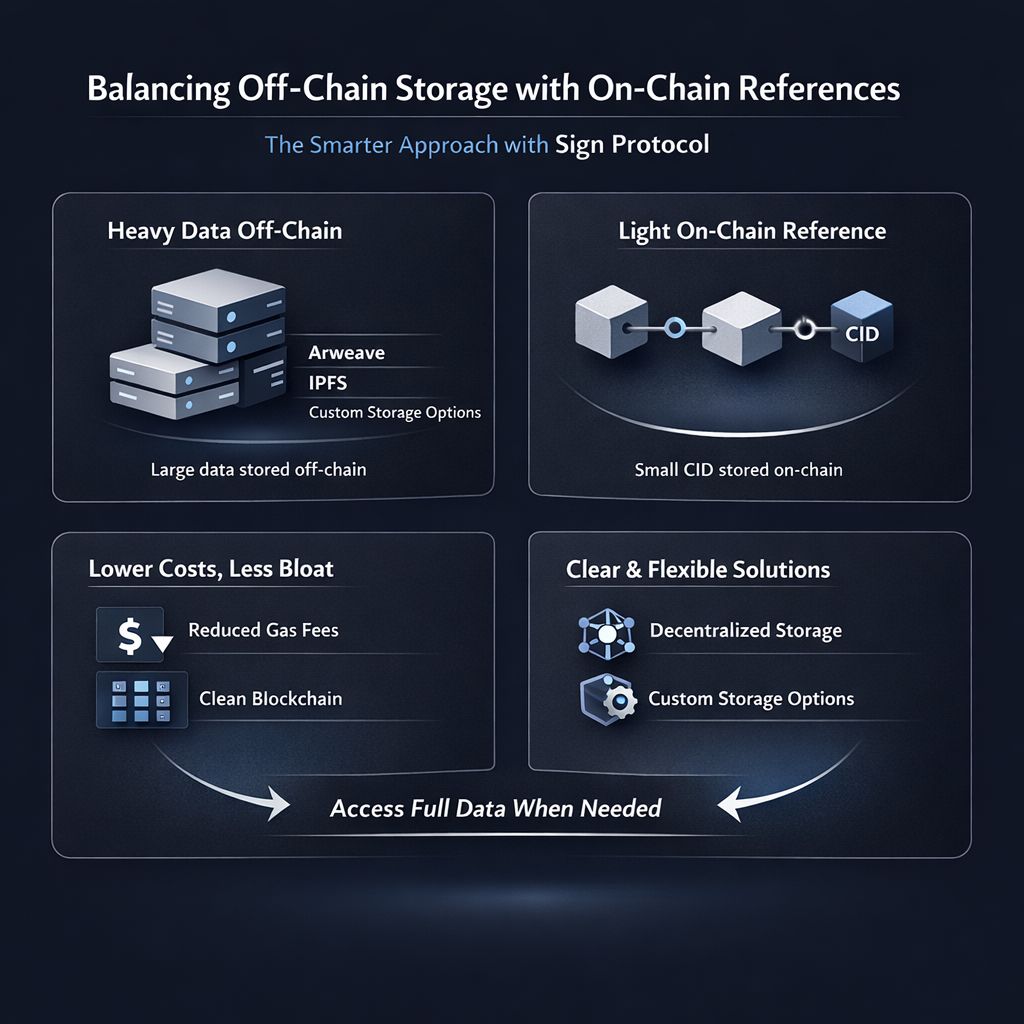
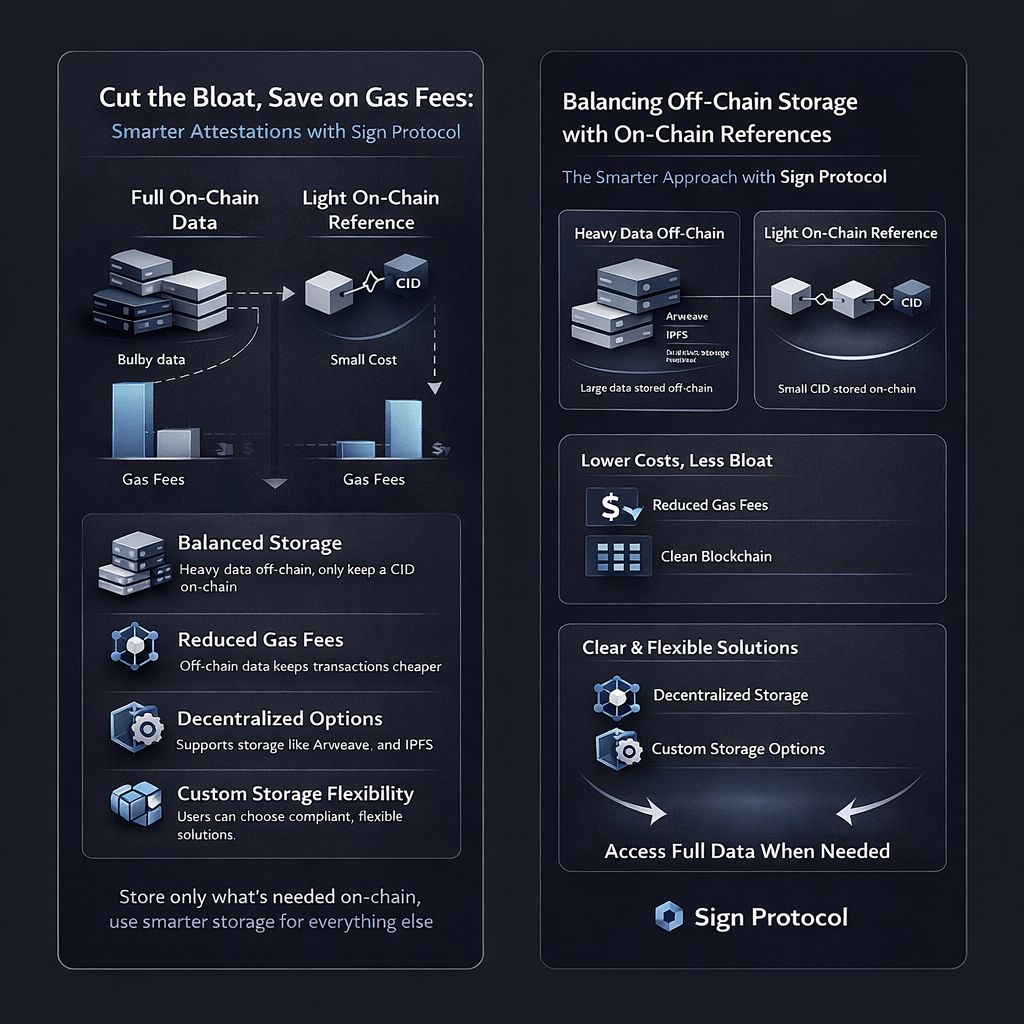
Instead of forcing all attestation data fully on-chain, it takes a more balanced approach. Heavy or detailed data can be stored off-chain using decentralized storage systems like Arweave or IPFS. The blockchain then holds a lightweight reference—like a CID—that points to that data.
It sounds simple, but that separation solves a lot of problems at once.
First, it keeps gas costs under control. You’re no longer paying to store large datasets directly on-chain, which makes the system far more sustainable. Second, it avoids clogging the chain with unnecessary data, which benefits the broader network as well. And third, it still preserves access and verifiability, because the reference on-chain ties everything back to a specific, tamper-resistant source.
What really stands out to me, though, is the clarity of the system.
A lot of projects talk about hybrid storage, but they make it feel abstract or confusing. Here, the schemas and attestations clearly show where the data lives and how it’s structured. You don’t have to guess what’s on-chain and what’s off-chain. That transparency matters more than people realize, especially when you’re building real applications that depend on accurate, trustworthy data.
Another thing that clicks for me is the flexibility.
Not everyone wants to rely purely on decentralized storage. Some teams have compliance requirements. Others need more control over how and where their data is stored. In many systems, you’re forced into one model whether it fits or not. But here, custom storage solutions are supported as well. That means developers can choose what works best for their specific use case instead of being boxed into a single approach.
That kind of optionality is important. It acknowledges that real-world systems are messy, and different use cases have different constraints.
When I step back and look at it, the core idea is actually pretty straightforward: balance.
Keep the blockchain focused on what it does best. Use it for verification, integrity, and coordination. Don’t overload it with data it was never meant to carry. And for everything else, use smarter, more appropriate storage layers.
This is the part I think developers need to take seriously. Being selective isn’t a limitation—it’s good design. Saving gas isn’t just about cost optimization, it’s about making systems usable at scale. And choosing the right place for the right type of data is what separates something that works in theory from something that actually works in practice.
For me, this approach feels honest. It doesn’t try to romanticize the blockchain or force it into roles it wasn’t built for. It accepts the trade-offs and designs around them in a way that feels intentional.
And that’s why it sticks.
 In a space that often leans toward overengineering and excess, this feels like a step back toward practicality. Sign Protocol doesn’t just recognize the problem of on-chain bloat—it addresses it in a way that is clear, flexible, and actually usable.
@SignOfficial #signdigitalsovereigninfra $SIGN
