

Last week, I had dinner with a friend who is working on an early-stage project. They had just completed their funding and talked about the most headache-inducing issue recently. I thought he would mention code problems or a cold market, but instead, he said: 'How to distribute the tokens is really critical.'
How to set up the lock-up for institutional investors, how to dismantle the vesting for KOLs, whether there are duplicate wallets in the airdrop address to exploit — their team of three has been working for nearly two months and still made several errors in distribution. Later, I realized that this problem is not unique to their company; it exists throughout the entire industry.
Then I turned to the TokenTable section in the white paper @SignOfficial and found that I really missed a vital point before.
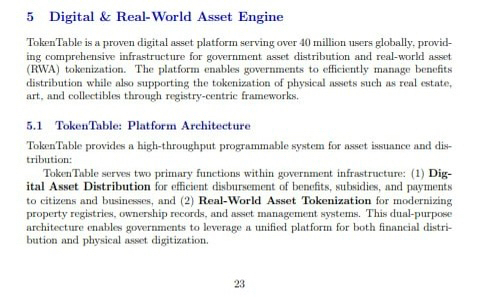
TokenTable currently serves over 40 million users globally and is an infrastructure specifically designed for government-level and project-level asset distribution. But what I want to emphasize is not this number—but the logic behind it, which is truly on a different level compared to other distribution tools on the market.
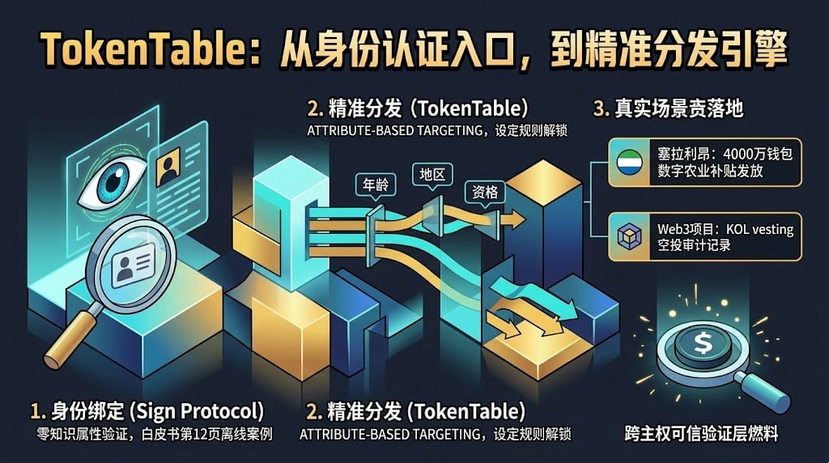
The ordinary token distribution tool solves the problem of 'how to transfer money out', while TokenTable solves the problem of 'how to confirm that this person is eligible to take it, how much they can take, when they can use it'. There is a whole layer in between—identity binding.
The white paper states very clearly: TokenTable is directly integrated with the Sign Protocol, using on-chain identity authentication to perform 'Attribute-Based Targeting'—precisely distributing based on identity attributes. Your age, region, and qualification status can all serve as distribution conditions, and on-chain records are kept, with every transaction having an immutable audit trail. This is a necessity for governments and equally a necessity for Web3 projects.
My understanding upgrade of $SIGN is here: many people treat it as an identity protocol, thinking it's just a tool for stamping on-chain. But the identity layer is merely the entrance. Behind the entrance is the TokenTable distribution engine—who can receive, how much they can receive, how many installments, where to use it, and how to verify on-chain—all programmable and fully auditable.
What I find even more interesting is that this system is not just for Web3 projects. The white paper specifically discusses government application scenarios: social welfare distribution, agricultural subsidies, regular pension disbursement, emergency rescue funds... these matters require higher accuracy in verification than any Web3 project, and TokenTable is already doing this.
The reason I specifically mentioned Sierra Leone is that the white paper repeatedly uses it to illustrate the issue: 73% of the country's citizens have identity numbers, but only 5% have physical IDs. As a result, 66% of people are excluded from the financial system, and 60% of farmers cannot receive digital agriculture subsidies due to identity gaps—money cannot reach people; it's not a technical issue, it's a problem with identity infrastructure. The entire logic of SIGN starts from this fundamental issue.
Of course, I'm not blindly optimistic. TokenTable serves 40 million users, but how many of these are large government clients, and how large is the actual distribution volume? The data currently available in the market is limited. This is something I am still observing.
But from an investment perspective, I see the logic of $SIGN as not complicated: identity authentication is its moat entrance, TokenTable is its commercialization exit; together, these two legs form the true value closed loop of this agreement. Currently, the market pricing basically only accounts for the identity leg, and almost no one has seriously calculated the distribution infrastructure part.
My own operation is to hold the bottom warehouse, not to chase high, and wait for more news of government cooperation to serve as the basis for the next judgment.
Have you looked at SIGN from this perspective? Let's discuss in the comments.
@SignOfficial $SIGN #Sign地缘政治基建
